By the time the last Ocean Bottom Seismometer was diving deep into the ocean (previous post) big waves and strong winds arrived to us. We spent a day or so surviving to that feeling of sea sickness that accompanies you for a while even ashore…
Our next objective was to investigate how is the geology underlying the OBSs. For this the University vessel (Helmer Hanssen) is equipped with several instruments that produce and record acoustic waves of various frequencies. The lower the frequency of the wave the deeper we manage to image under the ground. But the higher the frequency, the more detail we get. We used every instrument available to get a highly detailed 3D image of the under-ground.
We collected geophysical data along 12 profiles and with the software onboard immediately produced spectacular “radiographies” of the mother Earth hidden under-water mountains and cracks in this remote part of the globe.
We started with 2D surveys (the ship moves in a straight line). Everything went so smooth and the excitement about amazing data was such, that we decided to do a 3D survey (the ship moves in parallel and closely spaced lines and the recorded data is then interpolated to get a volume).
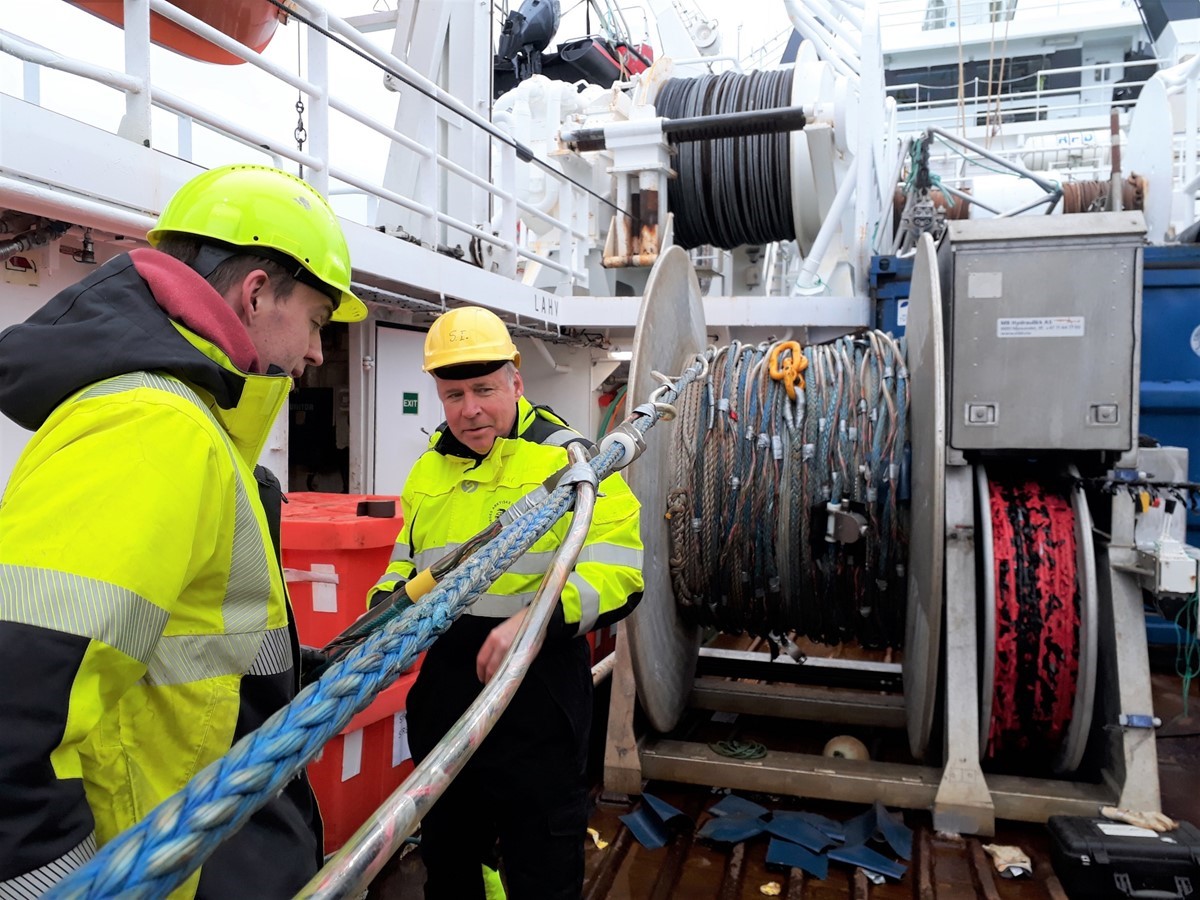
Stormer and Steinar carefully connect the hydrophones to the cable that allows us to produce a 3D seismic image of the ground.
To image deeper we use an air source that produces an acoustic signal with 20-500 Hz. For 2D lines we connect the cables one after the other one (we refer to it as the green spaghetti).
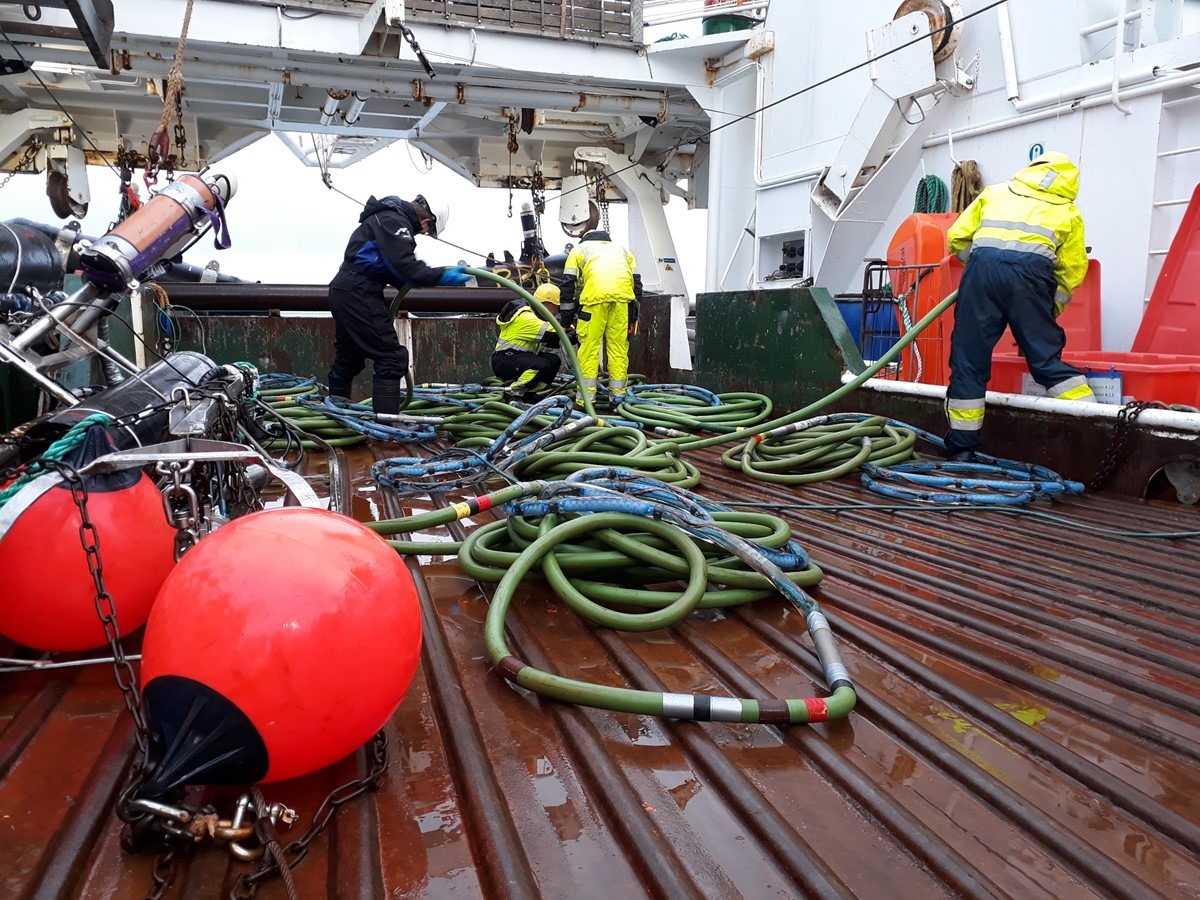
The green spaghetti (the hydrophone cables) is rolled on deck while we change from 2D to 3D mode.
To image in 3D we put the cables one next to the other. Changing from one configuration to the other one implies a lot of action on deck for the crew, our engineers, ourselves and even our colleagues form AWI helped on deck pulling and connecting hydrophones for the surveys. Also the processing team had a lot of action and a sufficient amount of data to keep us awake during the night shifts.
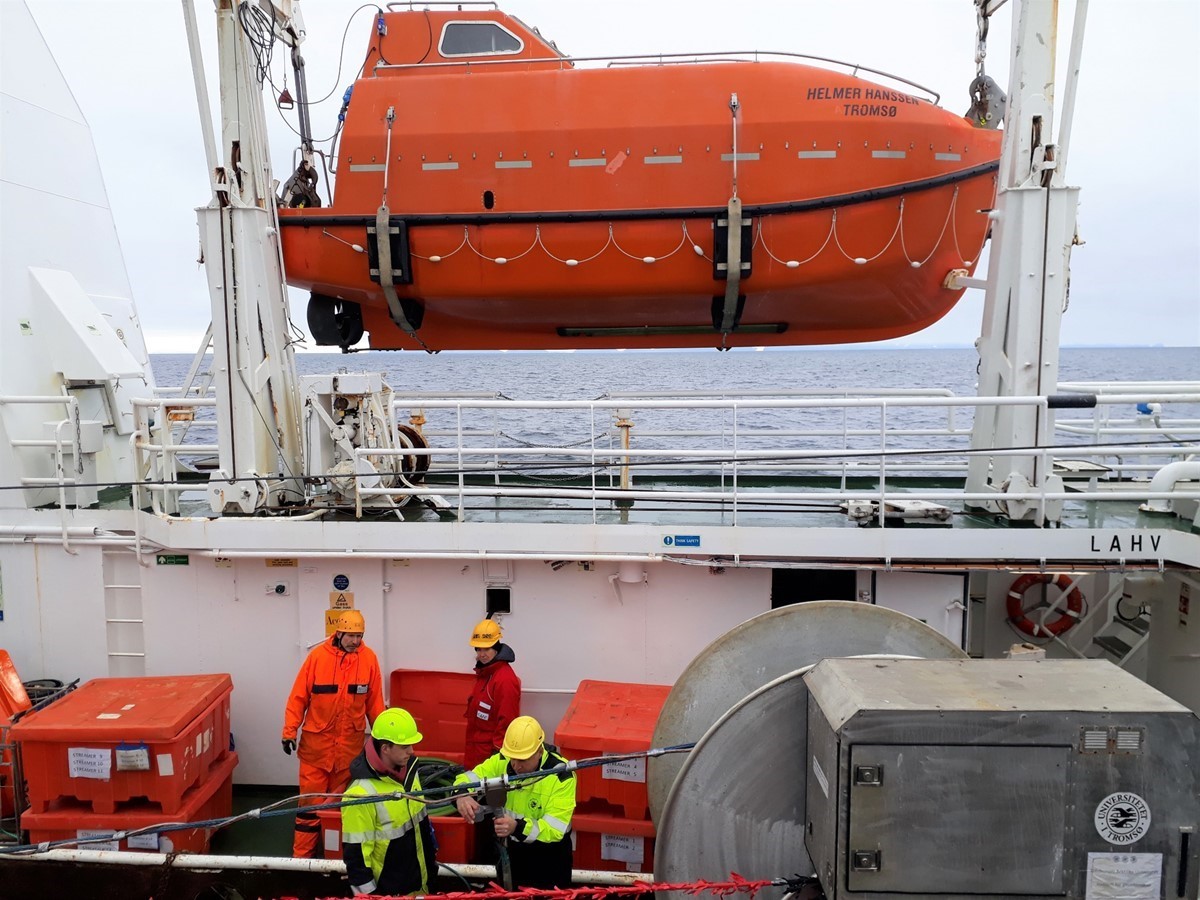
Stormer and Steinar carefully dry and put leads in the hydrophone connectors while Henning and Vera (AWI) wait for the next hydrophone cable to role it into the box.
It was a productive research cruise with a great crew and lots of inspiring moments. We had intense research discussions and collected significant data sets for the Seamstress project. Part of the new lines complement as well a data set we are using for a scientific drilling proposal (IODP).
We sail satisfied to our next target before heading to our final destination…Home
Text and photos: Andreia Plaza-Faverola