

Louis Waterman Quist’s doctoral project
Romantic Pedagogy: Connecting Education and Nature for the Present
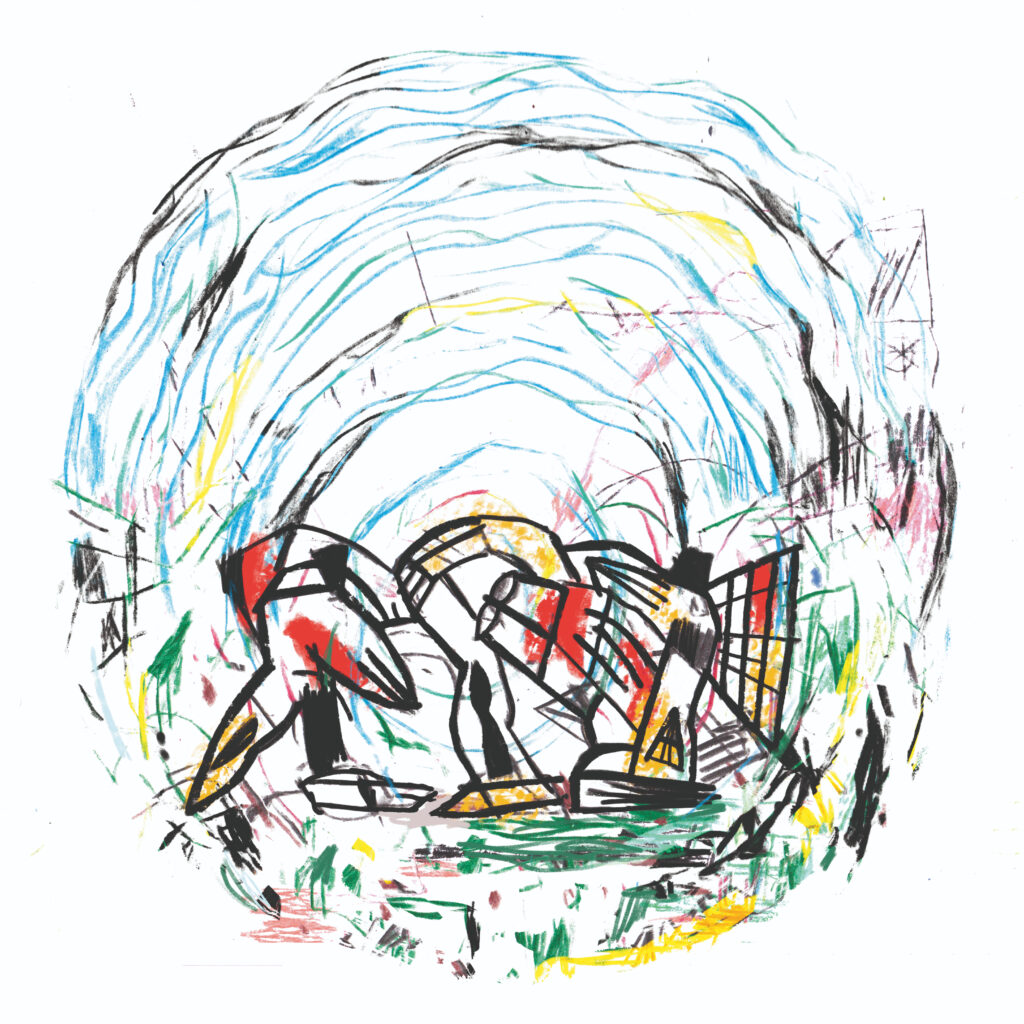
This text accompanies my poster at Harstad Festpillene under the theme «En verden verdt å leve i». Arctic Youth, in collaboration with ArcHum and Lærerutdanninga 200 år has responsibility for organising the exhibition.
My PhD project is about Romantic Pedagogy. It is not self-evident what this concept means – to speak of a distinctly “Romantic” form of pedagogy. Therein lies the task of my thesis: to give expression to the concept “Romantic Pedagogy”. My thesis does this in written form; this poster instead gives it shape in visual form.
What does the artwork show?
1. Humans are in the centre, intertwined, as if dancing together. Most immediately, this represents education as the influence of one on another (not excluding self-education). It also points to the collaborative and free pursuit of thinking and theorising together that was termed free sociability (freie Geselligkeit) by FRIEDRICH SCHLEIERMACHER– social interactions not constrained by external purposes, emphasising relationships that are formed and maintained for their own sake, rooted in mutual respect, understanding, and the intrinsic value of human connection.
2. The picture is circular, with a spiral inside. The circle symbolises unity, without begninng or end, that shows interconnectedness of all things. Circles are important symbols in nature and connected with an organic view of development (contra linear, mechanical), such as the natural rhythms of day and night, seasons, life and death. The circular, organic metaphor is important for Romantic Pedagogy: that human formation follows the same rhythm observed in the natural world. However, the circle benefits from its more open-ended complement in the form of the spiral. The spiral is given expression in classic conceptions of Bildung, such as with WILHELM VON HUMBOLDT: of leaving oneself through alienation (Entfremdung) and important return, now at a higher level.
3. The image has dark streaks, with flashes of light. This reflects two aspects of being human: emotion/ feeling/ passion (nature) – symbolically, this is obscure and cannot be fully grasped; whereas mind/ intellect/ reason is clear and light, (think of phrases such as «clarity of thought», or to «shed light on something»). Romantic Pedagogy does not reject the light of reason, but key is that the darkness of emotion takes precedence. We see this for example with NOVALIS in «Hymns of the Night». From the darkness of emotion springs the clarity of reason. The night is not merely the absence of light but a sacred space where one can transcend earthly limitations and connect with the infinite, acknowledging the interconnectedness of all existence in a holistic whole.
Why is this relevant for Arctic Youth and the theme “En verden verdt å leve I»?
We need concepts to make sense of and give shape to how we interpret the world. Without them, our intuitions are blind, as we already learn from IMMANUEL KANT. The concepts we use shape what comes into view and what is left omitted. My argument is that Romantic Pedagogy helps us see education in fruitful ways as pointed to in the image and that will be expanded upon in my thesis.
See my full research profile here.