
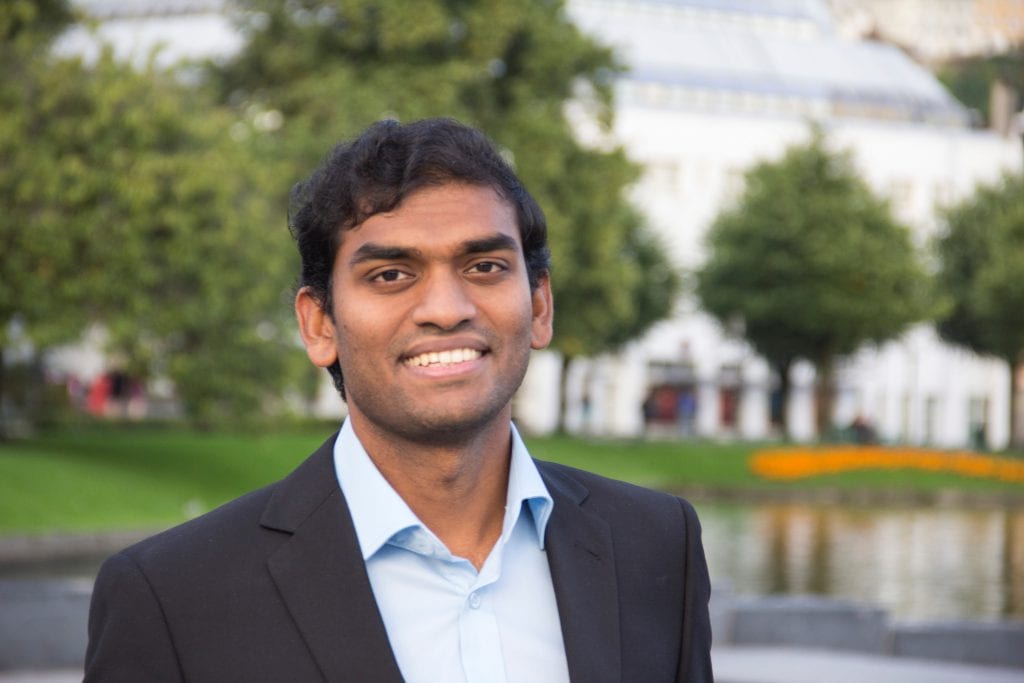
Sunil Vadakkepuliyambatta recently defended his doctoral thesis entitled: “Sub-seabed fluid-flow systems and gas hydrates of the SW Barents Sea and North Sea margins”
The aim of the study was to improve the understanding and overview of gas leakage systems and gas hydrates within the sediments of the southwestern (SW) Barents Sea and northern North Sea. Leaking of methane gas hydrates can potentially release greenhouse gas due to ongoing global warming. The research was funded by Trainee School in Arctic Marine Geology and Geophysics (AMGG) administered by the Department of Geology. He defended his thesis 25th of April 2014.
Large fluid leakage structures occurs in SW Barents Sea and shows links to the major tectonic setting. The glacial periods (uplift and erosion) have caused fluid leakage from deep reservoirs. In many locations, fluid leakage results in accumulations of shallow gas and gas hydrates that are relatively stable in structures containing thermogenic hydrocarbons. But gas hydrate stability varies widely throughout the SW Barents Sea. Possible gas hydrate occurrences in many parts of the SW Barents Sea can be sensitive to changes in ocean temperature due to global warming. This can then lead to melting of large quantities of gas hydrates in the upper 100 m below the seabed over a relatively short period (100-200 years).
The thesis of Vadakkepuliyambatta included the study of the distribution and evolution of fluid migration systems and gas hydrates in the SW Barents Sea and northern North Sea. His work was based on interpretation of seismic and well data and numerical modeling of hydrate stability.
Sunil Vadakkepuliyambatta was born in 1986 in Kerala, India. He studied marine geophysics and graduated from Cochin University of Science and Technology, Kochi, India. After working in a research institute and an oil company in India for a short period, he started his PhD in 2010 at the Department of Geology. His major interests are fluid-flow systems and gas hydrates.