
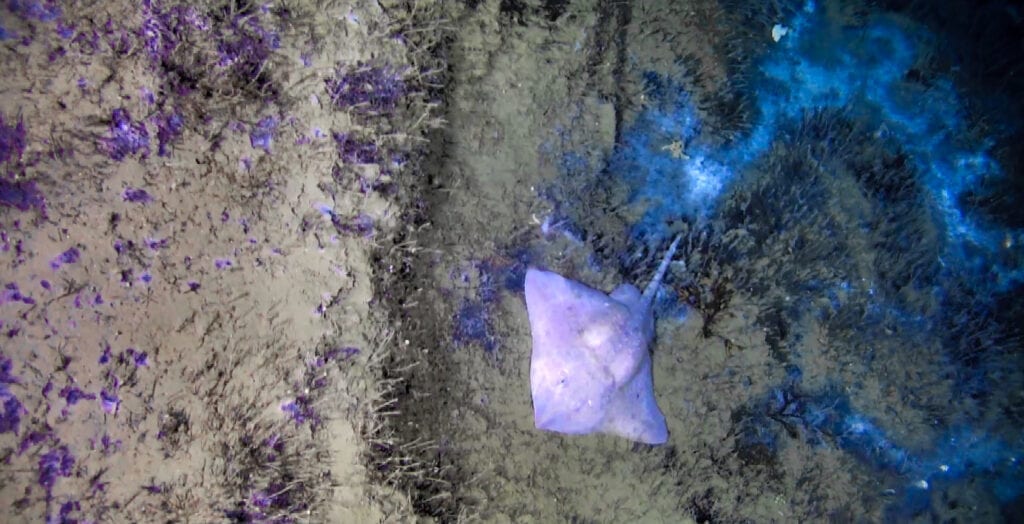
Even in such remote deep-sea areas, the consequences of human existence are evident
Hydrocarbon-releasing cold seeps in Arctic waters have attracted much attention in recent years, due to the potential impact that this release may have on the environment. However, nature never fails to surprise us. Not only was a brand new cold seep site recently discovered off the Lofoten-Vesterålen islands of northern Norway, this site displays characteristics that are unheard of in such locations.
Here are the highlights of the unusual activity:
- Worms that typically only live in soft sediment are living on hard sediment crusts at this site. The worms themselves alter the chemical reactions in the sediment at this seep site, such that the crusts formed around them.
- Egg cases of the deep-water Arctic skate thrive at this location. This is the first example of a cold seep being used as an egg case nursery this far north. It is hypothesized that the slight temperature increase at the site serves as a natural incubator for the egg cases.
- Despite the toxic environment at the seep site, regular deep-sea animals appear to live there in comfort. Seep-specific animals that have a tolerance to such toxicity normally dominate these sites, yet at this site no seep-specific animals exist.
It is worth noting that although the Lofoten cold seep site is located deep within the Arctic waters, only accessible to humans via sophisticated and pressure-resistant technology, we still find evidence of human interference. Large amounts of modern-day trash clutter this otherwise pristine example of evolutionary persistence, which will likely not decay for years to come. It should serve as a warning to humanity that our every-day activities, seemingly inconsequential, can have a further reach than we imagine.
Arunima Sen of the Centre for Arctic Gas Hydrate, Environment, and Climate (CAGE UiT) is the first author on an article recently published in Scientific Reports entitled, ‘Atypical biological features of a new cold seep site on the Lofoten-Vesterålen continental margin (northern Norway)’. For more information, read the article for recounts, analyses, and theories on the strange findings at this cold seep.
Text: Jessica Green
Cover Photo: ROV/Norcrust