

Prof. Robert Beckman, Senior Advisor, Ocean Law and Policy, Centre for International Law, National University of Singapore
Bikashita Choudhury, Research Associate, Ocean Law and Policy, Centre for International Law, National University of Singapore
CIL/NCLOS Dialogue Symposium
Introduction
One of the “unintended consequences” of the imposition of sanctions on the Russian Federation by the United States (US) and the European Union (EU) has been increased interest in developing commercial shipping on the eastern sector of the Northern Sea Route (NSR) along the Russian coast of the Arctic Ocean between Russia and East Asia. This commentary will first examine the use of the NSR by ice-class tankers transporting Liquefied Natural Gas (LNG) and crude oil from Russia to China. It will then examine the increased investment by China and the Republic of Korea in icebreakers and ice-class container ships to develop commercial shipping on the NSR. Finally, it will explain that these developments are likely to heighten concerns about oil spills and ship-source pollution of the marine environment.
Increase in Transport of Crude Oil and LNG along the NSR
Russia has traditionally supplied crude oil and LNG to Europe via pipelines and along the western sector of the NSR. However, Russia’s invasion of Ukraine in 2022 resulted in sanctions on Russian crude oil and LNG terminals and price caps on cargo. As a result, Russian ships were denied insurance coverage, shipping services, and certification. This has led to Russia’s increasing reliance on the eastern sector of the NSR to transport crude oil and LNG to China.
Despite the withdrawal of such carrier contracts, Russia maintained the same LNG export level along the NSR as in 2022. The impact became evident in 2023, when around 1.5 million tons of crude oil were transported through the NSR. While details on the number of tankers vary, sources confirm significant use of the eastern NSR from July to October in 2023. Non-Russian transit traffic had dropped by 90%, while sanction loopholes allowed LNG to reach certain European ports via the western NSR. Additionally, the redirection of cargo flows due to sanctions saw a record high in LNG trade volume. Significant tanker traffic continued in 2024 on the eastern sector of the NSR, with crude and LNG dominating. China alone received around 1.9 million tonnes of crude. Russia reportedly issued permits to 33 LNG and 22 oil tankers. By contrast, traffic in the NSR contracted slightly in 2025. The likely reasons include technical problems with vessels, maintenance issues at cargo terminals, stalled delivery projects, and a shorter ice-free season.
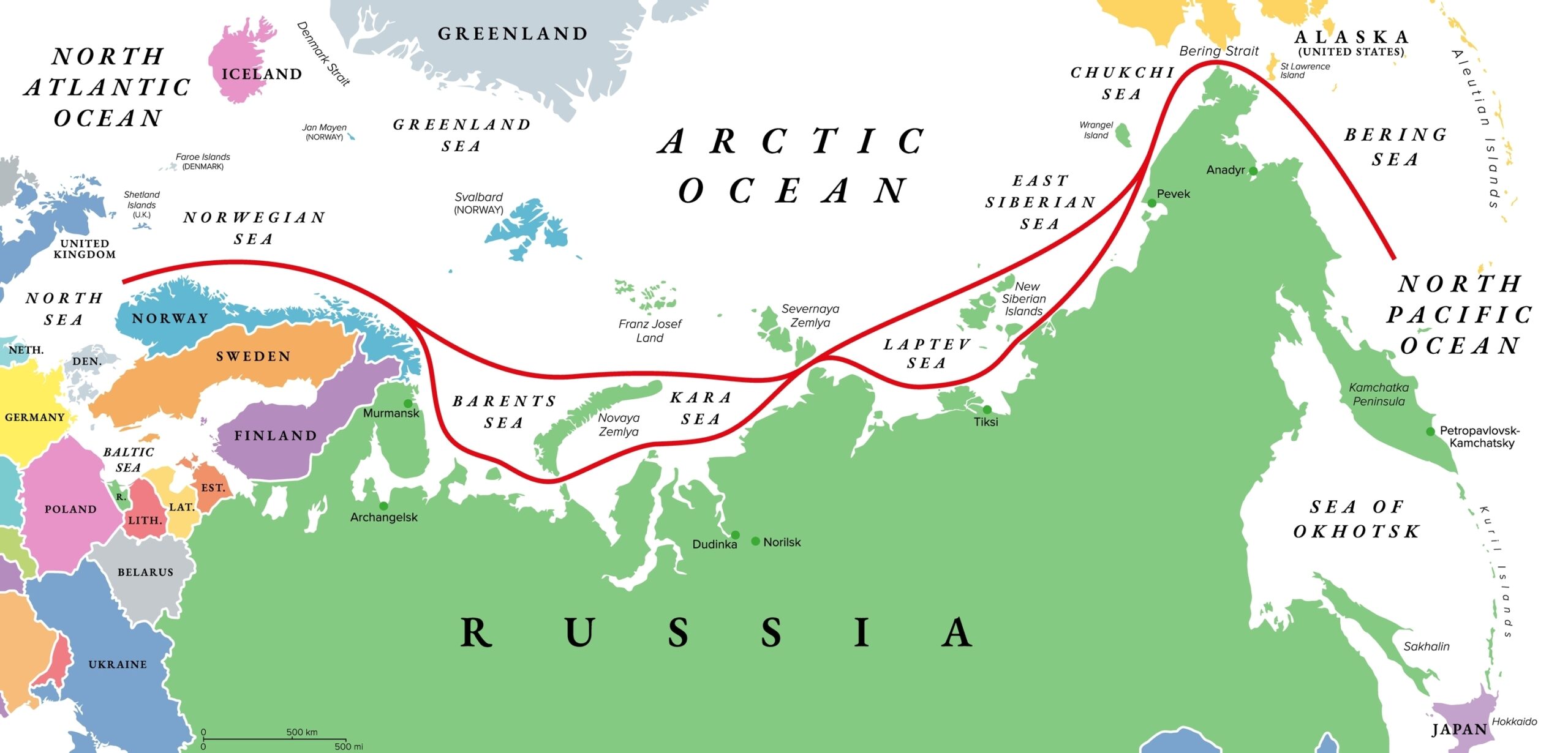
Photo: Peter Hermes Furian / Shutterstock.com
The Trend of Tanker Traffic in the NSR
In general, the trend of tanker traffic along the NSR aligns with Russia’s long-term goal of exporting 100 million tonnes of cargo volume annually. However, the types of tankers transiting the NSR raise concerns. Russia reportedly used newly built Arc-7 ice-class tankers to transport LNG. However, for crude oil, it has been reported that tankers crossing the NSR were primarily low-ice-class tankers, although it was argued that such permits were issued at the peak of the 2023 summer. Movable ice, thick fog, and sudden storms could cause navigation problems for these ships with thin hulls.
In addition, 2024 marked an increase in transits by tankers in the “shadow fleet” and non-ice-class tankers on the eastern sector of the NSR. Tankers in the shadow fleet generally do not comply with the safety and pollution requirements set out in the IMO Conventions. They engage in multiple name and flag changes, have data gaps in their voyage history, and may not have the liability insurance required by the 1992 Civil Liability Convention. One news outlet reported that around 100 shadow fleet tankers transited the NSR in 2025. In addition, “shuttle tankers” normally used for transit within the NSR also travelled to China, a voyage arguably beyond their technical capacity. Finally, it has been reported that in 2025, one-third of the vessels permitted to transit the eastern sector of the NSR were not “ice-classed”.
Shadow Fleets and Infrastructure
The use of the NSR by tankers in the “shadow fleet” that do not comply with the IMO’s ice-class regulations is likely an interim problem. In the past, Russia has strictly regulated the use of vessels on the NSR. The US and EU sanctions likely prompted Russia’s premature shift to using the NSR, even as its fleet and shore-based infrastructure on the NSR were still developing. Several NSR development projects managed by South Korean companies, including the delivery of ice-class tankers, were stalled. Equipment delivery delays by Turkish companies and the decommissioning of ice-class vessels from Russia also contributed to the NSR’s underdevelopment.
Russia is likely to strictly regulate ship passage through the eastern sector of the NSR to increase use of that sector while protecting the marine environment. It is rapidly developing home-built ice-class LNG tankers to replace its existing tankers, and it is also building nuclear-powered icebreakers. In addition, Russia has concluded agreements with China to expand the NSR’s port and transit infrastructure. China is also constructing ice-class tankers and icebreakers for use on the NSR. In addition, the Northern Sea Navigation Support Centre of the Ministry of Transport of China has begun releasing a live Arctic sea-ice monitoring product in collaboration with the Tianjin Marine Centre Observatory to provide more accurate data on the safety of Arctic shipping routes.
The imposition of sanctions on Russia following its invasion of Ukraine is likely to result in Russia becoming increasingly dependent on China to develop commercial shipping on the NSR. China’s development of ice-class container ships and icebreakers makes it likely that China will demand some special considerations, such as the right to use its own icebreakers to escort Chinese ships. Currently, Russia requires the use of its icebreakers and charges a fee for their use.
The Development of Container Shipping on the NSR
As Arctic sea ice and glaciers melt due to climate change, it has been assumed that there will be a gradual increase in the number of weeks when commercial ships can navigate the NSR. Since the NSR stretches along Russia’s coast, it has been interested in developing shipping along the route to both Western Europe and East Asia.
China and Korea have expressed their interest in developing container shipping on the NSR between East Asia, Russia and Western Europe. They also have the capacity to contribute investment and expertise in shipbuilding and equipment development. The NSR would then become a “seasonal alternative” to the traditional route from East Asia to Europe through the Straits of Malacca and the Suez Canal.
Chinese companies have proposed using the Northern Sea Route to connect three ports in China (Qingdao, Shanghai, and Ningbo) with four ports in Europe: Felixstowe (United Kingdom), Rotterdam (Netherlands), Hamburg (Germany), and Gdansk (Poland). The Arctic portion of the route can be covered in 18 days, less than half the time required for the traditional route via the Straits of Malacca, Singapore, and the Suez Canal.
The development of this route can boost Russia’s seaborne trade in hydrocarbons and, in the future, minerals. Some examples of the expansion of the seasonal NSR include building high-ice-class containerships and nuclear-powered icebreakers. A joint venture between Russia’s Rosatom and China’s NewNew Shipping, which is scheduled to begin in 2027, includes the construction of ARC7 ice-class container ships with a capacity of 4,400 TEU. Korea also plans to begin pilot operations for Arctic shipping in the summer of 2026 and to establish a special NSR division within its Ministry of Oceans and Fisheries. It has constructed Arc7 ice-class oil and gas carriers, mostly under Russian contracts. Korea is likely to propose its southern port, Busan, as a network port for the NSR.
The High North News reported that the navigation season on the NSR in 2025 concluded in November after roughly 4.5 months of operations due to unfavourable ice conditions compared to previous years, and that the open-water window may have lasted only two weeks.
Nevertheless, it further reported that the total transits through the NSR increased from 97 in 2024 to 103 in 2025, and that container ship transits increased from 11 in 2024 to 15 in 2025. The increase in container ship transits signals growing interest in seasonal container shipping on the NSR. Chinese container ship operators have reportedly announced plans to further expand their operations in 2026.
Environmental and Safety Concerns
Marine scientists and environmental groups are concerned that increased navigation on the NSR will increase ecological pressure on the Arctic’s already fragile marine environment. This is compounded by the harsh, unpredictable Arctic weather, which compromises safety and emergency response capabilities. Major European shipping companies, including MSC and Maersk, are signatories to the Arctic Corporate Shipping Pledge, a voluntary commitment to avoid using the NSR because of environmental and safety concerns. Nevertheless, Russia and China seem intent on developing container shipping on the NSR.
Furthermore, oil tankers pose greater environmental risks to the NSR than container ships. Permitting non-ice-class tankers and low ice-class tankers raises issues of compliance with the Polar Code and Russia’s own Northern Sea Route Administration Rules. Although the IMO has imposed a Heavy Fuel Oil (HFO) ban, tankers in the shadow fleet are unlikely to comply with the ban in the Arctic. Russia has also sought an exemption from the ban until 2030; thus, tankers in the shadow fleet using the eastern sector of the NSR will continue to cause black-ice problems, accelerate ice melt, and exacerbate climate change.
The increased use of the NSR by tankers carrying crude oil or LNG also raises the risk of a disastrous oil spill. As the 1996 HNS Convention is currently not in force, an LNG spill would be a critical problem, as the liability framework for the carriage of LNG is absent. A crude oil spill would also pose serious liability issues. Under the 1992 Civil Liability Convention (1992 CLC), the tanker owner must carry liability insurance for oil pollution damage. However, if a tanker is part of the shadow fleet, the owner may not have liability insurance. The pollution damage could also exceed the owner’s liability, bringing in the 1992 Fund Convention, which holds the receivers of oil by sea from tankers liable for such spills. However, Russia, as an oil exporter, would not be required to contribute to the Fund. China, the primary recipient of oil from Russia via the NSR, is not a party to the Fund Convention and therefore would not be required to contribute either. Consequently, other parties to the Fund Convention that receive oil from tankers, such as India, Japan and Korea, would have to contribute to compensate Russia for pollution damage caused by an oil spill in the eastern sector of the NSR.
The Gulf War and the NSR
The imposition of sanctions on Russia following its invasion of Ukraine incentivised Russia, China, and Korea to develop shipping on the eastern NSR. The 2026 Gulf War and the disruption of oil supplies through the Strait of Hormuz and the Red Sea are likely to provide further incentives for development of the NSR for both container shipping and for tankers carrying LNG or crude oil. Russia may also be able to attract investment from other major oil-importing States in Asia, such as Korea and Japan, to develop the NSR for the shipment of LNG and crude oil to East Asia.
Conclusion
Western sanctions on Russia have increased interest among Russia and China in developing the Northern Sea Route for the seasonal transport of crude oil and LNG from Russia to China. At the same time, there is growing interest in China and Korea in developing seasonal container shipping from Europe to East Asia via the Northern Sea Route. These developments are likely to increase concern about their impact on the Arctic marine environment. Hopefully, Russia, China and Korea will decide that it is in their long-term interests to ensure the increased shipping in the Arctic is in compliance with the international rules and standards and best practices set out in the applicable regulations of the International Maritime Organization.
This article is part of a series: CIL/NCLOS Dialogue Symposium
Connected articles:
- Black Carbon and the Heavy Fuel Oil Ban in the Arctic, Amanda Wee and Yulu Liu
- Charting the Future of Arctic Shipping: Why Navigational Rights in the Northern Sea Route Matter?, Jan Solski,
- Arctic Ecosystem Governance as a Security Concern, Vito De Lucia