UArctic took place in Tórshavn, Faroe Islands, at the Arena við Tjarnir. The event was hosted by the University of the Faroe Islands (Setur), in collaboration with the Ministry of Foreign Affairs and Culture and the Faroe Marine Research Institute.
Mathias (Várdobáiki), Trude and Eli-Anita (UiT) from the Biebmolassi-project participated with the presentation “Reconciling Sámi Food Systems” in the session “Indigenous Food Systems and Foodways of the Arctic,” organized by Dr. Amy Caughey from the Nunavut Research Institute in Iqaluit, Canada. We had 15 minutes to present two projects on Sámi Food Systems, the Interreg-project Máhtut and the NRC-project Biebmolassi.
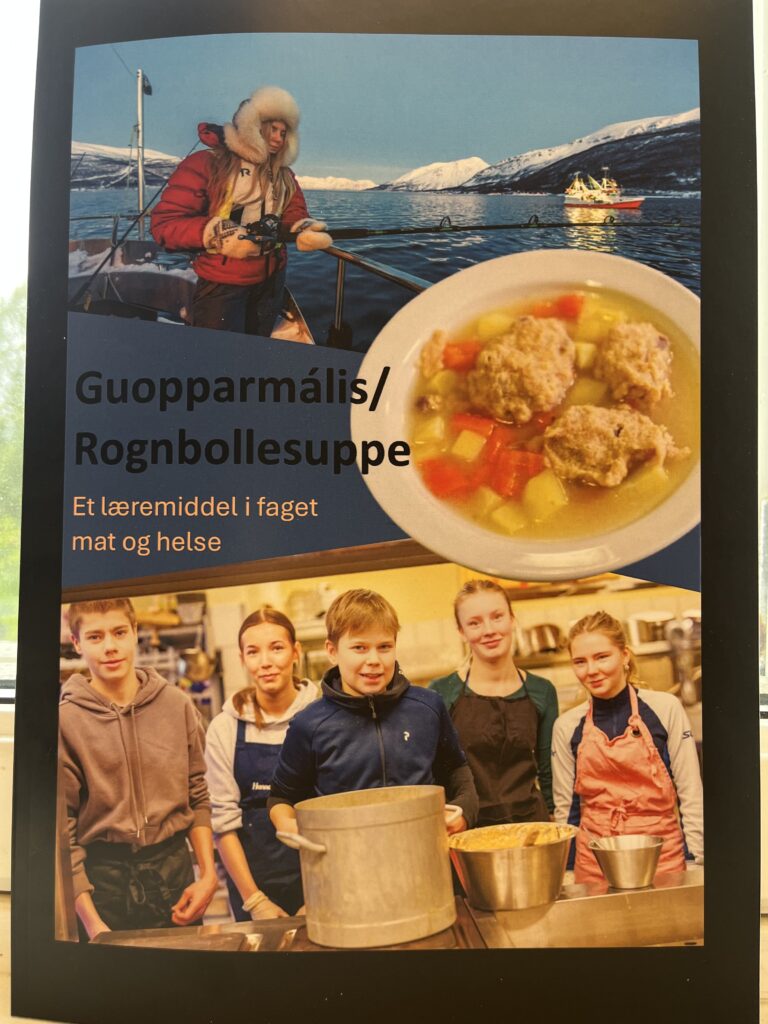
Máhtut (2023–2026) is led by the University of Lapland (Finland). The other partners are the Sámi Education Institute (Finland), Várdduo the Centre for Sámi Research (Sweden) and the Arctic University Museum of Norway (UiT). On the Norwegian side, UiT has a close collaboration with Davvi Álbmogiid Guovddáš (DÁG). The project examines the coastal Sámi food system in Gáivuotna (Kåfjord), centering on the traditional cod roe soup, guohpparmális. At the UArctic, Eli-Anita presented the project’s overall aims and facts, and took us through the four bargobádji (workshops) the project had together with DÁG and eight 8th grade students and their teacher on conservation, fishing and the making of the soup. One of the outcomes of the project was a teaching material – a booklet for secondary school students – created by the students and their teacher at Olmmáivákki School, which we distributed among those present. Trude introduced how the project has explored the museum archives for traces of coastal Sámi food traditions, and presented some of the findings from these investigations. Through tracing coastal Sámi food traditions in the museum’s archives questions are raised about how archives can be decolonized, as well as how tradition and knowledge in the archives can be passed on to new generations and transformed in the present.
Biebmolassi (2025–2028) is a follow-up to the recommendations of the Truth and Reconciliation Commission in Norway, and is a collaboration between UiT, Várdobáiki sámi guovddáš, Nordland Research Institute and Salten Mat. The project examines historical and contemporary Sámi food systems in Sallto (Salten) in Nordland and Stuornjárga (the Skånland Peninsula) in Southern Troms – both regions in the north of Norway. The project aims to (among other things) map local Sámi food traditions and practices in these two regions. At the UArctic, Eli-Anita briefly introduced the project’s overall aims and facts, while Mathias presented Várdobáiki’s part of the project.
The presentation was very well-received, and there was significant interest in the project—particularly in the teaching booklet. Several participants expressed a desire to receive a copy of it and wanted to connect with us.
Other presenters from the session on Indigenous Food Systems were:
- Dr. Amy Caughey, Nunavut Research Institute, Iqaluit, Canada and University of Alberta, Iqaluit, Canada who organized the session and introduced the topic “Indigenous food systems and foodways of the Arctic”.
- Associate Professor Aviâja Lyberth Hauptmann, Ilisimatusarfik, Nuuk, Greenland and University of Copenhagen on the topic “Arctic Indigenous food systems as role models for connecting the wellbeing of communities and environment”.
- Dr. Sean Desjardins, Arctic Centre, University of Groningen, Groningen, Netherlands and Paleobiology Section, Canadian Museum of Nature, Gatineau, Canada, presented on the topic “Bridging knowledge on Inuit subsistence harvesting and long-term food security in northern Foxe Basin, Nunavut, Inuit Nunangat”.
- Dr. Pal Weihe, AMAP Chair, Faroe Islands, Denmark on the topic “Future Priorities of the Arctic Monitoring and Assessment Program (AMAP) Human Health Assessment Group”.
The presentations were followed by a short discussion on projects should not be “top-down” but rather take the local as a starting point, which involves facilitating inclusion of indigenous perspectives and knowledge systems.
The Máhtut film:
Written by Eli-Anita