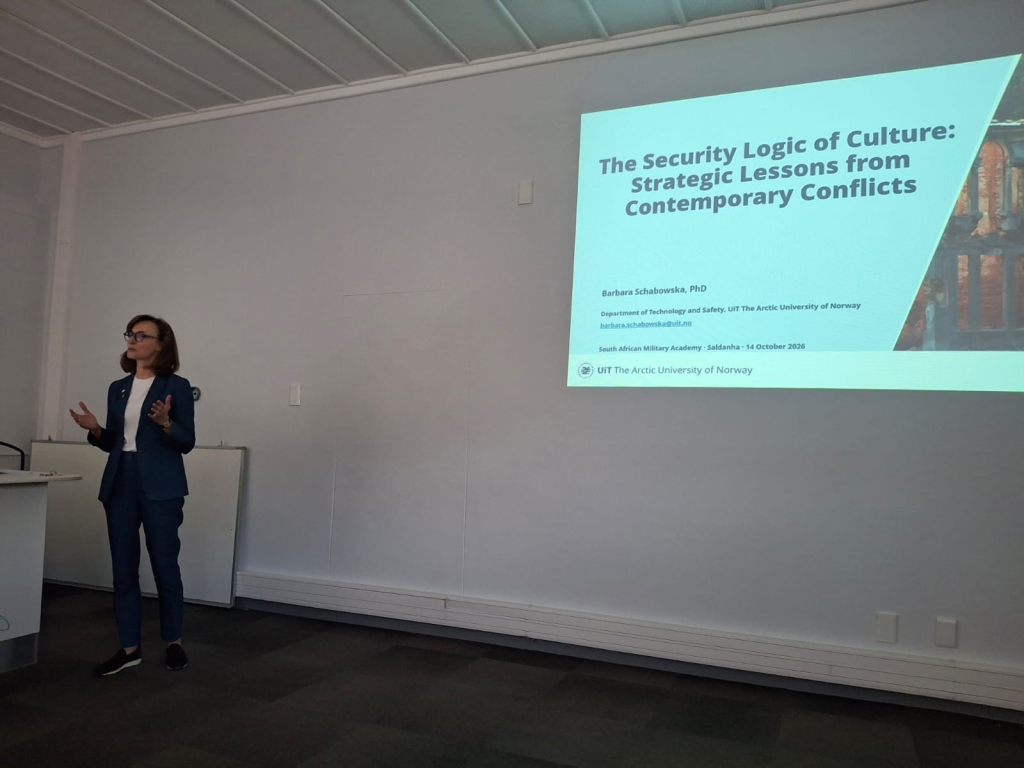
Barbara Schabowska of UiT The Arctic University of Norway was recently invited to give a guest lecture at the South African Military Academy in Saldanha, where Stellenbosch University’s Faculty of Military Science is based.
During her stay in the Western Cape, she also visited AfriForum’s office in Durbanville to learn about the work of the Solidarity Movement, a network of Afrikaner organisations and institutions that supports the development of education, culture, science, civil society and social welfare within its community. For researchers working on societal resilience, the movement is an interesting case of a minority community that has built its own institutions to preserve its identity and keep essential services running in a challenging economic, social and cultural environment.
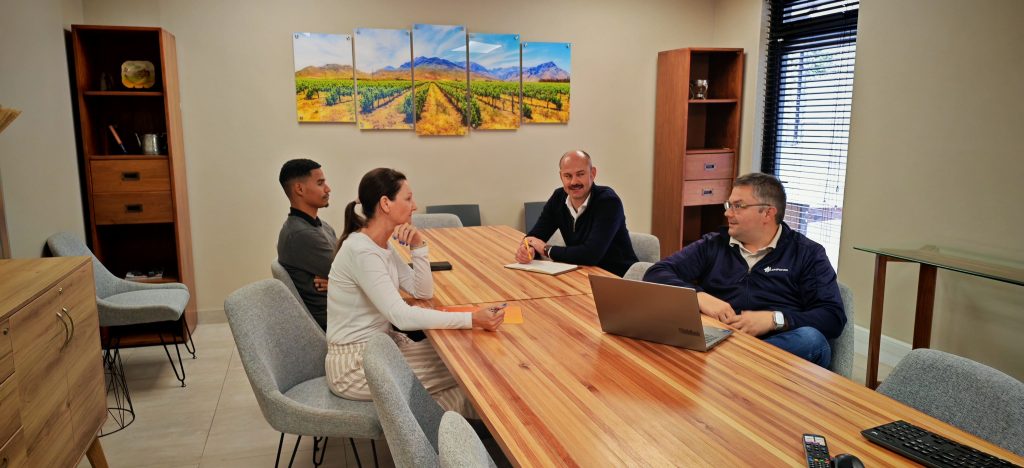
The visit was possible thanks to Bernard Pieters, Southern Regional Head of Intercultural Relations and Cooperation at AfriForum. In Durbanville, Barbara also spoke with Barend Uys, who heads the division nationally. He presented AfriForum’s work and its place within the wider Solidarity Movement, and discussed the challenges facing education in the community. The programme also included talks with people involved in the movement’s main areas of activity:
- Natasha and Morné Venter, lecturers at the Paarl campus of Akademia, a private Afrikaans-language higher education institution;
- Jolene Leroux of the FAK (Federasie van Afrikaanse Kultuurverenigings), the Federation of Afrikaans Cultural Associations, who is responsible for developing the Afrikaner cultural programme;
- Mariëtte Roos, Regional Organiser for the West Coast, Winelands and Northern Suburbs at Helping Hand, a welfare organisation that works to alleviate and prevent poverty through social services, training and community development.
Relevance for GLOBSEC
Within the Solidarity Movement, education, culture and welfare are closely linked and support one another. The movement shows how civil society can organise and sustain such structures on its own initiative.
The visit also ties in with Barbara’s research on societal resilience, which looks at how communities draw on shared identity, values and their own institutions to cope with prolonged crisis.