
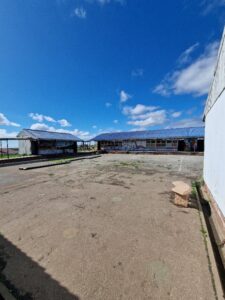
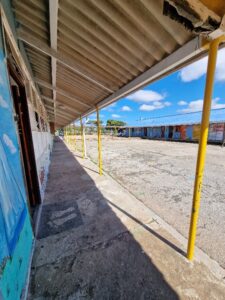
The second week has been full of impressions. There are a lot of things that are similar to Norway, but also some things that are really different. The school is surrounded by a fence for safety. The classrooms and staffrooms are split between six buildings, and between every classroom you have to go outside to get into the other rooms. This also goes for when the teachers or the children needs to use the bathroom. One classroom is in a container next to the other buildings. The outside of the buildings are painted with different themes, for example Frost, Moana, and different positive quotes and rainbows.
 |
 |
 |
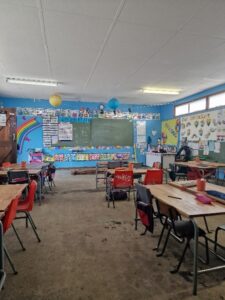 |
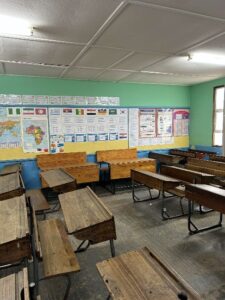
The classrooms for first and second grade are quite big with plenty of room between the desks. The learners mostly sit in groups of four to six pupils, and they can cooperate while working. In third grade the learners sit two together on one desk and have a bit smaller space in their classrooms. All rooms in foundation phase, 1.-3. Grade, are colorful and has many posters of different things hanging on the walls. For example, the alphabet, numbers, and different decorations that can be helpful for the learners. Each teacher has their own classroom, and it is up to them how they want to decorate their room. However, decorating the room is also on their own cost. The classrooms we have seen in foundation phase has been colorful and look quite similar to Norwegian classrooms considering decorations. The school do not have any digital resources, however they can buy their own pc or other digital resources if they want to. But not many teachers do this because both because of economy and because it is not safe to keep in the classroom, and the teachers must bring it home every day. In addition, the classrooms are not equipped for digital resources.
It is also up to the teachers to buy pencils and other equipment for their self and their pupils. Many pupils often lose their pencils, and as a result the teacher often must get a new one for the pupil because sometimes their parents cannot afford it. Most of the classes do not have textbooks for the pupils, and because of that they use a lot of worksheets. They can print at school, but it is limited how much they can print, so they often have to prioritize. Every class in the same grade follows the same plan, and mostly use the same worksheets.
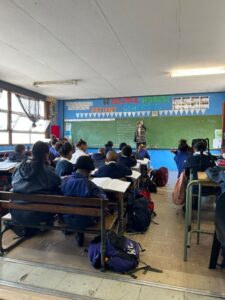
When the learners go from third to fourth grade, they are split from four to three classes, and in addition the classrooms get smaller. One classroom for a seventh grade is so small that it is difficult to walk between the desks. In this classroom there are 43 pupils in addition to the teacher. The teacher for this class has bought her own pc and overhead projector to use in her classroom, but this is the only teacher that has her own pc.
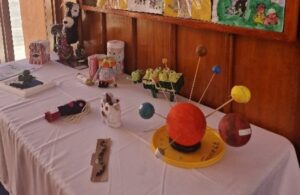
There is not a lot of focus on sustainable development, but in some projects the learners use reusable materials. For example, the first grade had a project where they made animals out of for example milk cartoons, egg carton or different bottles. The first grade has also started a project now where they are making a house out of reusable materials they bring from home.
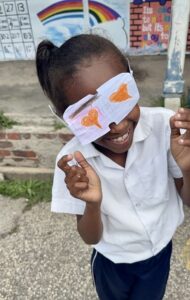
Another thing that is positive for sustainable development is that the teachers collect different things that can be used when teaching. For example, one teacher has collected used caps from bottles that the pupils can use when they are counting. This is something we can see in several classrooms, and it is positive because things are looked at as a resource and not just garbage. In Norway many things that are used in classrooms are thrown in the trash when they are done using it, but this does not happen as much in South-Africa, which is a positive thing for sustainable development. Also, the teachers are really good at using what they got, for example in the picture with the girl they made masks out of paper because that is what they had available at the time.
 |
 |