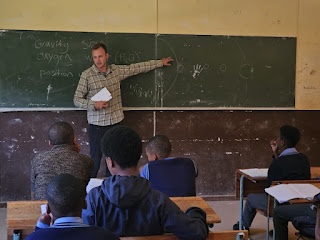
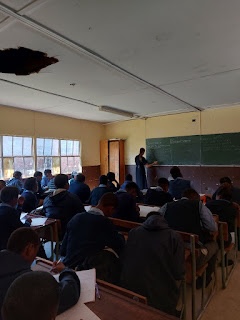
Over the initial three weeks of our practicum, we’ve had the opportunity to witness and acquire insights into another form of classroom management and pedagogical leadership style.
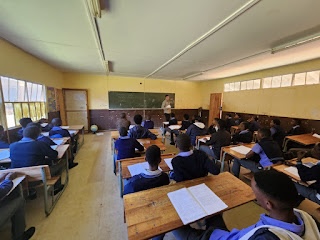
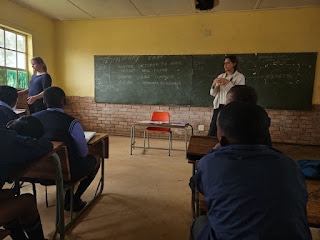
The blackboard is used in a greater extent than what we are used to in Norway, which changes the class management style quite a bit. The teacher often spends time writing on the board in order to get the learners what they need for their upcoming exams. This requires everyone to sit still and take notes. Because of this the classroom management style and pedagogical style is different.
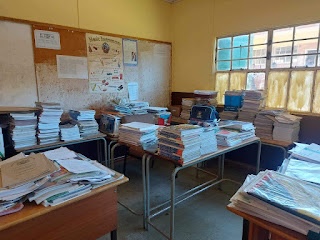
Students here are accustomed to taking greater initiative in their own learning. If chalk or erasers are missing, a student will quickly retrieve them without being asked. Teachers never need to transport books to and from the classroom as a student is always sent to fetch them. In cases of excessive noise, students often self-police and encourage their peers to remain quiet with a collective “shhhhh”.
Lecturing is a common practice in these classrooms, where the teacher typically explains the expectations and offers their thoughts on student performance before writing and assigning tasks on the board. While there have been a few exceptions with teachers encouraging dialogue between students and themselves, the predominant teaching style involves a teacher monologue.
Since the classroom can contain up to 60 students, the ways to get the students attention is different. We observed many teachers, which each had their own way of getting the classrooms attention. We have observed teachers raising their voices to an extent that we haven´t seen before, and the hands to hit the table to get the students attention. We ourselves have tried out different silent signs and the Norwegian clapping to get everyones attention. It has worked in some classes, although there is a lot of joking around in the classroom when we have tried to use the peace sign as a silent sign.
Student participation differs significantly. They aren’t accustomed to class discussions, pair discussions, or group work. We introduced poster-making in social science class, but many students sought immediate answers rather than exploring the topic creatively. They tended to rely on answer keys rather than embracing exploration and creation. Our experiences in a South African 8th-grade classrooms highlight potential challenges in working with the values of “fostering creativity, active engagement, and exploration” that we try to incorporate in as many subjects as we can in Norway. Some students embraced poster creation, while others felt pressured by grading criteria, affecting their enthusiasm.
It is important to point out that a lot of what we observed of class management takes place in Xhosa. Therefore we do not have a overall picture the pedagogical choices that the teachers take, only parts of it.
– Tord, Ulrikke og Linnea