
South Africa is a country of big differences, facing significant inequalities between the rich and the poor. These disparities are also evident when comparing the framework conditions of various public schools in Gqeberha. After two weeks of teaching practice at Machiu Primary School, we gained valuable insight into the school’s framework factors. In this blog post, we will discuss the framework factors at Machiu Primary School and link them to the interdisciplinary topic of public health and life skills.
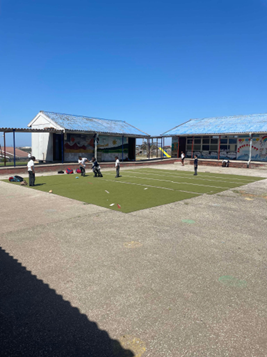
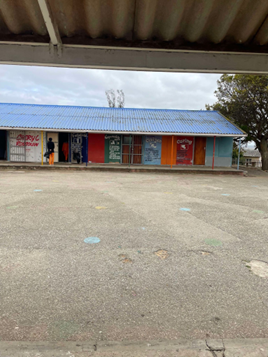
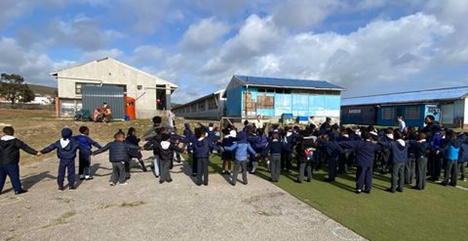
From grades one to three, each grade is divided into four classes, while grades four to seven are divided into three classes. The classrooms are equipped with double desks and arranged according to each teacher’s preference. A key difference from Norway is that classrooms are assigned to teachers, meaning students change classrooms while the teachers stay in the same room. The teachers choose if or how they want to decorate the classroom, and the school does not fund this. Despite this, the teachers have done a great job decorating, and the rooms closely resemble Norwegian classrooms, except that more desks are needed due to larger class sizes. The schoolyard is small, given the number of students, but the children make the best use of the space, for example, by setting up their own homemade soccer goals around the schoolyard.
In South Africa, the school system is organized differently to equip students with competencies related to public health and life skills. From grades one to three, students take “Life Skills.” The students at Machiu Primary School are not just learning, and they are enthusiastic about it. For example, we taught a first-grade class about dental hygiene, reading Karius and Bactus by Thorbjørn Egner, which we brought from Norway. The story was a big hit, and the students found it exciting. Life Skills lays the foundation for students to gain knowledge in public health and life mastery.
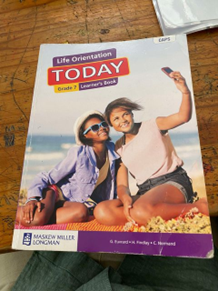
After completing the lower grades, the subject is renamed “Life Orientation.” In grade seven, the first-term focus is on physical activity and exercise. Students learn about different types of exercise and the importance of warm-ups. Through Life Orientation, students are taught essential topics that the government considers critical for personal development. In contrast to the Norwegian system, where public health and life skills are integrated across subjects, South African schools have a more structured approach. Life Orientation has impressed us by covering important topics such as physical activity, substance abuse, and human rights, ensuring that all students engage with these themes. There has been debate in Norway about creating a similar subject where students could also learn about personal finance.
We were given a tour of the facilities on our first day at Machiu Primary School. The school has its own soccer field, which is used for physical education. However, a larger field outside the school’s fence is no longer used due to safety concerns. There have been discussions about fencing the area to create a better space for physical activity, but the school currently needs more resources for this. Additionally, the school has a paved area intended for physical activities, but because the school does not have a designated parking lot, teachers use this space for parking. During our tour, a teacher explained the vast differences between public schools in Gqeberha.
Curious to explore these differences, we contacted a South African teaching student at a quintile 5 school. He kindly gave us a tour of Victoria Park High School. Victoria Park High School is a public school, but students must pay 28 600 rand per year in tuition. Since the school charges fees, it receives less funding from the government, and lunch is not free. Every public school is divided into groups, called quintiles, according to financial resources. Quintile 1 schools receive most funding from the government, due to less funding from parents from being in lower income areas. Victoria Park High School’s framework conditions and classrooms were similar to those in Norwegian schools. The biggest difference, however, was in sports facilities. Victoria Park High had several fields for rugby, soccer, hockey, and cricket, as well as a great fitness center and multiple staff dedicated solely to sports programs.
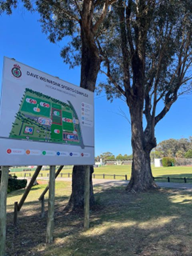
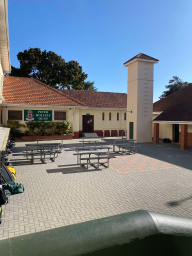
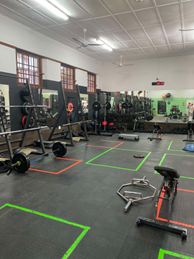
Our purpose in visiting Victoria Park High School was to understand the differences between public schools in South Africa. The framework factors vary greatly from school to school, making it impossible to generalize about South African schools. At Machiu Primary School, teachers and school leadership maximize their resources. For example, teachers organize cricket or soccer activities after school during their free time.
Nora, Marte, Karianne, Mina and Torjus