
av Abigail Mamami Copaja
Introduction
My name is Abigail, and I am currently a computer science student at UiT. This semester I had the opportunity to complete a three week internship at Microsoft together with two other students. During this period we worked closely with engineers and got a glimpse of what software development actually looks like inside one of the world’s largest technology companies.
In this blog post I will share some of the experiences from our internship, the project we worked on, and what I learned from seeing how theory from university is applied in real software systems.
Microsoft – A Global Technology Company
Microsoft is one of the largest technology companies in the world and plays a central role in the development of modern software and digital services. Many of the tools people use every day, such as Teams, Windows, and Azure, are developed by Microsoft. The company’s mission is to empower every person and organization on the planet to achieve more. This vision is reflected in the way Microsoft invests heavily in research, technology, and collaboration.
Our Project – An AI-Powered Escape Room
During the internship we worked on a project exploring how large language models and AI agents can be used to build interactive applications. Instead of just using AI to generate text, the goal was to experiment with how AI could be integrated into a real software system.
To explore this idea, we built an AI-powered escape room game that runs directly in the browser. In the game, the player can type actions in natural language, for example “inspect the desk” or “use the key on the door.” The system interprets what the player is trying to do and generates the next event in the story. The idea was to design something interactive where AI works together with program logic instead of controlling everything.
The application consisted of a React frontend and a Python backend built with FastAPI. The frontend handled the interface where the player could see the room, objects, the map, and the current game state, while the backend managed the game logic and sessions. We used LLMs to interpret the player’s intent and generate narrative responses that move the story forward.
Work Culture and Social Activities
Beyond the technical work, it was also really interesting to experience the work culture at Microsoft. The office had several social activities where people could hang out after work. I joined Board Game Night, where employees gather in the office to play different board games together, which was a really fun way to meet people.
There was also Lønningspils, a monthly after-work gathering where people just chill, talk, and spend time together in the office. One of the highlights was when the office had booked the PUST sauna. That was a very cool and very northern Norwegian experience, and it was fun to see how activities like this help people relax and connect outside of work.
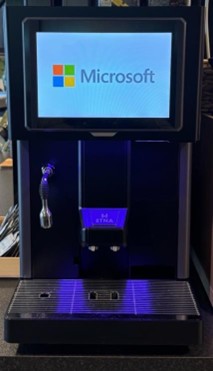
The office environment was also very welcoming. There were different drinks available, like soda and other refreshments, which made the atmosphere feel relaxed and friendly.
Reflection
My studies in computer science definitely helped a lot during the internship. It provided a strong foundation for understanding how the different parts of the system work together. At the same time, I also learned new things, especially about LLM-based architectures and AI-driven applications, which is a field that is evolving very quickly.
Conclusion
Finally, I would like to thank Microsoft for the opportunity to experience their work environment and learn from their engineers. Getting a glimpse into professional software development has been both inspiring and educational.
This experience has given me a better understanding of how knowledge from my studies can be applied in practice and has made me even more motivated to continue working with software development in the future.