
Sammendrag
Léonard Saint-Arnaud from Université de Montréal performed his internship at the University of Bergen.
Léonard Saint-Arnaud, Geography student (second year) at Université de Montréal
I had the chance to go on a 6-week trip to Norway for an internship, thanks to the GeoInternational committee based in Tromso. This opportunity to collaborate between universities, departments and countries is written in the form of a summarized journal.
A sunny start (July 16th – July 21st)
When I first got to Bergen, it was the opposite of what people told me. Great sunshine and 30°C were the most pleasant surprise I could get. Along with the sunny weather came a warm welcome from the research team of the biology department at the University of Bergen (UiB), led by prof Suzette Flantua. During the inaugural barbecue in this most uncommon summer weather, we discussed what would be the following steps for my internship, which led to me getting an office in the department the day after. However, that day would become one of the only ones where I would be in an office, since I was sent to do fieldwork at the Finse research station the day after. This is where I learnt that one of, if not the most important skill to have as an intern is flexibility. Indeed, my task was to help create a database of the research done at the research station, however, this goal was set way before my actual arrival in Bergen, and when I got there, priorities shifted.
First time in Finse (July 22nd – August 8 th)
Life at the station was pretty sweet, I got to swim in lakes everyday whilst staying in a cute lodge with other researchers who all share a passion for nature. The work I started with was helping two master’s students in biology. The both of them were studying the impact of early blooming of willows in the area on the pollination of a flower species, to each student their species. This made fieldwork sometimes demanding and sometimes relaxing, the demanding part was mainly to get to the study areas and to identify new individuals to study, whereas the calming moment was the pollinator observation, where we would simply sit still and watch designated flowers get pollinated, counting and identifying the pollinators. My previous experiences in the field in a geoscience context were very helpful for this type of work. Even though instruments can change, the scientific method doesn’t! In this manner, the protocols were very easy to understand and to apply. I had the chance to have previous experiences with handling instruments in the field; therefore, the fieldwork wasn’t stressful at all. Furthermore, coming from a geography background and helping with biology work, my input could help identify some factors that weren’t as obvious for biologists, and vice-versa! Since the Geography program at the Université de Montréal (UdeM) includes some elements of biology and ecology, I had the necessary basis to understand what was the purpose of the study and what dynamics were included in the research, I could not have done such without a proper background, which would’ve led to an added degree of complexity for me to understand the tasks I was charged with.
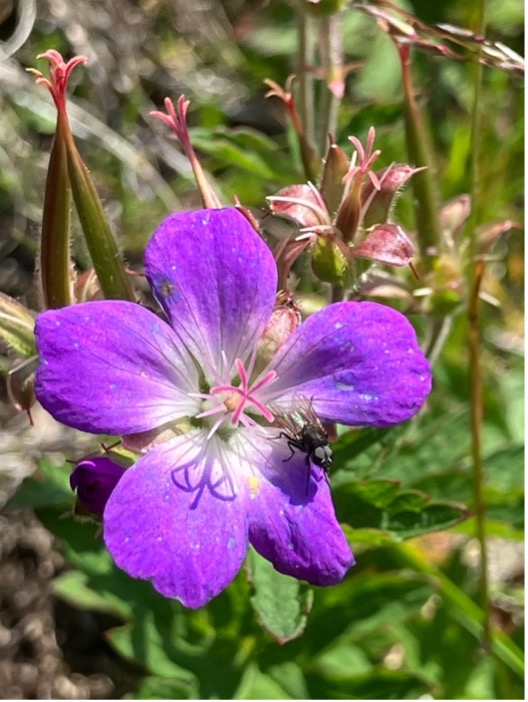
Figure 1: Silene acaulis pollinated by a fly.
The dynamic changed for a couple days when the research team came in to help with the project. We were charged with the task of doing some transects across multiple study areas. This ten-person team was very efficient and highlighted the usefulness of having a group, this way, what would’ve been days of work for me alone became a two-day of hiking and chatting with friends and colleagues making the whole process much more fun. In that sense, the quality of being open and friendly to others might seem obvious but it is certainly important while doing fieldwork. Especially when staying in a remote place like Finse, one can start to become a bit self-centered because of the lack of socializing, even if taking care of oneself is fundamental, getting out of one’s comfort zone to socialize is also an important part of an internship in general. With the internship done, I can now see that what I remember the most about my experience was the people, researchers come from all over the world and not only having their contact but also having their input on a plurality of subjects is a real luxury.

At that point, I had understood that I would not have a stable day-to-day life. Every excursion being subject to the weather, we could or could not do certain type of work. For example, raining prevented the pollination from insects, therefore no observation was possible. Other days it was simply too bad weather. Also, there were a lot of days where I had planned to do a certain type of fieldwork but just before leaving, my help was needed elsewhere for a more urgent matter, in this sense flexibility and adaptability mattered a lot, but I think the attitude is the most fundamental part of it all. Doing fieldwork in horrible weather happens to anyone, but managing to have a good day nonetheless is not given to everyone. Hopefully, this is something people can work on, how to make horrible conditions feel not so horrible, or even fun. For example, I had booked a train to leave Finse and go back to Bergen to have a little break and buy groceries, unfortunately all trains were canceled that day because of a storm that continued for a couple days. I had to deal with that unpleasant surprise… I found myself finding stuff to do, catching up on some computer work I had left behind. In that sense, even a bad surprise can be a good opportunity.
Second time in Finse (August 19th – August 27th)
Going back to what I did in the field, when I came back to Finse after a little break of work, I changed my focus. Indeed, I had a new mission concerning bumblebees. It was now to randomly walk in a designated area for 30min and spotting bumblebees, identifying the flower they were pollinating and the bumblebee itself. A very fun mission I have to say, even though it was dependent on the weather. A classic day would resemble this: wake up and have breakfast, pack a lunch, get out and walk as much as I can, lunch on the field, walk some more and come back to the station for the night. I did that for a couple days and then changed mission again. I did not have any specific knowledge of alpine fauna, especially not regarding insects, therefore it was very difficult for me to identify the individuals I was spotting. This made my fieldwork harder than it would’ve been if I was a biology student or had taken more biology classes, it also made a clearer difference between geography and biology as subjects. I couldn’t imagine a biology student struggling as I did but I could certainly imagine my geography colleagues having trouble in this situation.
After that, I got a new mission: flower hunting. The objective of the research, led by prof. Orjan Totland, is to search for genetic differences between the flowers in front of the Blaisen part of the glacier. Being very old, it has melted a lot, some flowers growing in areas that were only recently not covered by the glacier anymore. My job was to find flowers growing in front of the glacier, at different distances from it to have a comparison between flowers that grow in spots that were recently uncovered and not recently uncovered. In this specific task, my knowledge in geomorphology helped me to identify the places where the glacier was most likely to be sat tens and hundreds of years ago. This was fundamental because finding a flower that was in a spot that was never covered by the glacier was useless.
My last task was to help another researcher, in this case the responsible of the research station. For his project, we had to collect algae in the river that was flowing from the glacier. It was a very easy task at first because following a river is obvious and there were a lot of good spots to stop and collect data. However, as the path got steeper heading closer to the glacier, the river sometimes turned into waterfalls, making the collection impossible and transforming the hiking into scrambling. Water got also colder as we were gaining altitude, forcing use to use adapted equipment such as waterproof gloves. I can’t say my knowledge as a geoscientist helped me lots in this case since the focus was mainly on biology. However, my knowledge as an outdoor guide helped me to find easier ways to hike in an unfrequented area. It also helped me with packing which was very important since we carried a lot of equipment and the weight we carried got heavier as we were taking samples.
Take-away
In general, it was interesting to see how multidisciplinary studies such as geography (in my case) can sometimes apply very well and come in very handy in certain research subjects and certain types of fieldwork, especially when the subject is broader. It was also very important to see how geoscientists are not biologists or ecologists even though they have a lot in common. For me, this highlighted, the importance of collaboration between disciplines, departments and universities, as one cannot understand every phenomenon only using their own angle and point of view. The world is a very complex place, opportunities like the one I had are what tend to make its understanding easier and better for everyone in the scientific community.
At the end of my internship, I went back to the office for goodbyes, it was maybe the second time I went.
Léonard Saint-Arnaud Geography student (second year) at Université de Montréal