
Sammendrag
Anders Magnus Søvik shares his experiences from his internship at the University of Johannesburg, South Africa.
This summer I had the opportunity to spend two months in South Africa as a GeoIntern, based at the University of Johannesburg. I travelled there to develop my geological skills, but the experience gave me much more than that. I returned home with professional training, new networks across two universities, and personal impressions that will stay with me for a long time. It was an internship that combined geology with culture and people, and together these elements created an experience I will never forget.
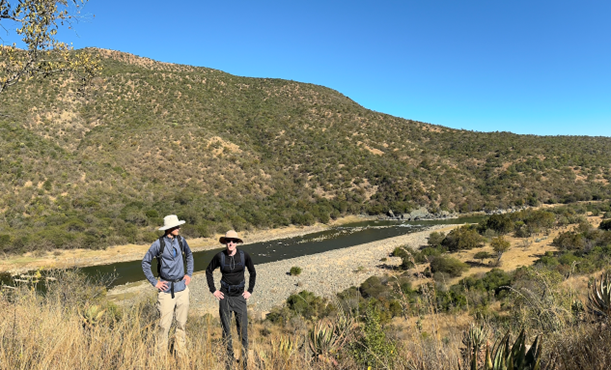
Most of my time was spent in the province of Mpumalanga, where I worked with postdoctoral researcher Shalene Manzi. Our project was to map the contact between the Bushveld Complex and the Transvaal Supergroup. Days began early, usually around seven, when the sun was rising over cold valleys. Nights often dropped to zero degrees and with uninsulated houses and one layered windows, the mornings were chilly, so we often started the day wrapped in several layers. As the sun rose higher, the air warmed to a pleasant 15–22° C, making the field conditions ideal. From there, the workday was straightforward but intense. Armed with a hammer, compass and tablet, we moved through ridges and valleys, describing quartzites and layered igneous rocks and documenting structures in FieldMove. It was a mix of hiking, observing, and thinking, always with an eye on how the details fit into the larger story of the Bushveld Complex. Evenings were spent cooking, downloading and sorting data, and preparing the plan for the next day. The rhythm was clear: physical work under the sun during the day, mental work over maps and notes at night. It was demanding, but the kind of demanding that makes you grow.
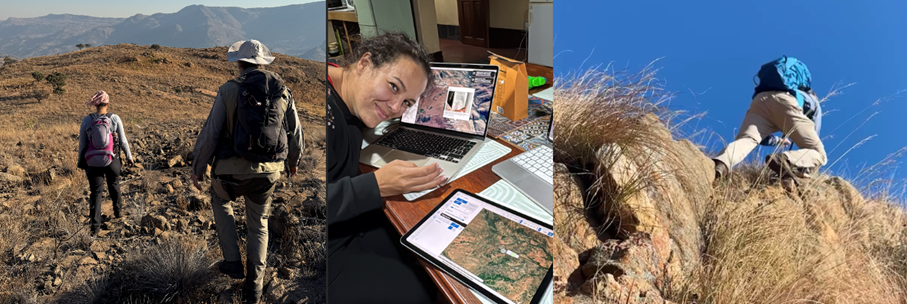
Several times Professors Jérémie Lehmann and Rais Latypov joined us in the field. Their expertise turned each outcrop into a small lecture in igneous geology. A thin seam of chromitite or a shift in layering could suddenly lead to a long discussion about magmatic processes and regional geology. I quickly realized how much I could learn simply by observing together with people who had studied the Bushveld Complex for years. Their questions challenged me to think bigger and connect local observations to continental-scale processes.
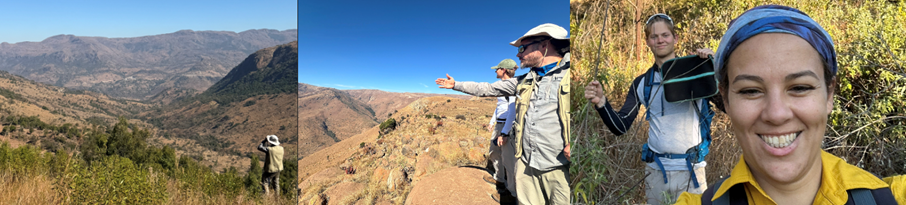
Not all days went as planned, though. In Norway, especially in Bergen, we pride ourselves on being “rainproof”. Fieldwork continues regardless of weather. In South Africa it was the opposite. If it rained, the day was cancelled. At first, I laughed at this, surely people could still go out! But I quickly understood that it is enough sunny days to skip the rainy ones. The terrain, the roads, and the local habits all played a role. It was one of those small cultural differences that stays with you because it reminds you that even in science, context matters. When I was not in the field, I worked at the Department of Geology in Johannesburg. There I compiled our field data into structural and lithological maps using GIS. This gave me the satisfaction of seeing the full cycle: from describing a contact in the field to visualizing it as a clean line on a digital map. I had worked with digital tools before, but this time I understood better how dependent they are on systematic, precise work in the field.
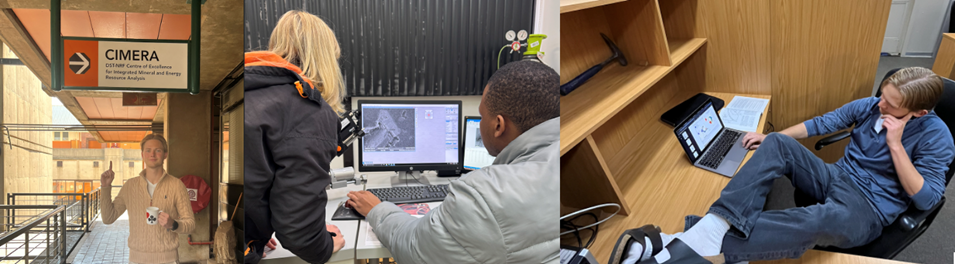
An important dimension of the internship was the people I met. Already in the first weeks I established contact with the University of the Witwatersrand (Wits), which meant I was fortunate to have a foot in both UJ and Wits. Being included in two academic communities at the same time was unique. It gave me access to different perspectives, skilled researchers, and valuable discussions. I left Johannesburg with a network that I hope to keep and develop in the future. These are contacts I want to follow, collaborate with, and learn from as I move forward in my career. Having this dual affiliation strengthened me both professionally and personally.
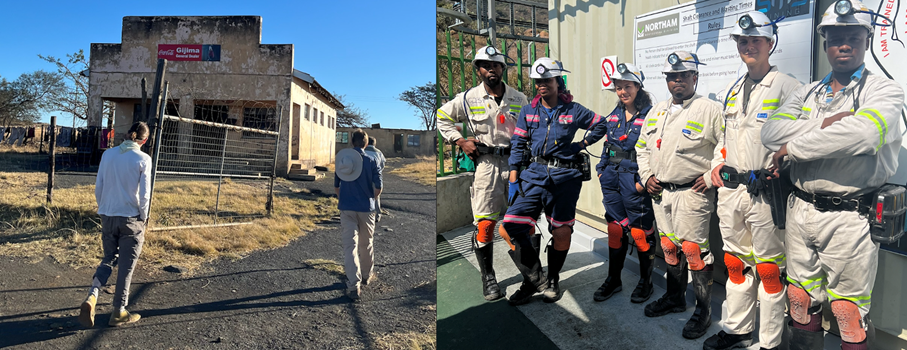
Life outside work also left a strong impression. South Africa is full of contrasts, and I encountered them daily. Nights in Mpumalanga were cold, mornings often harsh in uninsulated houses, while the days were warm and comfortable. Electricity and water were not always stable, and power cuts could come without warning. Showers were unpredictable, either ice cold or scalding hot. At first these were small frustrations, but they quickly became part of everyday life. By the end, they were experiences I looked back on with a smile, and they made the return to a stable Norwegian shower a small luxury.
In Johannesburg, safety was always something to be aware of. I learned simple rules: never walk in certain streets, take an Uber after dark, and avoid showing valuables. At the same time, I never felt unsafe as long as I followed advice. What stood out most was how open and generous people were. I was invited into private homes, shown around by colleagues and students, and always met with warmth. The generosity of the people I met contrasted with the visible inequalities in the city, and it made me reflect on how much resilience and community matter in daily life. During my stay I also had the chance to experience more of South Africa. Early on I joined UJ students in KwaZulu-Natal for a field course, where their more analogue mapping style gave me new appreciation for basic geological methods. I spent a weekend in Pilanesberg Game Reserve, where I stayed in a lodge and went on safari to see the Big Five, a once-in-a-lifetime experience. I also travelled to Cape Town, which many locals described as the best city in the world. Between Table Mountain, the ocean and the lively streets, it was easy to understand their pride in the city.
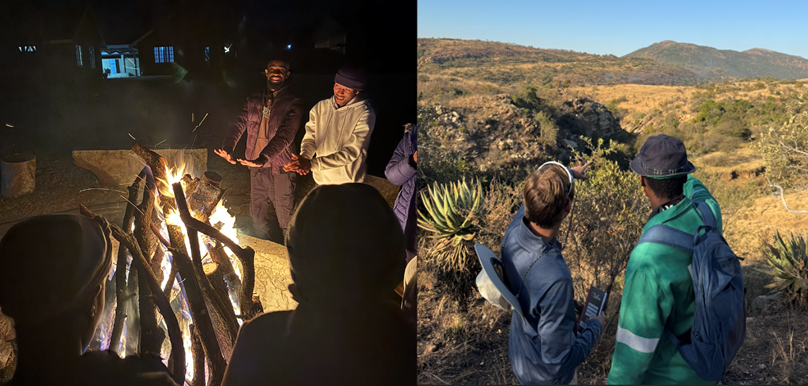
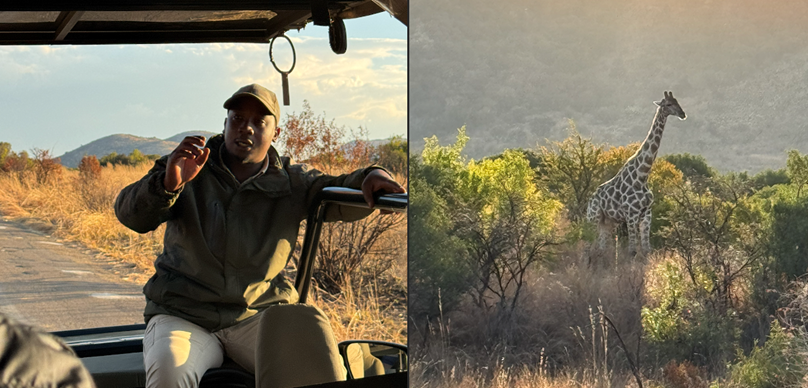
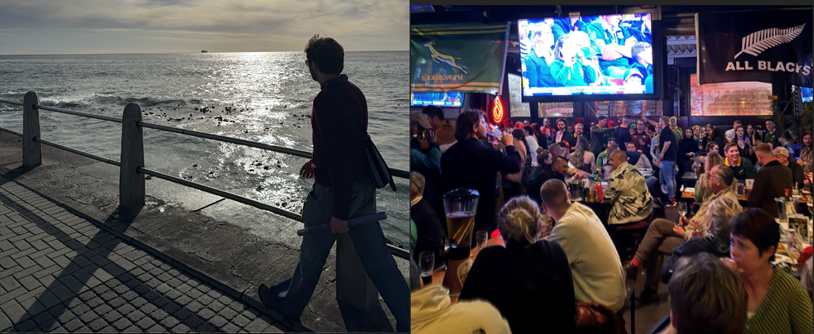
The experience that made the deepest impression, however, was visiting the township of Orange Farm. There I saw informal housing, limited resources, and unemployment that shaped daily life in ways I had never seen before. At the same time, we were welcomed with warmth, openness, and honesty. People shared food, stories and music with us, but also spoke frankly about the realities of living there. It was a humbling experience that gave me perspective on inequality, resilience, and the importance of community. Orange Farm was not just a visit, it was a lesson I will carry with me.
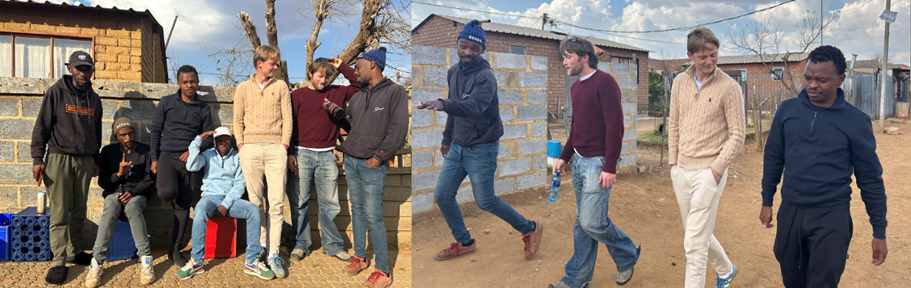
Looking back, I see the internship as a whole. Professionally, I strengthened my skills in structural mapping, lithological description and digital processing. I learned to connect small-scale features to regional geological processes and gained valuable insight into igneous geology. Personally, I became more adaptable and aware of how science, culture and daily life are intertwined. Most importantly, I built a professional network at both UJ and Wits University that I hope will remain part of my career fro many years.
The internship gave me more than I could have expected. It combined geology at the highest level with cultural experiences and human encounters that broadened my horizons. I returned home more confident in my skills, more reflective in my outlook, and more motivated to continue my path as a geoscientist.