
Sammendrag
Benjamin Oliver Davis shares his experiences from a two-month internship at the University of Johannesburg, South Africa.
My name is Benjamin and in early May I was lucky enough to be selected for a Geointerninternational program that would send me to Johannesburg, South Africa. The program was set to last for two whole months, and now at the tail end of the project, I would like to reflect on some of the insights and things I have learned the past eight weeks.
My project was supposed to encompass a field study of some greenstone belts in either the Limpopo or KwaZulu-Natal regions. I was incredibly excited to get started with the internship, as I had never interacted with rocks close to the ages of these greenstones, and never had a project to lead on my own. Unluckily the project didn’t go quite to plan, as my professor, Axel Hofman, did not realize I was arriving in June when he proposed the project and he would be teaching the entirety of my stay, and would not be able to guide me through the internship. . The project took another form, and instead I shadowed Axel for a field trip of his and would collect some of my own samples to prepare and analyse for myself.
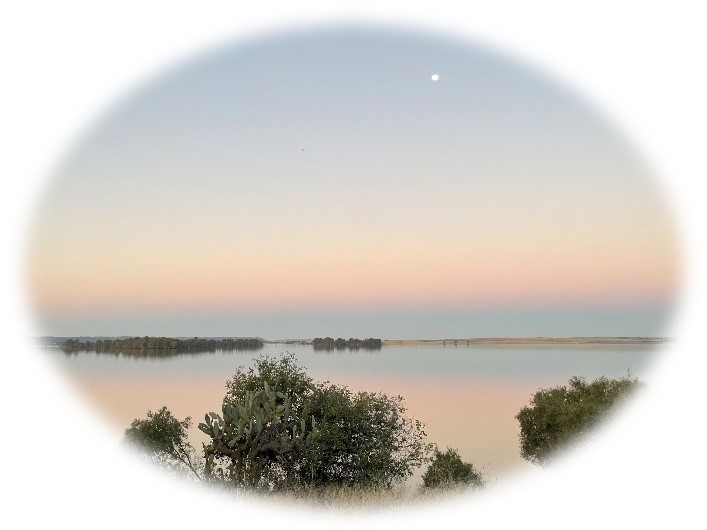
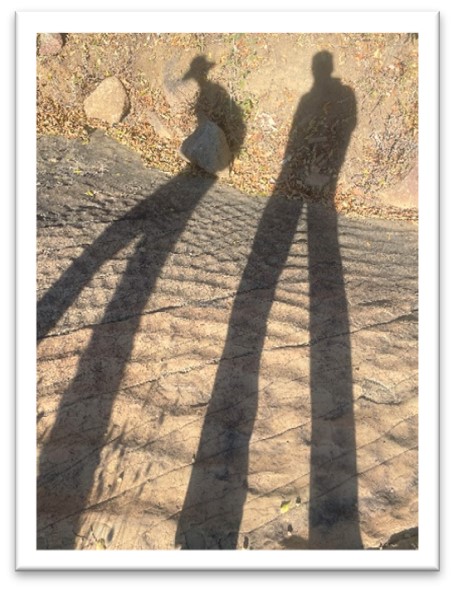
When me and the two other interns arrived in Johannesburg in late June, we were greeted by Professor Jeremie Lehmann at the airport and driven to our accommodation. The actual internship began when we joined a weeklong field trip with the third-year students of the Department of Geology of the University of Johannesburg (UJ), on mapping course in KwaZulu-Natal. The area exposes Archaean volcano-sedimentary successions along the Buffalo River. We joined different groups each day and where lucky enough to see glacially deposited diamictite, more than 300 million years old, some of the earliest stromatolites in the geological record, and beautiful spinifex textures in komatiites. We were also exposed to a different teaching philosophy; at UJ the professors would let the students out in the field with a lot less guidance than what we were used to back home in Bergen.
This opened the possibility for students to learn by their own initiative, gaining experience through doing the mapping project on their own, which was cool to see. During this field trip I was given a couple of individual tasks, mapping the sedimentary rocks within the greenstone belt and getting some samples for later analysis in the lab, to see the chemistry of the layering and hopefully extract some zircon for dating.
After the weeklong field trip with the students, I joined Axels own field trip. He had invited along a professor from the University of the Western Cape and two post-docs from Germany and Russia. We would travel to Kimberley to look at different kimberlite pipes and abandoned mine dumps and saw some incredible banded iron formations. We travelled in the local area, jumping over fences to see some localities, and sometimes had to deal with angry farmers that thought we were secretly mining on their property. The whole experience taught me about different aspects of how to behave in the field, how to prepare before going out in the field and to investigate the localities with a purpose, without excluding other theories about the rock one is investigating.
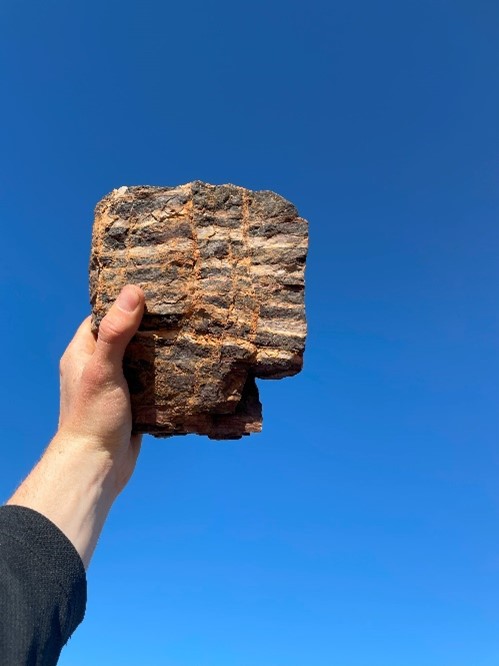
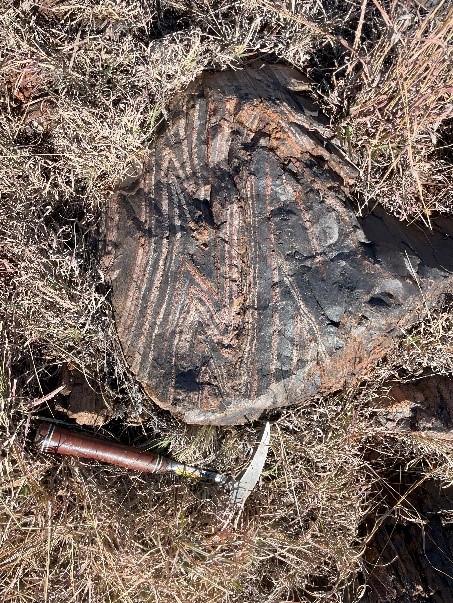
This fieldtrip also taught me how little I know about petrology, and how crucial it is in the field. It was quite difficult for me to keep up with the other professors, as they could identify a rock in seconds, which would’ve taken me a lot of time and effort to figure out. Fortunately for me, Axel and his crew were more than willing to impart knowledge about the rocks at hand, and to guide me through their methods of thinking when engaging with a rock. One of the professors was a metamorphic petrologist, so this kind of work was right up her alley, and she is still sending me messages about how she can help me with any future work I may have, so I feel lucky to have been able to spend a week with such knowledgeable people
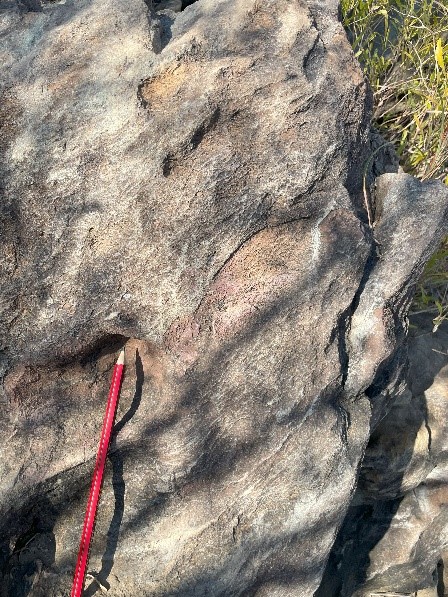
After these weeks of field work, the work continued back at the university. Samples that had been collected needed preparation for the different analytical instruments they would have to go through, and it was my job to get them ready. This required cutting the samples in slabs for the micro-XRF scanner, crushing parts of the rock into sand for zircon-dating and other parts into fine powder for geochemical analysis. I experienced first-hand the practical teaching methods of UJ, as I was left to my own devices to cut and crush rocks with machines I had never used, let alone seen before. Luckily, Shadrak, the chief of sample preparation at the university, gave me a quick introduction and I was off smashing rocks. This kind of on hands-on experience felt valuable and I would never have been given access to these kinds of equipment in Norway. Unfortunately, the machines were somewhat old, and prone to breaking down, so the preparation took longer than expected. When everything was prepared, there were not many weeks left.
In the meantime, as I was waiting for equipment to get back online Axel let me join the field trips that he was teaching for the third-year students. I had already met most of these people at the field course in the very beginning of our trip, so I was happy to join them for a few more trips around the Johannesburg area. They left for the field every Wednesday, to check out a new group of rocks that had been deposited in the part of the geological timescale that they covered in the lecture the previous Monday. This created a practical understanding of the timescale and the rocks that were deposited. It was interesting to see how much of geological history is represented in South Africa — they have some of the oldest rocks in the world, and continuous record of rocks that spans for billion of years. It really is a dream destination for a geologist, there is so much history in this part of the world, that I never would have seen without the internship.
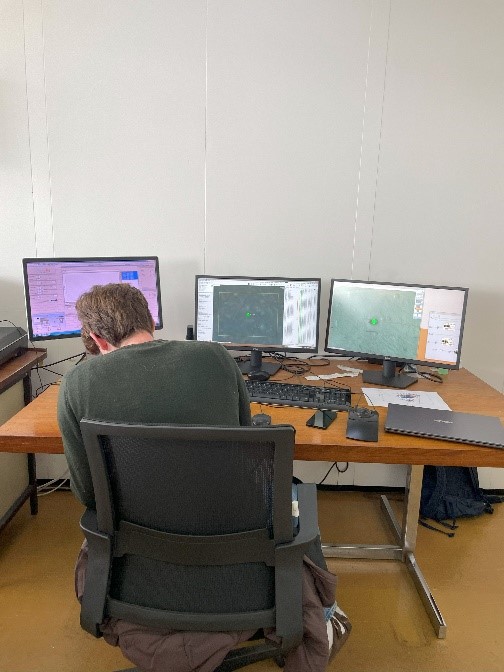
When the samples were ready for analysis, Axel took me to his home for zircon-panning. This method would help separate the heavy and light minerals, removing most of the light from the rest of the sample. The water was cold in the early hours of the morning, and my fingers were quite numb, but I got the samples ready for picking, going through the whole sample picking individual zircons from the rest of the grains. This was a time-consuming process, that I could not finish in time, but I was walked through the rest of the zircon dating process, which included mounting the crystals in resin, taking close-up pictures of the crystals and determining were to shoot the laser to get the best possible data.
I also used the slabs I had cut earlier for element mapping using a micro-XRF spectrometer. This machine would provide an incredibly detailed map of the different elements found in the sample, providing information about how much of each element was present, and exactly where it was present. After the spectrometer had run through all the samples, we were left with amazing pictures containing valuable information about the different layers of the sample, which were to be interpreted later.
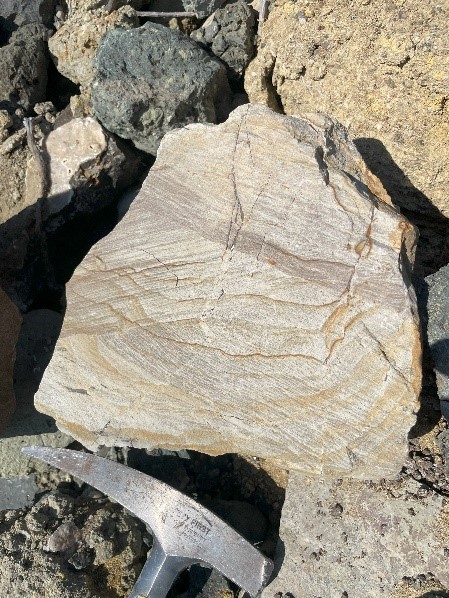
Part of the program was also to learn about the country you visit, and South Africa has a rich history outside of geology. It has been enriching speaking to people about challenges faced in day-to-day life, as well as a complicated history with segregation and Apartheid. The barriers that separated people during this dark part of history, are still visible today through social and economic lines that are difficult to cross. A visit to Cape Town also showed us the stark contrasts about how people live, the absurd riches right next to people that have absolutely nothing. This was an uncomfortable sight to behold, but also necessary for a better understanding of South Africa and its complex history. Even though I did not get to complete a full project, my time in Johannesburg has provided me with exceptional experience about field work, sample preparation and analysis, well beyond what had expected. I would like to extend my thanks to Professor Axel Hofman for taking me under his wing these past two months, as well as Anfisa Skoblenko, Kseniya Erofeeva, Juergen Reinhardt, Kwame Fynn, and Robin McRoberts for their guidance and help during my internship.