Sammendrag
Léa Cornette from Université de Montréal in Québec shares her experiences from her internship at Natural History Museum in Oslo.

My name is Léa and I’m a master’s student in geography at Université de Montréal in Québec. Over what felt like two very short months, I had the privilege of being part of the GEco group (Geo-Ecology Research Group) at the Natural History Museum (NHM) in Oslo. Professor Anders Bryn, a plant ecology enthusiast, took me under his wing and gave me the opportunity and liberty to carve a new project based on our common interests. As a thoughtful advisor, he also emphasized the importance of experiencing Norway outside the work environment, for which I am truly grateful.
As part of my master’s research, I’m studying the impacts of wildfires on the western Canadian Arctic tundra landscape. When discussing possible internship directions, we realized that Anders had recently developed an interest in wildfires as well, after noticing what appeared to be firescars in aerial photos from certain regions of Norway. This shared curiosity naturally evolved into this internship project with the goal of exploring the phenomenon of wildfires in lichen-dominated mountain areas of southeastern Norway. The key word here is “exploring”, for two reasons:
1) to date, literature on this subject is scarce or even non-existent, which means we had to start from scratch, and 2) there is a limit to what can be accomplished in only two months, but we aimed for the stars anyway. From there, I started by locating potential firescars – brown spots on lichen patches – using remote sensing in the Femunden region. Once they were found, the challenge was to identify the reason for their presence: were they caused by fires or by people harvesting lichen, or “måsså”, to feed livestock back in the days? To answer this question, the next step was to go on the field. I planned to visit 14 sites where random 1 x 1 m plots, both inside and outside the disturbed areas, would be selected to compare the vegetation cover and the lichen height. Another objective was to document any evidence of fire or lichen harvesting, and finally, to collect soil samples for charcoal analysis. Together, these methods aimed to clarify the cause of this phenomenon and provide a preliminary understanding of its impact on vegetation.

Bruno, another internship student from the GeoInternInternational project, became my passenger princess for a 10-day field trip. With the support of our supervisors, we divided our time between the actual fieldwork and exploring some of the must-see places of Norway. For the field part of the trip, storm Amy, apparently one of the hardest to hit the country in the past 25 years, forced us to reconsider our itinerary and adjust our plans – which is, after all, the essence of fieldwork. As a result, we visited a grand total of 10 sites out of the 14 scouted locations. Despite the weather, the snow left behind by the storm, and sleeping bags that weren’t quite warm enough, we still had a wonderful time and accomplished everything we set out to do. Every day began the same way: packing up our (wet) camping gear while drinking mint tea with Biscoff cookies. Then we would head to the next destination listening to a mix of Norwegian music (shoutout SYMRE) and Québec news, prepare our field equipment, hike to the sites, and start to work. Our questionable food choices (hot dog sausages, ramen soups, cheese, and chocolate) did nothing to diminish our appreciation of the grand scenery – the different landscapes were breathtaking! We had both seen Arctic tundra landscapes before, but discovering a similar environment on top of mountains was truly special.

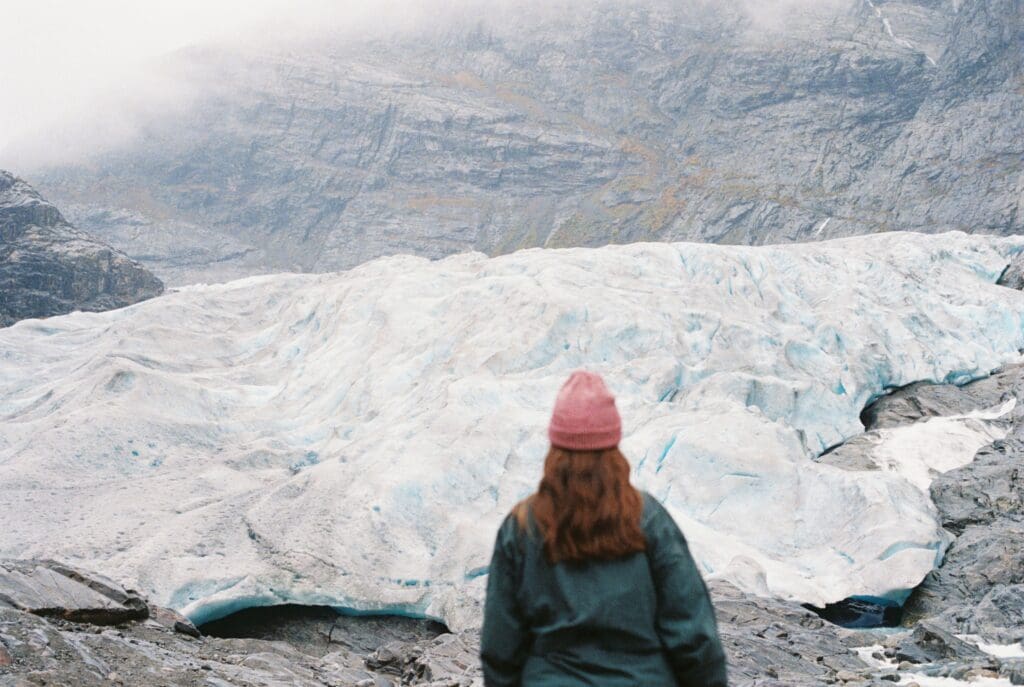
As for the must-sees, we spent (not enough) time in the mining town of Røros, visited Lom’s Stave Church, slept in the most charming traditional Norwegian farm with turf roof, and ventured near the magnificent Nigardsbreen glacier where we met an elderly French couple who reminded us not to wait until it’s too late to start enjoying life – thank you Danielle and Patrice. We continued our journey along Aurlandsfjord, Nærøyfjord and Lustrafjord, each one more beautiful than the last, to the surreal Vøringsfossen waterfall (note here that Bruno had the courage to cross the stairs, unlike me) and finished our trip to Rjukan where we were eager to learn more about the heavy water war. Finally, it was only at the end that we realized, to our great delight, that we had spent most of our time driving on some of Norway’s most popular scenic routes.


When we got back, I released Bruno from his duties, and it was time for me to work on the data we’ve collected. Between the lab work, the data analysis, the project summary, and the seminars, I didn’t have time to get bored. I divided my days between my office at the NHM and Grünerløkka’s cafés, and my nights wandering around the city: sauna, museums, music festivals, markets, parks, restaurants, volleyball – to name a few. After all these efforts (but also a lot of enjoyable moments, don’t worry), the conclusion of this project and the moment you’ve been waiting for: we were able to confirm that not only all sites visited were indeed firescars, but also that there is a significant difference in vegetation cover and lichen height between disturbed and undisturbed sites, exposing a very slow recovery. We were all pretty excited about this finding and are already thinking about the next steps.

Overall, this internship was a life experience, and I am forever grateful for it. The work environment in the GEco group was truly supportive and inclusive – I felt welcomed and comfortable from the start. But what struck me most was the work-life balance and the importance they attach to it, which I sincerely admire. Tusen Takk to all the people that made this internship possible (Anders, Oliver, Helge, Frans-Jan) and to everyone who crossed my path at one point or another (Ingrid, Adam, Peter, Daniel and all the cats).