Category: Central Barents Sea 20.2

  • We discovered new methane pingos in the Barents Sea

    We discovered new methane pingos in the Barents Sea

    Text: Pavel Serov, CAGE.

    We were not supposed to find gas hydrates (flammable ice-like crystals consisting of methane and water) in this CAGE cruise as the expedition objectives were slightly off gas hydrate topics. After 10-days, the long, all-consuming hunt for methane seeps and meltwater channels on the seafloor brought us to the very center of the Barents Sea.

    Many factors have to coincide to form a shallow gas hydrate accumulation: the water depth should be large enough, the temperature should be low enough, there should be a strong supply of methane gas, and some soft sediments should be available to accommodate hydrate. It clicks when you realize that a point you are looking at on the map has it all. It certainly clicked that day when we found a group of seafloor mounds bursting gigantic flares of methane bubbles (figure) rising through the thick and cold layer of seawater. Hydrates.

    Scanning the seafloor relief and overlying water gives us an idea about where methane gas is leaking from. That is where hydrates are likely to be found. Figure: Pavel Serov

    Some hours later we found ourselves preparing a 1000 kg metal pipe (a gravity corer), which we hoped would pierce the methane-bursting mound and reveal its content. The first attempt did not bring us any touchable evidence for burning ice, but plenty of smell. A strong smell of rotten eggs, terribly unpleasant, but very useful indicator of methane on the seafloor. It was worth trying again. The second gravity corer was certainly not empty. Hydrates and bubbling degassing sediments were sticking out from the pipe. That’s what we hoped for!
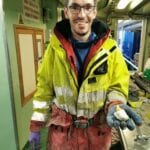
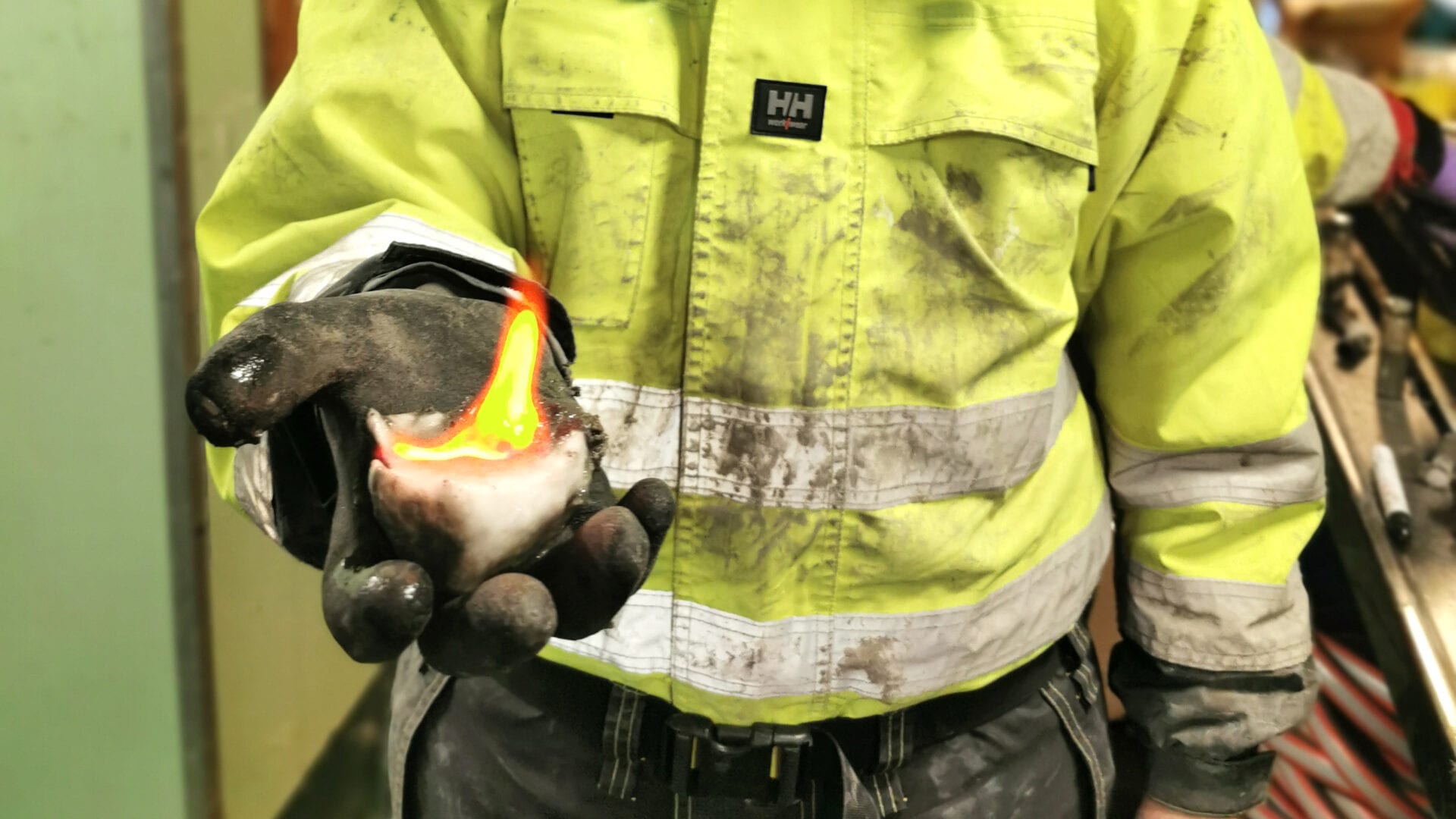
    It took minutes to seal the first gas sample and find a firecracker. One should prove that these white crystals are burning ice, and there is no better test than setting them on fire. After plenty of successful tests, it was time to retrieve the rest of the core from the protective plastic liner.
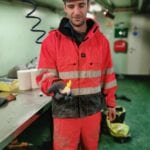
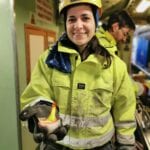
     

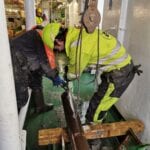
    With the help of the Helmer Hanssen crew and a disk saw (totally safe) the rest of the bubbling mud and layers of beautiful white hydrate became available for public view.

    Splitting the core linear. Normally it is done in the laboratory and using a special core splitter. Here we had to improvise. A disk saw came in handy. Photos by Henry Patton (CAGE).

    Sampling hydrates is good fun – they burn, they make bubbles, they melt, they fizz, they blow up glass bottles if you seal a piece in it. But feeling that your predictions of where to find them were right is even better

    Back in 2015, we proved for the first time gas hydrates in similar gas hydrate mounds (we call them pingos) in the western Barents Sea. It feels great to be a part of the team discovering another gas hydrate pingo field 5 years later. It means we have learned something about these methane-bursting beasts, we understand them better now. And we know how to find them.. – these were my last thoughts before falling asleep after a long shift on the hydrate day of the cruise.

    A layer of hydrate in bubbling sediments. Photo: Henry Patton


  • Coring under the Arctic midnight sun

    Coring under the Arctic midnight sun

    Text and photos: Lina Alexandropoulou, CAGE

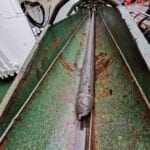
    It’s Monday the 13th of July 2020, 13:54:09. According to the plan, the last core for this cruise has just been collected, processed, and put into cold storage waiting to be analyzed once back onshore. It has been an intense three days. Researchers, engineers, and crew members of R/V Helmer Hanssen joined forces for one main goal: to collect gravity cores. We faced several challenges, for example at one site the 6 m-long, steel barrel used for coring bent, proving that sometimes sediments can be too hard to core. Despite all this, by the end, we managed to acquire 20 gravity cores and recover a total of 52 meters of glacigenic and glaciofluvial sediments.

    The liner, filled with sediments, is out of the barrel and the team is ready to process the gravity core. Photo by Lina Alexandropoulou

    These sediment cores will form the basis for the GlaciBar research project led by Mariana Esteves, a researcher at CAGE, UiT. The main objective of this project is to characterize and constrain the timing of glacial retreat of the last Barents Sea Ice Sheet through Sentralbankrenna. This major trough hosted a fast-flowing and marine-terminating ice stream that shared many similarities with glaciers found in Antarctica today.

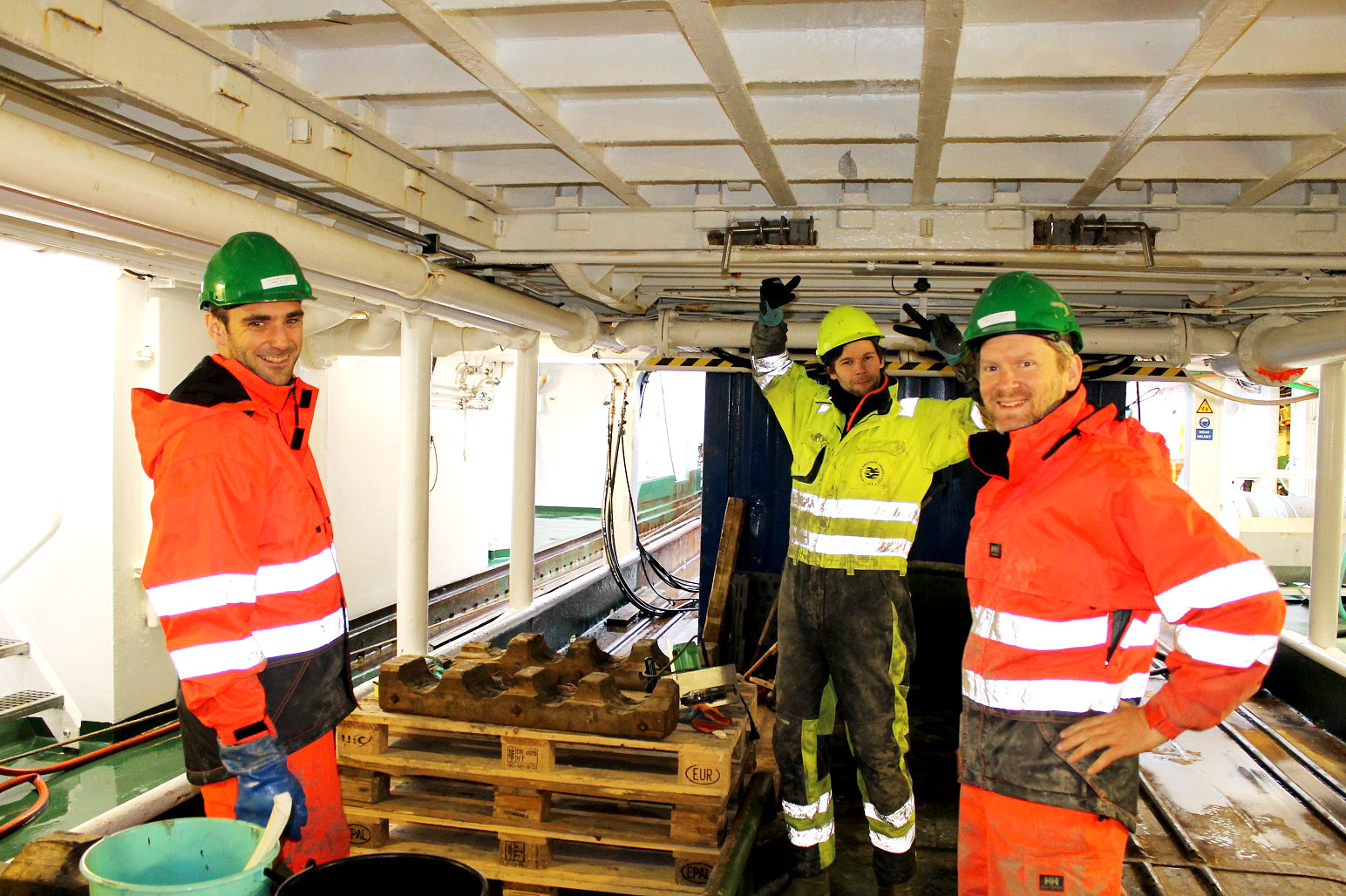
    When there is teamwork, great things can happen. In our case, 20 gravity cores and 52 m of sediment recovery. Photo by Lina Alexandropoulou

    Working on the deck is always fun especially when the weather is nice, like in our case, allowing us to enjoy the Arctic summer and the midnight sun (even though it prefers to hide behind the clouds). But wait, the research cruise hasn’t finished yet. Now it’s time to go back to the instrument room where new scientific surprises are waiting for us

  • Into the blue

    Into the blue

    Text and photos: Henry Patton, chief scientist

    Even by generous estimates, around 80% of the world’s oceans have not been surveyed – the surface of Mars is better mapped than our own planet. This fact rings true in the Barents Sea as well, where there are still vast areas where we don’t really know what the seafloor looks like. Imaging and reconstructing the landform imprint left behind by the last ice sheet is therefore much like trying to complete a vast unfinished jigsaw puzzle, where there are still more pieces left in the box than on the table.

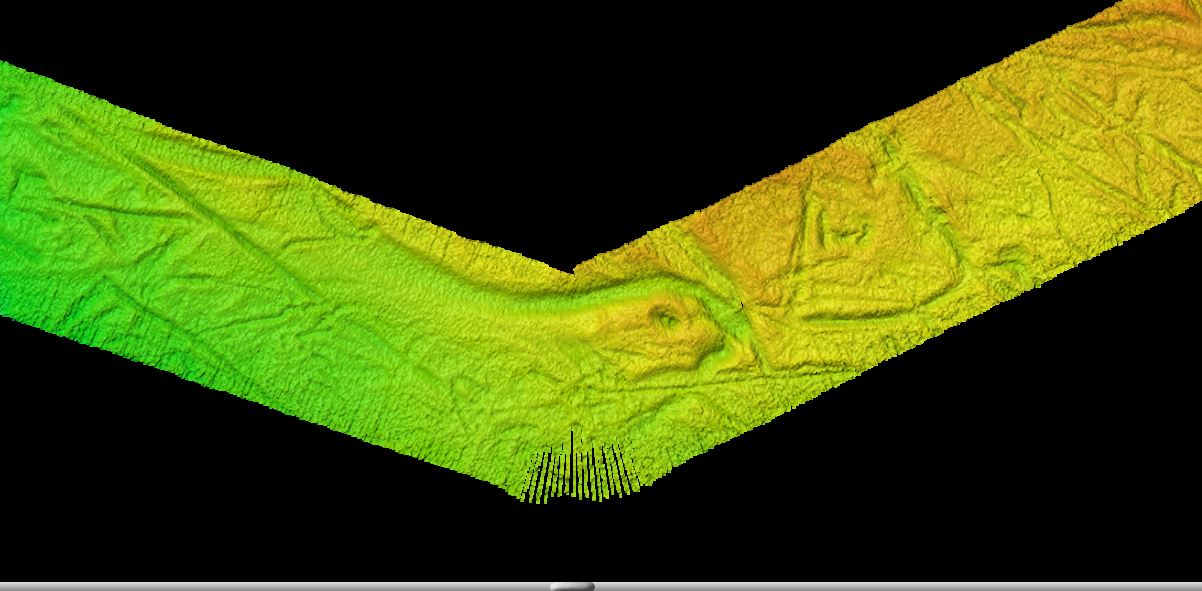
    Here is one such jigsaw piece we found and surveyed this week. This impressive channel feature carried vast quantities of water beneath the ice sheet, which perhaps came via vertical pipes that captured meltwater from the ice-sheet surface above. Like in river systems that you see onshore, there are similar morphologies in these subglacial features too, including channel braiding and the occasionally connected lake basin.

    Knowing these features exist and that water was abundant gives us clues into what conditions were like at the base of the ice sheet, and into the processes of how the ice sheet eventually collapsed.

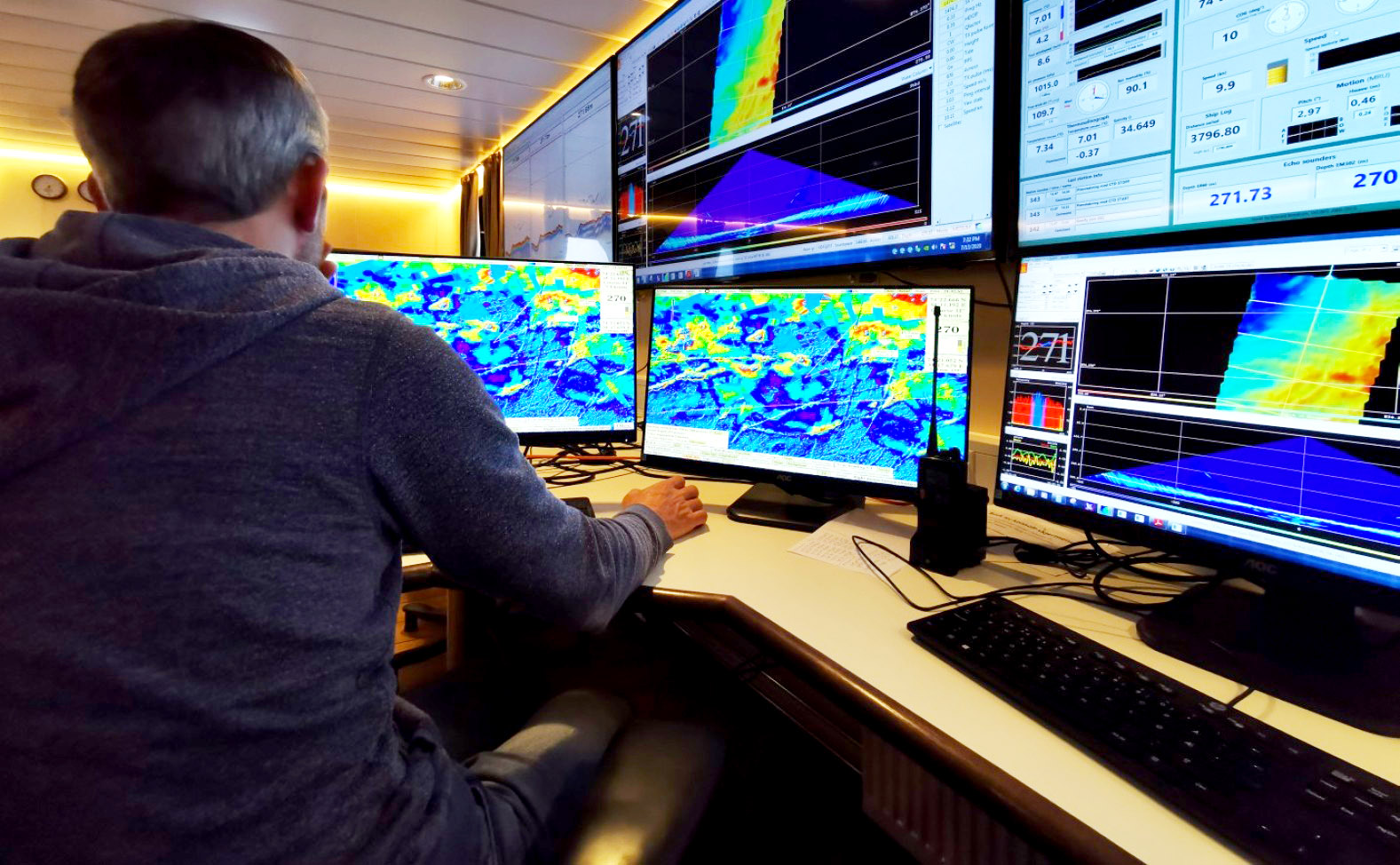
    Surveying the seafloor is a frustratingly slow process – to get images of sufficient quality we are sailing at less than 20 km per hour. However, the live data feed that comes in makes great ‘slow TV’ for geoscientists! From the warmth of the instrument room, it’s possible to be captivated for hours, watching as the glacial landforms slowly reveal themselves and never knowing what to expect next. Of course, there are many teasing features that we see along the way that would be great to visit, but time is limited and we must be patient and come back another year to add more pieces to the puzzle.

  • Birds will be birds

    Birds will be birds

    Text and photos: Frances Cooke, phd CAGE.

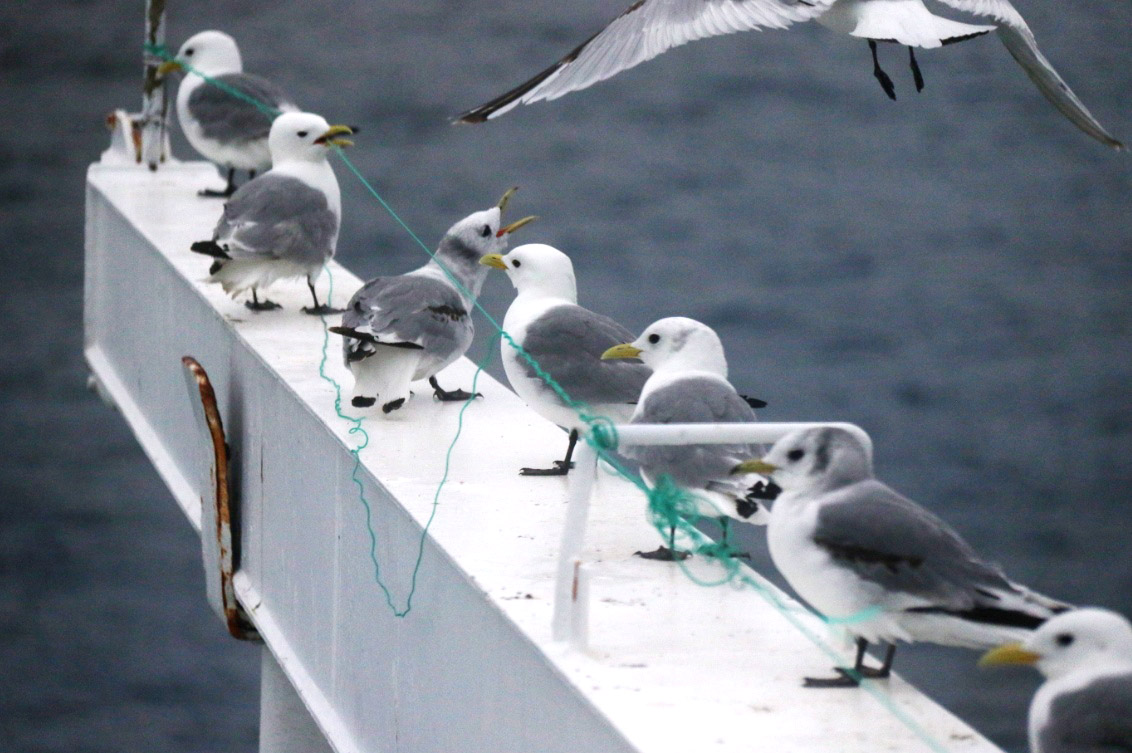
    I arrived in Tromsø in 2019 at the end of spring. It is this time of year that Tromsø’s inhabitants start preparing the exterior of their houses for the summer. This may include dust blowing, snow spreading, and for many putting up kite bird repellers to deter the seagulls. Currently out in the Barents Sea on the Helmer Hanssen there is no deterring the birds. Stein, one of the ship’s deckhands has designed his own bird deterrent.

    It has since been referred to as the bird scratcher, as a bird (pictured) has finely demonstrated. With the intent to scare the birds away, Stein’s bird deterrent became a favorite spot for the birds to rest. He is now working on an improved model.

    I haven’t always been a bird enthusiast. My fascination began when I started to work on ships in 2010. You develop a certain respect for them being out in the open ocean, forgetting that this is their natural environment and that they are, of course, adapted to these conditions.

    Early on in my career, I was working on a ship in the North sea. One morning I walked into the instrument room to find a pigeon standing there. It seemed quite happy so I let it be. It was no ordinary pigeon, it was well looked after – a homing or racing pigeon. I hadn’t expected a bird like that to come out to sea, I thought they found their way following roads or landmarks. I decided to keep an eye on it over the course of the day. I took a break and went to check on the new crew member, only to be told that it had just been caught and taken to the galley by the Indonesian cook. I asked what he might be doing with a bird in the galley, not thinking that someone would actually consider eating this pigeon. I ran to the galley. “What are you doing with the pigeon!” – “I’m going to cook it” he said. “..But you can’t do that, it belongs to someone!” I was relieved to find that the pigeon was alive and well. It was handed to me. The poor thing was so trusting, had no idea that some humans, knew nothing of its importance!

    Some years later I decided to place myself in a warmer part of the world – in Australia. I was on a ship with one of Tasmania’s highly regarded and most passionate marine ornithologists – affectionately known as ‘Bird Man’. He had dedicated his whole life to protecting birds and cared for them as much as one would their own children. I learned from him how to identify birds from their motion in flight. Some would flutter, almost butterfly-like and others would take advantage of the lift from the waves and tilt repeatedly from one side to the next dipping their wings right down to the water’s edge, with tremendous precision. Others would soar high above, like a kite, namely, the Frigatebird. To Bird Man’s dismay, I developed a distaste for this bird. The Frigatebird, also known as the ‘Pirate of the Sea’ is kleptoparasitic. Yes, you guessed correctly, it chooses prey that have recently fed, latches onto them, making them regurgitate their food, and then eats that regurgitated food. This is how they feed. It quickly adopted a new name that was banned from use on Bird Man’s watch – ‘The Frigging Frigate’.

    No penguins here. But are we seeing fish or flares?

    It was on a voyage to the remote sub-Antarctic Heard and McDonald Islands in 2016 that inspired my move to the Arctic – to CAGE, and not because of the penguins (..!) but they were an impressive part of the scenery. We were not there to study penguin colonies but to hunt for gas flares seeping from the seafloor. A notable difference in data collection here in the Arctic is the absence of water column disturbance from penguins streamlining through the path of the multibeam echosounder. There is a very high flaring activity in the Barents Sea and we are here monitoring that activity. There are many clues in the data that corroborate flare presence, for example, pockmarks or circular depressions found on the seafloor that are collapse features. There are fish that are known to make homes in these shallow craters. You may often hear, “Are we seeing fish or flares?” and where there are fish there will always be birds!

  • Into the heart of an ancient ice sheet

    Into the heart of an ancient ice sheet

    Text: Henry Patton, chief scientist.

    During the last ice age a vast, 3-km thick ice sheet covered much of Fennoscandia and the Barents Sea. Yet, around 15,000 years ago, its marine-based sectors collapsed catastrophically within a matter of centuries. One of the primary objectives for our team of 5 scientists and 2 engineers over the next two weeks will be to sail into the central Barents Sea to unlock some of the secrets behind how and why this ancient ice mass rapidly disintegrated.

    We left Tromsø on July 8th on-board the research vessel Helmer Hanssen, leaving behind the calm waters and sunny vistas of Lyngen and northern Troms. Our first study area is ‘Sentralbanken’, an area that lay at the centre of this Barents Sea ice sheet and where some of its last icy remnants persisted. The transit there is a long one, taking over a day to sail. However, this is not wasted time and there is always plenty to do in preparation, including making sure all the geophysical equipment is working, setting up the instrument room for processing incoming data, and refining our research plans. So far no hitches!

    Leaving Arnøya behind. Heading for The Barents Sea, Photo: Henry Patton

    Our route north has also been strategic, taking the opportunity to investigate potential areas of methane seepage from the seafloor, for example, where this ice sheet has eroded the constraining cap rocks; so far our predictions have proved very fruitful, with many newly discovered flaring locations.

    Preliminary data show methane flares where gas is escaping from the seafloor into the ocean.
    Preliminary data show methane flares where gas is escaping from the seafloor into the ocean.

    Once we reach Sentralbanken we will begin our plans to survey the glacial fingerprint left behind on the seafloor by the ice sheet, as well as collecting glacial sediments that will help unravel the deglaciation story here, including when the ice retreated and what conditions were like beneath the glacier. We keep our fingers crossed for some calm weather ahead.