Category: EMAN7 22.3

  • Stressed seeps under pressure

    Stressed seeps under pressure

    Text: Bénédicte Ferré

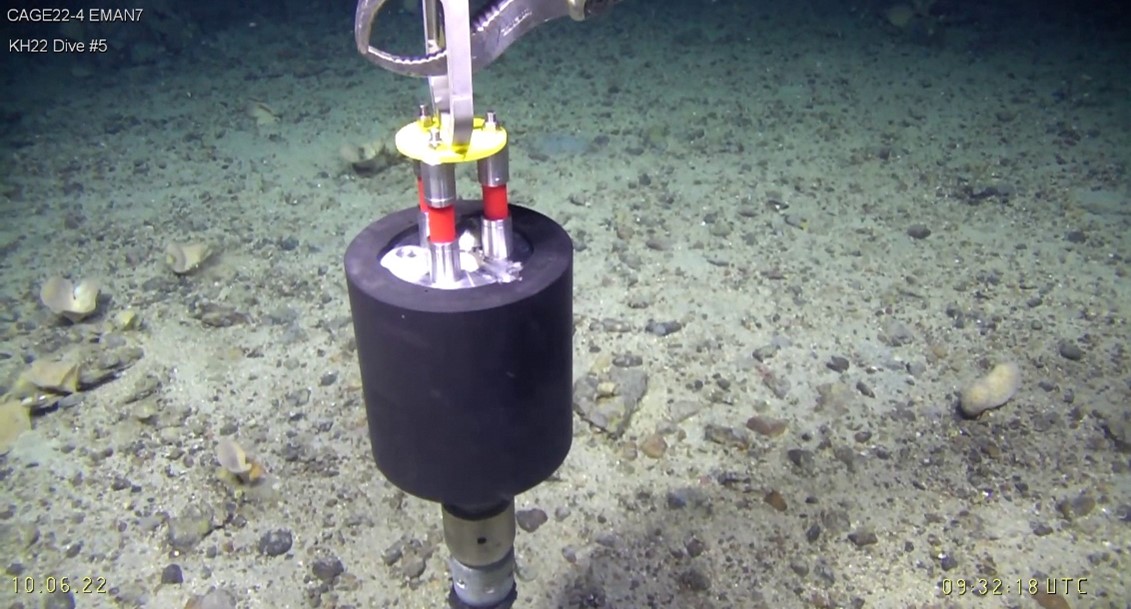
    One of our operations was to deploy two piezometers in order to monitor the pore pressure within the sediment near the seeps, an operation lead by Thibaut Barreyre at UiB. We used a huge 4-tons rig to deploy this thin 3-m long equipment. The operation requires the ROV to detach the weights from the rig that releases the piezometer onto the sediment, and once the rig is lifted back up from the ship, the ROV installs the datalogger that will keep collecting data for 511 days. The data will then be analyzed and used to unravel the subseafloor permeability, to ultimately constrain how much methane is released from the seabed to the overlying ocean.

    And sometimes sciences means improvising, here is how we clean dirty piezometers at a 250m deep site… and it worked!

    Rig used to deploy the piezometers.

    The ROV releases the weights so the standpipe penetrates the sediment.

    The ROV has installed the datalogger on the standpipe.

    This is not rocket science, but it does the job.

  • Cohabitation of methane seeps and coral reef

    Cohabitation of methane seeps and coral reef

    Text: Bénédicte Ferré

    The project EMAN7 (Environmental impact of Methane seepage and sub-seabed characterization at LoVe – Node 7) consists in a consortium between UiT, UiB and IMR. Our main mission is to understand how oceanic parameters and climate change influence methane seepage from the seafloor, and the subsequent impacts on ecosystem health. Node 7, one of the 7 nodes installed in the frame of the project Lofoten-Vesterålen Ocean Observatory (LoVe), is deployed in a seepage area. Only 180m north of these seeps lives a large and healthy cold water coral reef. Why are these coral reefs thriving there despite a possible ocean acidification due to methane emission? What is influencing this release and how does it influence the surrounding sub-seafloor and water column? How long has the methane been leaking there? Where does it go? How much carbon is expelled from the seafloor? We are trying to answer these questions using the long time series collected from the node, and also from data collected during our current cruise.

    We are used to chasing flares during our cruises at CAGE, but this time we also look for corals. These beautiful submarine flowers cover part of the floor at Hola trough, and one of the teams, led by Tina Kutti from IMR, collects them to understand the effect of CH4 seeps on cold water coral reef communities and their capacity for adaptation. Answering this is impossible in lab environment because these are extremely long -lived species that require decades of exposure to reveal their true stress response.

    Cold water coral reef near node 7 in Hola trough.