Tag: Media @en

  • CAGE researcher presents new climate knowledge in Nature

    CAGE researcher presents new climate knowledge in Nature

    Melting glaciers and rising sea levels are certainly not new phenomena. Climate change was dramatic even during the last ice age, says CAGE’s Professor Tine Rasmussen, who recently published an article in the prestigious journal Nature Communications.

    Rasmussen’s article shows that repeated, severe melting of the ice sheet contributed to a very unstable climate even during the Ice Age.

    Read the article here

    Active ice

    Together with Erik Thomsen from Aarhus University in Denmark she has studied sediment cores from the sea off north-western Svalbard. The studies show that the ice sheet shrank and grew again to a much greater extent than assumed during the last ice age.

    Professor Tine Rasmussen.“Our findings show that the ice was incredibly active. In less than 1,000 years it could retreat and grow again”, says Rasmussen (pictured right).

    It is safe to assume that the ice moved several kilometres.

    Important knowledge

    The cold climate during the Ice Age was repeatedly interrupted by short, rapid heating. This knowledge can help us understand what will happen during the global warming we experience today.

    “This information is of great importance, although the consequences of melting ice will be much less dramatic now than during the Ice Age, because there is less ice and temperature changes was much larger back then”, Rasmussen explains.

    Pink clay from Svalbard

    Sediment cores the researchers have investigated contains pink marine sediments. This pink clay can be traced back to 400 million years old red sand stones at Svalbard, and was carried out to sea by melt water from the ice sheet.

    “We can see that the red layers of the ocean floor is formed during the Ice Age’s warm periods, and that proves that every time the temperature rose, water from the melting ice was poured into the ocean”, says Rasmussen.

    “We know from previous studies that in few years the temperatures above Greenland could rise by more than 10 degrees Celsius, and during the Ice Age the ocean’s water level rose and fell several times by as much as 10 to 20 metres”, she says.

    The sediment cores also show that the number of icebergs fell dramatically during these heating periods, and that the ice retreated from the coast.

    This article is also published at Forskning.no (Norwegian version) and ScienceNordic.com.
     

  • CAGE is officially opened

    CAGE is officially opened

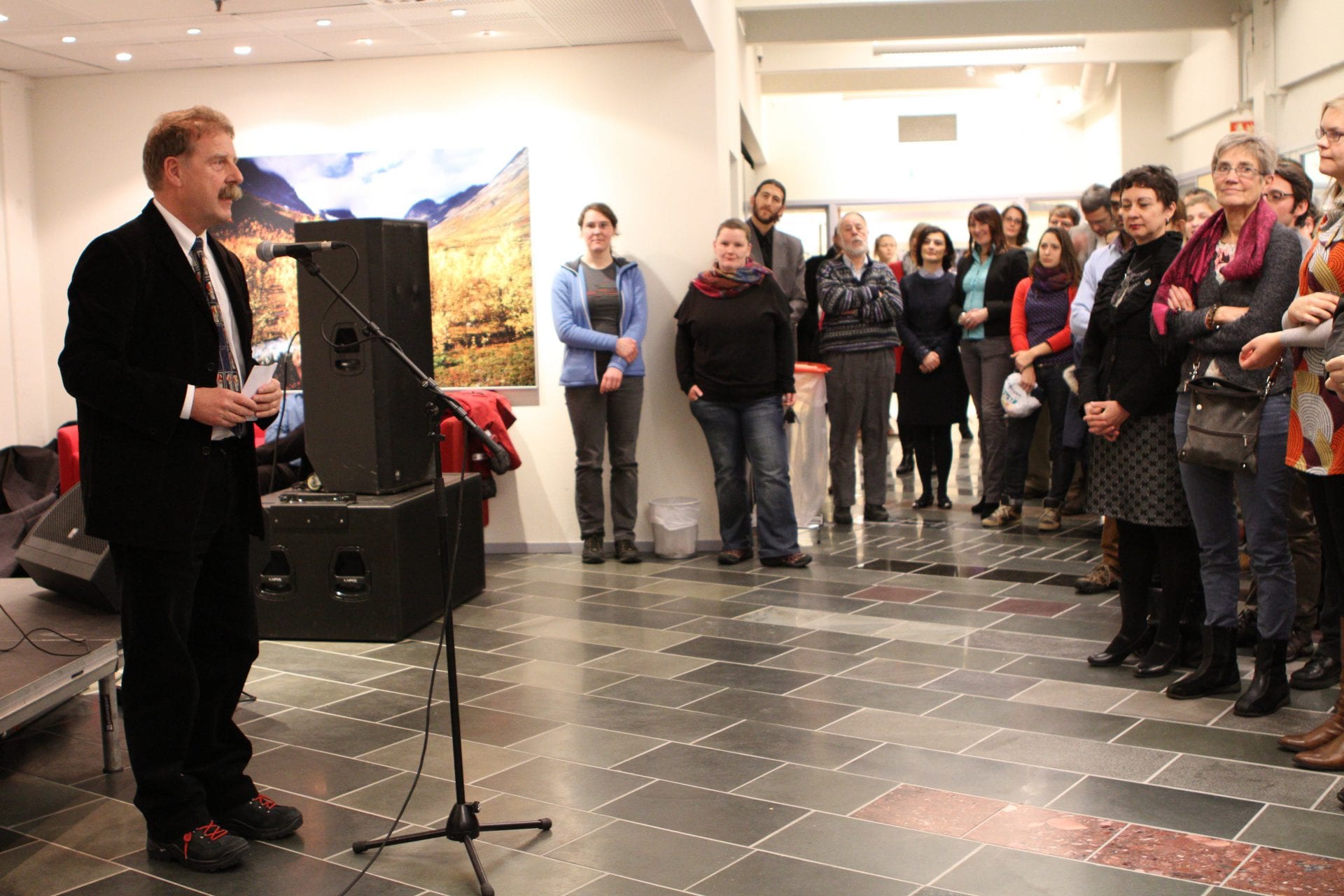
    CAGE was officially opened on Friday November 22.

    The official Norwegian Centre of Excellence plaque was presented to Centre Director Jürgen Mienert from Senior Adviser Liv Furuberg from The Research Council of Norway.

    “The CAGE projects are high quality, exciting and beneficial from a societal perspective. This centre also has an excellent timing and an excellent geographical location”, said Furuberg.

    These are some of the reasons why CAGE was given the Centre of Excellence title, after a long and severe competition where 139 research centres participated.

    – A big day

    Researchers, students, representatives from the industry and others showed up to celebrate CAGE . The director himself described the opening as a great day for UiT The Arctic University of Norway and for Tromsø – the ‘arctic capital’.

    “A Centre of Excellence is now opened, with an extensive budget over ten years and more than 40 employees. CAGE will be a national and international centre of gravity for arctic research”, he said in his speech for the day .

    CAGE is one of thirteen new Norwegian Centres of Excellence (CoE ) opening this year. There are great expectations for how the centre will contribute to climate research.

    “Remember that the world’s leading scientists took 20 years to find out that El Niño in the Pacific Ocean affect the climate system in the northern hemisphere . We have ten years to understand the effect arctic gas hydrates have on the environment and climate in the north. We will use this time to build a world-class international research centre”, said Jürgen Mienert.

    CAGE brings the world to Tromsø

    UiT’s rectorate was present at the opening , and Rector Anne Husebekk expressed both pride and great expectations for university’s third Centre of Excellence .

    Pro-Rector for Research and Development Kenneth Ruud believes that this centre is a result of the Department of Geology and Faculty of Science and Technology ‘s systematic quality work .

    – A Centre of Excellence is a great achievement that offers huge opportunities, puts the academic community and Tromsø on the map, and allows you to recruit the best researchers in the world . It is also a motivation for the world to come to Tromsø, stated Ruud.

    Gold medal

    Dean Morten Hald at the Faculty of Science and Technology, UiT, said that to succeed in the Norwegian Centres of Excellence competition is like winning a gold medal.

    – I feel sure that CAGE will have a generous and inclusive role as a leading research centre , he said.

    Department Director Jan Cramer greeted from CAGE partner The Geological Survey of Norway (NGU).

    – The Department of Geology has for many years provided good research and should be considered as a flagship for UiT. It was therefore no surprise when CAGE got the Centre of Excellence title – it was a correct and timely decision, said Cramer .

    Jarle Husebø from Statoil, former NASA employee Eric Kort from the University of Michigan and Alina Stadnitskaia from the Royal Netherlands Institute contributed with popular science presentations on energy, climate and environment. The Tromsø based electronica duo Frost performed at the opening.

    See what the media wrote about the opening

    Click on the images to enlarge: