Research Article: UiO and AU

Title:
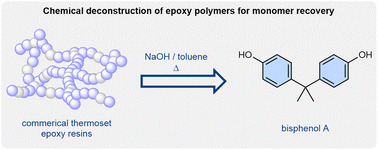
Solvent–base mismatch enables the deconstruction of epoxy polymers and bisphenol A recovery

Abstract:
Fiber-reinforced epoxy composites are key materials for the construction of wind turbine blades and airplanes due to their remarkable mechanical strength properties. On the flipside, their physical and chemical inertness results in a lack of viable recycling technologies. Recently, tailored resins have been introduced, which allow controlled fragmentation of the polymer matrix and thus the recovery of embedded fibres. However, for the separated thermoset epoxy fragments, there is no recycling solution available, resulting in the loss of complex molecular structures during their disposal. Here, we report a chemical process for recovering bisphenol A (BPA) from epoxy resins using a mismatched base–solvent system at an elevated temperature. We demonstrate a combinatory disassembly process/chemical deconstruction strategy on a commercial tailored composite sample, isolating both fibres and the polymer building block. The recovered BPA could potentially be reused in established polymer production chains, thus closing the recycling loop and reducing the need for virgin resources.

Find a list of publications by NordCO2 members on our Publications page 🙂

Research Article: UiT

graphical abstract

Title:
Understanding the Influence of Lewis Acids on CO2 Hydrogenation: The Critical Effect Is on Formate Rotation

Abstract:
Lewis acids (LAs) have been shown to accelerate hydrogenation of CO2, but the underlying mechanistic details remain to be elucidated. We have employed computational methods to investigate how LAs affect CO2 hydrogenation with a range of known metal-hydrides (LnIr–H, LnRu–H, LnMn–H, LnCo–H). Our results show that LAs can alter the nature of the hydride–CO2 bond formation step, but do not lower its barrier. Instead, the accelerating effect of LAs is on the subsequent step, the rearrangement of the metal-formate σ-intermediate. These insights are essential for understanding the effect of LA additives on metal-mediated hydrogenations of CO2.

Find a list of publications by NordCO2 members on our Publications page 🙂

Research Article: UiO

graphical abstract

Title:
Tracking Lattice Distortion Induced by Defects and Framework Tin in Beta Zeotypes

Abstract:
The use of powder X-ray diffraction (PXRD) coupled with lattice parameter refinement is used to investigate the crystal structure of Sn-Beta materials. A newly developed semiempirical PXRD model with a reduced tetragonal unit cell is applied to obtain the characteristic crystallographic features. There is a robust correlation between lattice parameters and the concentration of tin and defects for materials prepared via hydrothermal (HT) and postsynthetic (PT) methods. With tin incorporation, PT Sn-Beta samples, which possess a more defective structure, exhibit an extended interlayer distance in the stacking sequence and expansion of the translation symmetry within the layers, leading to larger unit cell dimensions. In contrast, HT Sn-Beta samples, having fewer defects, show a minimal effect of tin site density on the unit cell volume, whereas lattice distortion is directly correlated to the framework tin density. Furthermore, density functional theory (DFT) studies support an identical trend of lattice distortion following the monoisomorphous substitution of T sites from silicon to tin. These findings highlight that PXRD can serve as a rapid and straightforward characterization method to evaluate both framework defects and heteroatom density, offering a novel approach to monitor structural changes and the possibility to evaluate the catalytic properties of heteroatom-incorporated zeotypes.

Find a list of publications by NordCO2 members on our Publications page 🙂

Research Article: AU

graphical abstract

Title:
Ex-Situ Generation of Bis(trifluoromethyl)disulfide and Applications to Trifluoromethylthiolation Reactions

Abstract:
Herein, a convenient and operationally simple protocol for the ex-situ generation of bis(trifluoromethyl)disulfide from the readily available and commercial Langlois reagent is reported. The one-step synthesis of the toxic and volatile CF3SSCF3 is performed in a two-chamber reactor with simple PPh3 and N-bromosuccinimide as the activator, allowing for the safe handling and tandem utilization in direct trifluoromethylthiolation reactions. The versatility of the ex-situ generated CF3SSCF3 is demonstrated in known electrophilic, nucleophilic, and a radical trifluoromethylthiolation reactions. Furthermore, the application of the CF3SSCF3 in a copper-catalyzed cross-coupling with boronic acids is disclosed, showing good to excellent yields of trifluoromethyl-substituted aryl products, including pharmaceutically relevant molecules.

Find a list of publications by NordCO2 members on our Publications page 🙂

Research Article: AU

graphical abstract

Title:
Low Pressure Carbonylation of Benzyl Carbonates and Carbamates for Applications in 13C Isotope Labeling and Catalytic CO2 Reduction

Abstract:
Herein, we report a methodology to access isotopically labeled esters and amides from carbonates and carbamates employing an oxygen deletion strategy. This methodology utilizes a decarboxylative carbonylation approach for isotope labeling with near stoichiometric, ex situ generated 12C, or 13C carbon monoxide. This reaction is characterized by its broad scope, functional group tolerance, and high yields, which is showcased with the synthesis of structurally complex molecules. A complementary method that operates by the catalytic in situ generation of CO via the reduction of CO2 liberated during decarboxylation has also been developed as a proof-of-concept approach that CO2-derived compounds can be converted to CO-containing frameworks. Mechanistic studies provide insight into the catalytic steps which highlight the impact of ligand choice to overcome challenges associated with low-pressure carbonylation methodologies, along with rational for the development of future methodologies.

Find a list of publications by NordCO2 members on our Publications page 🙂