Nordic Consortium for CO2 Conversion

News

Research Article: AU

Figure 1

Title:
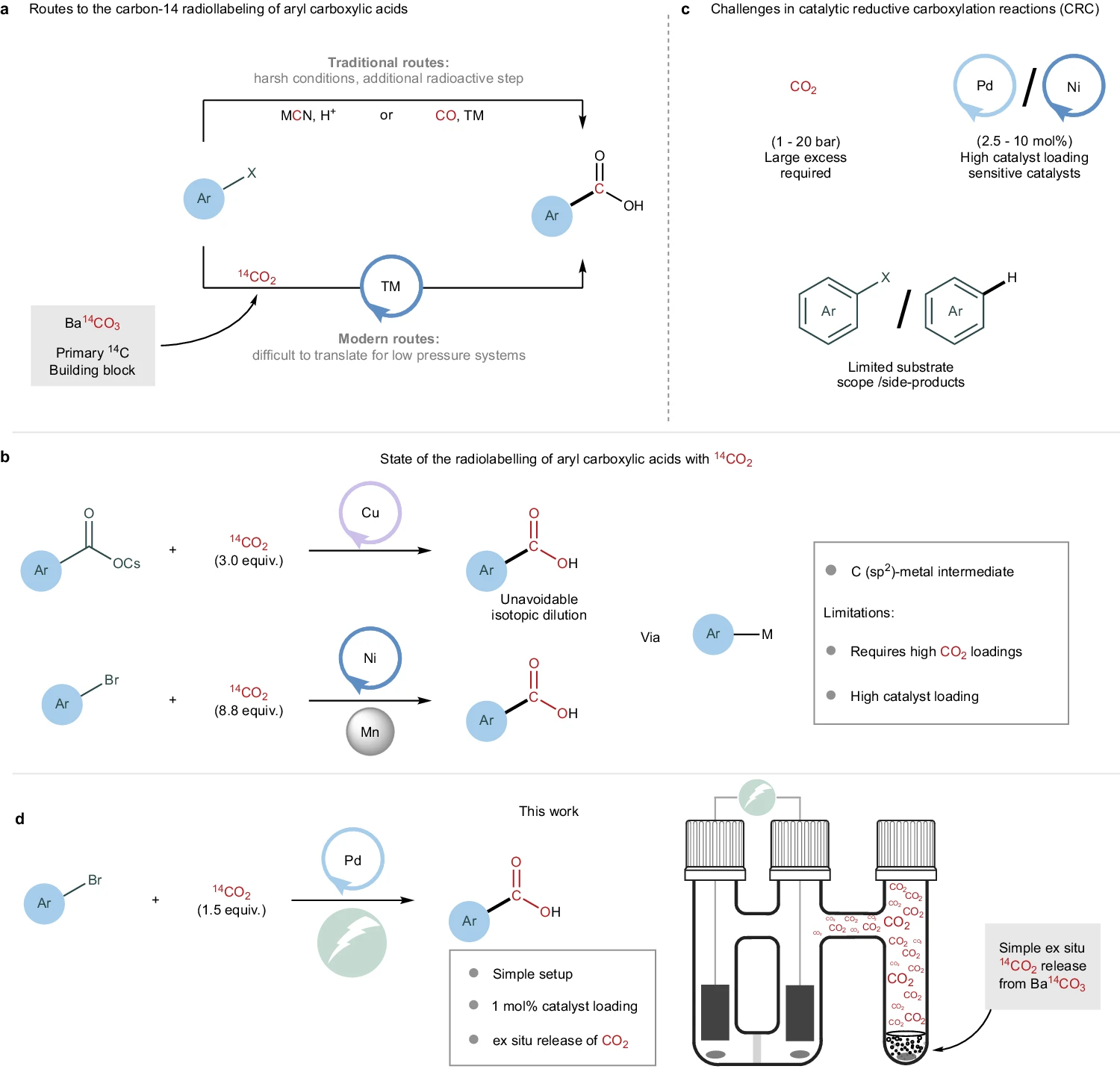
Efficient palladium-catalyzed electrocarboxylation enables late-stage carbon isotope labelling

Abstract:
Carbon isotope labelling of bioactive molecules is essential for accessing the pharmacokinetic and pharmacodynamic properties of new drug entities. Aryl carboxylic acids represent an important class of structural motifs ubiquitous in pharmaceutically active molecules and are ideal targets for the installation of a radioactive tag employing isotopically labelled CO2. However, direct isotope incorporation via the reported catalytic reductive carboxylation (CRC) of aryl electrophiles relies on excess CO2, which is incompatible with carbon-14 isotope incorporation. Furthermore, the application of some CRC reactions for late-stage carboxylation is limited because of the low tolerance of molecular complexity by the catalysts. Herein, we report the development of a practical and affordable Pd-catalysed electrocarboxylation setup. This approach enables the use of near-stoichiometric 14CO2 generated from the primary carbon-14 source Ba14CO3, facilitating late-stage and single-step carbon-14 labelling of pharmaceuticals and representative precursors. The proposed isotope-labelling protocol holds significant promise for immediate impact on drug development programmes.

Find a list of publications by NordCO2 members on our Publications page 🙂

Research Article: UiT

graphical abstract

Title:
Kinetically-Controlled Ni-Catalyzed Direct Carboxylation of Unactivated Secondary Alkyl Bromides without Chain Walking

Abstract:
Herein, we report the direct carboxylation of unactivated secondary alkyl bromides enabled by the merger of photoredox and nickel catalysis, a previously inaccessible endeavor in the carboxylation arena. Site-selectivity is dictated by a kinetically controlled insertion of CO2 at the initial C(sp3)–Br site by the rapid formation of Ni(I)–alkyl species, thus avoiding undesired β-hydride elimination and chain-walking processes. Preliminary mechanistic experiments reveal the subtleties of stereoelectronic effects for guiding the reactivity and site-selectivity.

Find a list of publications by NordCO2 members on our Publications page 🙂

Research Article: UoI

graphical abstract

Title:
Mechanistic Insights in the Catalytic Hydrogenation of CO2 over Pt Nanoparticles in UiO-67 Metal–Organic Frameworks

Abstract:
Metal nanoparticles (NPs) encapsulated within Zr-based UiO-67 metal–organic frameworks (MOFs) have increased selectivity toward methanol in CO2 reduction reactions. However, the reduction mechanism in these systems remains unclear. We built upon prior work examining the synergistic interaction between Pt nanoparticles and Zr6O4(OH)4 clusters in UiO-67 and developed five distinct models representing the possible active sites in the Pt ⊂ MOF system. Density functional theory (DFT) calculations were employed to elucidate the CO2 reduction mechanism toward methanol, methane, and CO formation. Our findings support previous evidence showing that the interface between the Zr6O4(OH)4 cluster and platinum nanoparticles plays a crucial role in the activation of CO2 to CO or formate intermediates and its further reduction to methane and methanol, respectively. Furthermore, we found different CO2 hydrogenation mechanisms for interfaces involving Pt-flat terraces and Pt-edges. On Pt terraces and interfaces near Pt terraces, the reaction goes via CO, which can be desorbed as CO(g) or be further reduced to methane. On interfaces near Pt-edges, the reaction proceeds via formate and preferably forms methanol over methane. We designed experiments to validate our computational insights involving large and small Pt nanoparticles interacting with Zr6O4(OH)4 clusters. These experiments showed that only CO and methanol were formed when smaller nanoparticles were present. Notably, methane formed with CO and methanol in the presence of larger nanoparticles, highlighting the need for flat platinum surfaces at the interfaces for methane formation. We could also associate the IR signals corresponding to CO and bidentate formate with platinum nanoparticles and Zr6O4(OH)4 clusters, respectively. Theoretical models and experimental data provided us with insights into the complexity of the reaction mechanism and emphasized the significance of understanding both the individual components of the catalytic system and their interactions in enhancing catalytic activity.

Find a list of publications by NordCO2 members on our Publications page 🙂
Research Article: UiO and AU

Title:
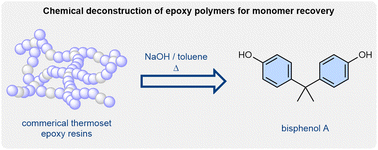
Solvent–base mismatch enables the deconstruction of epoxy polymers and bisphenol A recovery

Abstract:
Fiber-reinforced epoxy composites are key materials for the construction of wind turbine blades and airplanes due to their remarkable mechanical strength properties. On the flipside, their physical and chemical inertness results in a lack of viable recycling technologies. Recently, tailored resins have been introduced, which allow controlled fragmentation of the polymer matrix and thus the recovery of embedded fibres. However, for the separated thermoset epoxy fragments, there is no recycling solution available, resulting in the loss of complex molecular structures during their disposal. Here, we report a chemical process for recovering bisphenol A (BPA) from epoxy resins using a mismatched base–solvent system at an elevated temperature. We demonstrate a combinatory disassembly process/chemical deconstruction strategy on a commercial tailored composite sample, isolating both fibres and the polymer building block. The recovered BPA could potentially be reused in established polymer production chains, thus closing the recycling loop and reducing the need for virgin resources.

Find a list of publications by NordCO2 members on our Publications page 🙂

Research Article: UiT

graphical abstract

Title:
Understanding the Influence of Lewis Acids on CO2 Hydrogenation: The Critical Effect Is on Formate Rotation

Abstract:
Lewis acids (LAs) have been shown to accelerate hydrogenation of CO2, but the underlying mechanistic details remain to be elucidated. We have employed computational methods to investigate how LAs affect CO2 hydrogenation with a range of known metal-hydrides (LnIr–H, LnRu–H, LnMn–H, LnCo–H). Our results show that LAs can alter the nature of the hydride–CO2 bond formation step, but do not lower its barrier. Instead, the accelerating effect of LAs is on the subsequent step, the rearrangement of the metal-formate σ-intermediate. These insights are essential for understanding the effect of LA additives on metal-mediated hydrogenations of CO2.

Find a list of publications by NordCO2 members on our Publications page 🙂