


Research Article: SU
Title:
An Expedient Method for the Umpolung Coupling of Enols with Heteronucleophiles
Abstract:
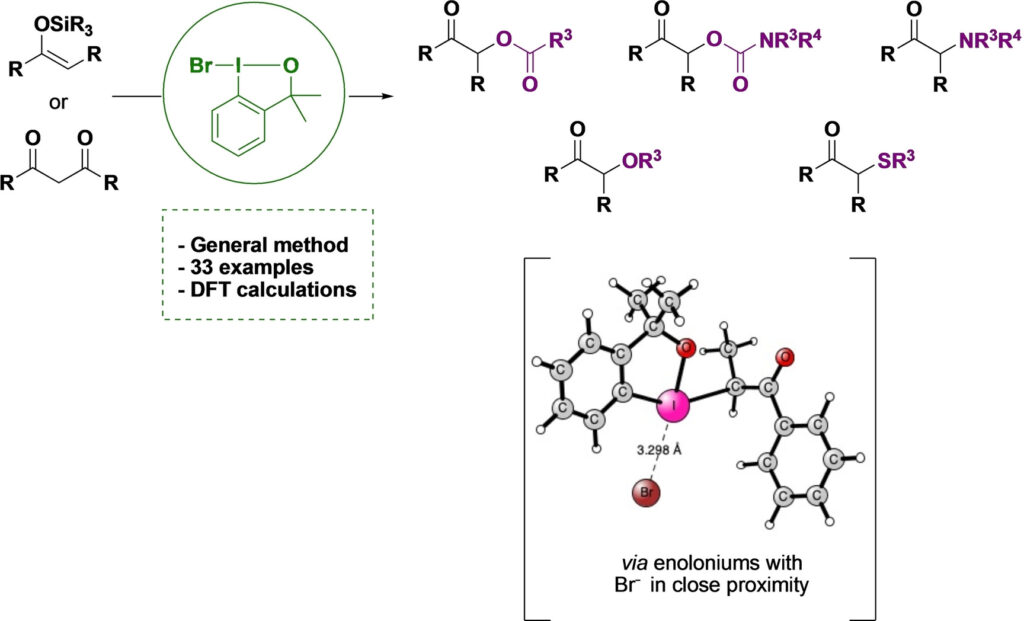
In this paper, we present an unprecedented and general umpolung protocol that allows the functionalization of silyl enol ethers and of 1,3-dicarbonyl compounds with a large range of heteroatom nucleophiles, including carboxylic acids, alcohols, primary and secondary amines, azide, thiols, and also anionic carbamates derived from CO2. The scope of the reaction also extends to carbon-based nucleophiles. The reaction relies on the use of 1-bromo-3,3-dimethyl-1,3-dihydro-1λ3[d][1,2]iodaoxole, which provides a key α-brominated carbonyl intermediate. The reaction mechanism has been studied experimentally and by DFT, and we propose formation of an unusual enolonium intermediate with a halogen-bonded bromide.
Find a list of publications by NordCO2 members on our Publications page 🙂
Research Article: UU
Title:
Self-Assembled Liposomes Enhance Electron Transfer for Efficient Photocatalytic CO2 Reduction
Abstract:
Light-driven conversion of CO2 to chemicals provides a sustainable alternative to fossil fuels, but homogeneous systems are typically limited by cross reactivity between different redox half reactions and inefficient charge separation. Herein, we present the bioinspired development of amphiphilic photosensitizer and catalyst pairs that self-assemble in lipid membranes to overcome some of these limitations and enable photocatalytic CO2 reduction in liposomes using precious metal-free catalysts. Using sodium ascorbate as a sacrificial electron source, a membrane-anchored alkylated cobalt porphyrin demonstrates higher catalytic CO production (1456 vs 312 turnovers) and selectivity (77 vs 11%) compared to its water-soluble nonalkylated counterpart. Time-resolved and steady-state spectroscopy revealed that self-assembly facilitates this performance enhancement by enabling a charge-separation state lifetime increase of up to two orders of magnitude in the dye while allowing for a ninefold faster electron transfer to the catalyst. Spectroelectrochemistry and density functional theory calculations of the alkylated Co porphyrin catalyst support a four-electron-charging mechanism that activates the catalyst prior to catalysis, together with key catalytic intermediates. Our molecular liposome system therefore benefits from membrane immobilization and provides a versatile and efficient platform for photocatalysis.
Find a list of publications by NordCO2 members on our Publications page 🙂
Research Article: AU
Abstract:
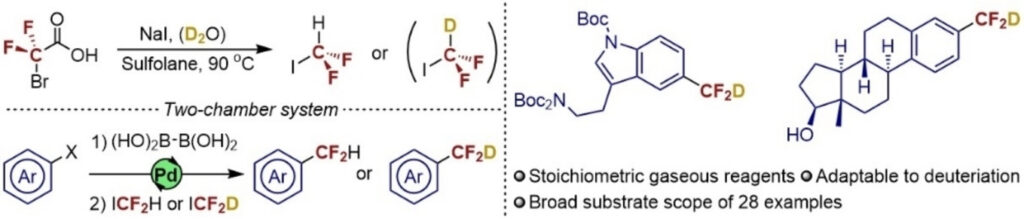
An expedient ex-situ generation of difluoroiodomethane (DFIM) and its immediate use in a Pd-catalyzed difluoromethylation of aryl boronic acids and ester derivatives in a two-chamber reactor is reported. Heating a solution of bromodifluoroacetic acid with sodium iodide in sulfolane proved to be effective for the generation of near stoichiometric amounts of DFIM for the ensuing catalytic coupling step. A two-step difluoromethylation of aryl (pseudo)halides with tetrahydroxydiboron as a low-cost reducing agent, both promoted by Pd catalysis, proved effective to install this fluorine-containing C1 group onto several pharmaceutically relevant molecules. Finally, the method proved adaptable to deuterium incorporation by simply adding D2O to the DFIM-generating chamber.
Find a list of publications by NordCO2 members on our Publications page 🙂
Research Article: KTH and UU

Title:
Microscopic Insights into Cation-Coupled Electron Hopping Transport in a Metal–Organic Framework
Abstract:
Electron transport through metal–organic frameworks by a hopping mechanism between discrete redox active sites is coupled to diffusion-migration of charge-balancing counter cations. Experimentally determined apparent diffusion coefficients, Deapp, that characterize this form of charge transport thus contain contributions from both processes. While this is well established for MOFs, microscopic descriptions of this process are largely lacking. Herein, we systematically lay out different scenarios for cation-coupled electron transfer processes that are at the heart of charge diffusion through MOFs. Through systematic variations of solvents and electrolyte cations, it is shown that the Deapp for charge migration through a PIZOF-type MOF, Zr(dcphOH-NDI) that is composed of redox-active naphthalenediimide (NDI) linkers, spans over 2 orders of magnitude. More importantly, however, the microscopic mechanisms for cation-coupled electron propagation are contingent on differing factors depending on the size of the cation and its propensity to engage in ion pairs with reduced linkers, either non-specifically or in defined structural arrangements. Based on computations and in agreement with experimental results, we show that ion pairing generally has an adverse effect on cation transport, thereby slowing down charge transport. In Zr(dcphOH-NDI), however, specific cation–linker interactions can open pathways for concerted cation-coupled electron transfer processes that can outcompete limitations from reduced cation flux.
Find a list of publications by NordCO2 members on our Publications page 🙂