Category: Cruise blog
-
Chief Scientists Diary: Jochen Knies
NOVEMBER 7. Dear team and crew: Thank you for your spirit and motivation!
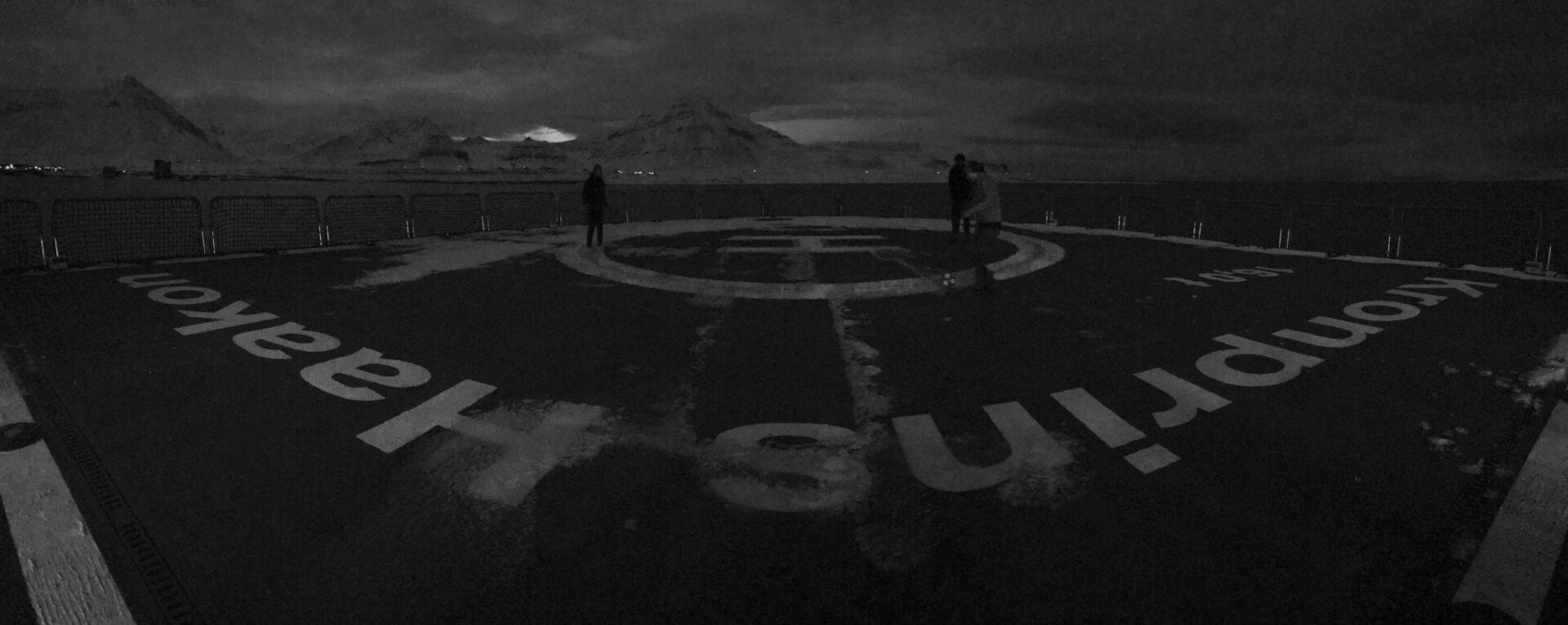
The last Calypso giant piston core came on deck before lunch time. We took the core right in front of Ny Ålesund in Kongsfjorden. The purpose to core in Kongsfjorden was to get a long sequence of Holocene climate variability, the last ca. 10.000 years. The material will provide insight on how climate changed on Svalbard after the end of the last ice age. We ended the scientific program with a BBQ on the Helicopter deck and a visit to Ny Ålesund.
Jochen Knies tending the BBQ onboard RV Kronprins Haakon When I started this adventure, I was looking for samples from the seafloor that could tell us a story of climate change in the Arctic for more than 100.000 years in the past. Well, now after 20 days at sea, I know that the Calypso giant piston corer is certainly the tool to provide the material for this story.
We took 20 Calypso cores and recovered more than 300 m of unique material between Svalbard and Greenland.
All material is safely stored in our cooling container and will be transported back to Tromsø by the end of November. The real work will start there! Analysing just one core can easily take the entire period of a doctoral student. This is normally 3 years. So, back to the keyword “patience”. We won’t continue the story before these 3 years are over. Stay tuned.

The precious material in safely stored in the cooling container. Photo Jochen Knies I wish to thank the Captain and Crew onboard RV “Kronprins Haakon” for all the support to realize our Arctic adventure. It is a pleasure to work with you and your crew. Many thanks to our Calypso team on deck. You made it all happen! Finally, I have a great team of early-stage and senior researcher and engineers. I thank you all for your spirit and motivation during the last 3 weeks.
-
Always be afraid of DNA contamination!
Text and photos: Danielle Grant and Kristine Steinsland, NORCE Climate
Danielle and Kristine here! We are two PhD students from NORCE Climate, based in Bergen.
Our research is part of the larger project, AGENSI: A Genetic View into Past Sea Ice Variability in the Arctic. The Arctic is drastically changing and there may soon be summer without sea ice. However, the impacts of a warming Arctic on regional and global climate systems are not well understood. We can use knowledge of past sea ice variability to understand the role of sea ice on Arctic climate, and learn more about our current situation. To do this we do sea ice reconstructions based on observational data (satellite and historical records) and sea ice proxies.

To understand the role of sea ice on the Arctic climate we reconstruct past changes in sea ice based on observational data (satellite and historical records) and sea ice proxies. Photo: AGENSI Our main goal on board is to collect surface sediment samples from multicores—which we will analyze back in Bergen for environmental DNA, IP25 biomarker, and palynology. Environmental DNA is an emerging tool for sea ice reconstructions, spearheaded by the AGENSI group. As we build confidence in this new proxy the surface samples collected during this cruise will contribute to a surface sediment database. The database will provide a calibration for our suite of proxies, which can then be applied for paleo-reconstructions of sea ice (hopefully on a core ranging back 150,000 years from this cruise)!
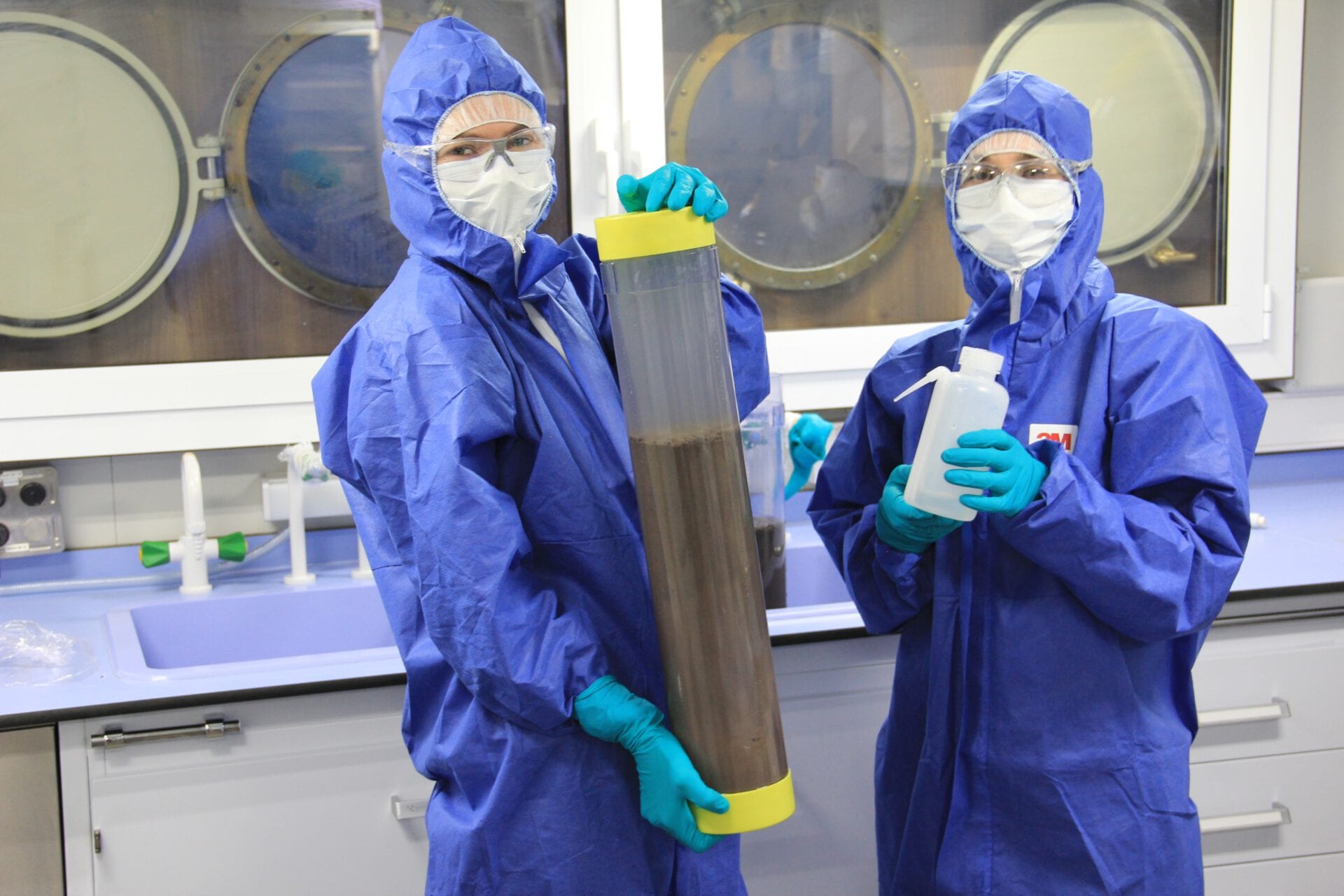
After 20 days onboard we have collected 32 multicores ranging from 100m depth to 2500 m. When we process a core, we first clean away the mud, and then wash with a chlorine solution (This is the first of many cleaning steps!) The core is then delivered to the molecular lab to one of us already dressed in a paper suit, hairnet, particle mask, safety glasses and double gloves! The core is then immediately cleaned with chlorine… again…twice. These cleaning steps are critical to ensure no DNA contamination! Always be afraid of DNA contamination!
Once things are clean, we can then take our surface samples using sterile instruments. Sampling the surface of a multicore is quite exciting! The MC preserves the sediment-water interface, meaning that you get an intact slice of the sea floor. So far, we have encountered plenty of tube worms, burrowing worms, and even a lively starfish!

Cleaning the samples is crucial to collect pristine DNA. Photo: AGENSI For some locations we also do a full downcore sampling, meaning we sample every 2cm of a split core. We like to think of this as ‘sediment surgery’—we have another designated clean lab exclusively for DNA downcore samples. The different levels of clean would not be possible without being on board KPH, it is a great luxury to have such control on the lab space and really limit any chance of contamination.
When we aren’t sampling (or cleaning), we can usually be found in the mess room (the juice on board is amazing) or on the observation deck with coffee! The coffee may be just as important as all the cleaning for our success!
The last few days have been exciting and busy with a lot of coring sites. We were slow to realize just how dark things have gotten outside! As things get darker and colder, we plan to visit the ship’s sauna we hear so such wonderful things about! Until then, happy cleaning and stay cool… like sea ice!
-
Chief Scientists Diary: Jochen Knies
November 3: On Overconfidence and High Spirits
Well, we became quite confident in what we were doing. Cores came on deck every day and we were making such fast progress that I was already thinking about alternate sites. Great team spirit on deck reduced the time of core handling, and the station map was rapidly filled up with core locations. Too much confidence though, makes you forget where you are.

We hit something harder than we thought we would hit. The result: Another bended core being hauled on board RV Kronprons Haakon. Photo: Jochen Knies The Svalbard continental margin is unpredictable and even with the best possible visualisation technology used on the sediments below the seafloor, one cannot exclude a sediment layer with stiff clay or dropstones released from melting icebergs. We lost a few hours due to another bended core, but still saved 12 m of core material. Now we will drop the very long (~25 m) piston corer for the remaining days at sea and will start building up our confidence again with the shorter (17 m) one.

Wizards on deck. Dag Inge Blindheim (NORCE), Stig Monsen (UiB) Photo: Renata Lucchi Perhaps, you readers will get a bad impression about the success of this cruise when you read my diary. It reminds me of summer holidays on the French Atlantic coast. You hardly remember the numerous sunny days at the beach, but tell your mates at home about the massive flood which almost destroyed your tent. Same here! I am pretty sure that the 200 m and more core material we have collected during the past 2 weeks will eventually provide some exciting breakthrough knowledge. But the first thing I will tell my mates when I come home is how things were delayed due to some bloody bended cores.

We have collected samples from 15 stations so far. Illustration Sunil Vadakkepulyambatta -
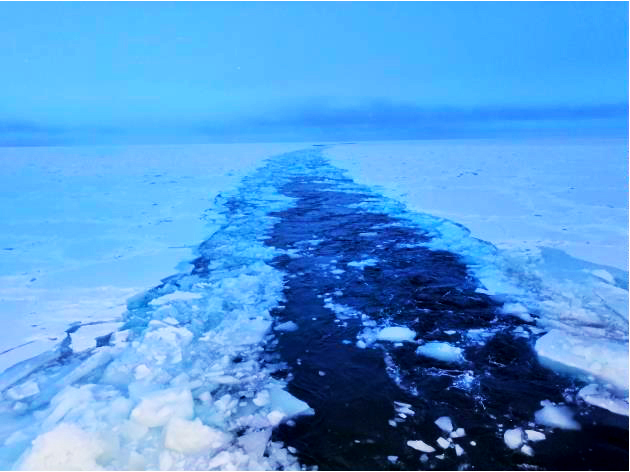
Long days and beautiful views
Text and photos: Remi Vachon
WEDNESDAY, October 30, 2019. It is my first time on a research vessel. Needless to say, I was very excited about the idea of going on a scientific adventure for three weeks. We started 10 days ago and even though the initial excitement has worn off a bit, I am still amazed by the landscape we are passing through. Witnessing the sea ice is truly a once in a lifetime experience. A bit of presentation: I am Rémi Vachon, a postdoc fellow from CAGE, Tromsø, involved in the SEAMSTRESS project managed by Andreia Plaza-Faverola. I was sent to research vessel Kronprins Haakon in order to test the geomechanical properties and orientation of the calypso cores. From those measurements, and other investigations, we aim to constrain the regional stress at specific locations along the Vestnessa ridge, a key area for gas hydrate formation.

We have various tools to our disposition. One of them, the magnetic sensor, is used to calculate the angle between the long axis of the sensor and the geomagnetic north. When fixed on the Calypso corer, the sensor gives us the absolute orientation of the core at any time. There is however one potential problem: The sensor is attached to a huge weight (see picture below), partially made of steel which generates its own magnetic field and has a big influence on the orientation data recorded by the magnetic sensor. We are, unfortunately, not yet certain that the orientations we are collecting will be of any use.

Most of the work we do takes place on the main deck. When receiving the calypso or gravity cores (length varying from 10 to 20 m so far), the 6 m long liners containing the sediments are cut into 1 m long sections by Martin, our team leader and expert “sawsman” . Then, each member of the team oversees a specific task. Marianna and Carmen label the sections and look at the lithology, Lina and Simone measure the density, the water and gas content of the sediment, Danielle and Kristin are looking for ancient DNA (to later open their own Jurassic park) and I test the shear strength on each section with my portable shear tester ( see photo below). When we are flooded with work, the second team (Renata, Ragga, Nessim, Steve, Sacha and Griselda) comes to support us, which definitely lightens our burden. According to the cruise leader, Jochen Knies, we are doing a good job onboard, everything is going smoothly, and we are currently even ahead of schedule.

The last four days have been very hectic though, as we didn’t have much transit between the stations (transit = chilling on a scientific cruise). Today should allow for some more free time and a perfect opportunity to reload our batteries. Tomorrow, we will be back to the SEAMSTRESS sites of interest. Hopefully, all the coring will go smoothly 😊.
-
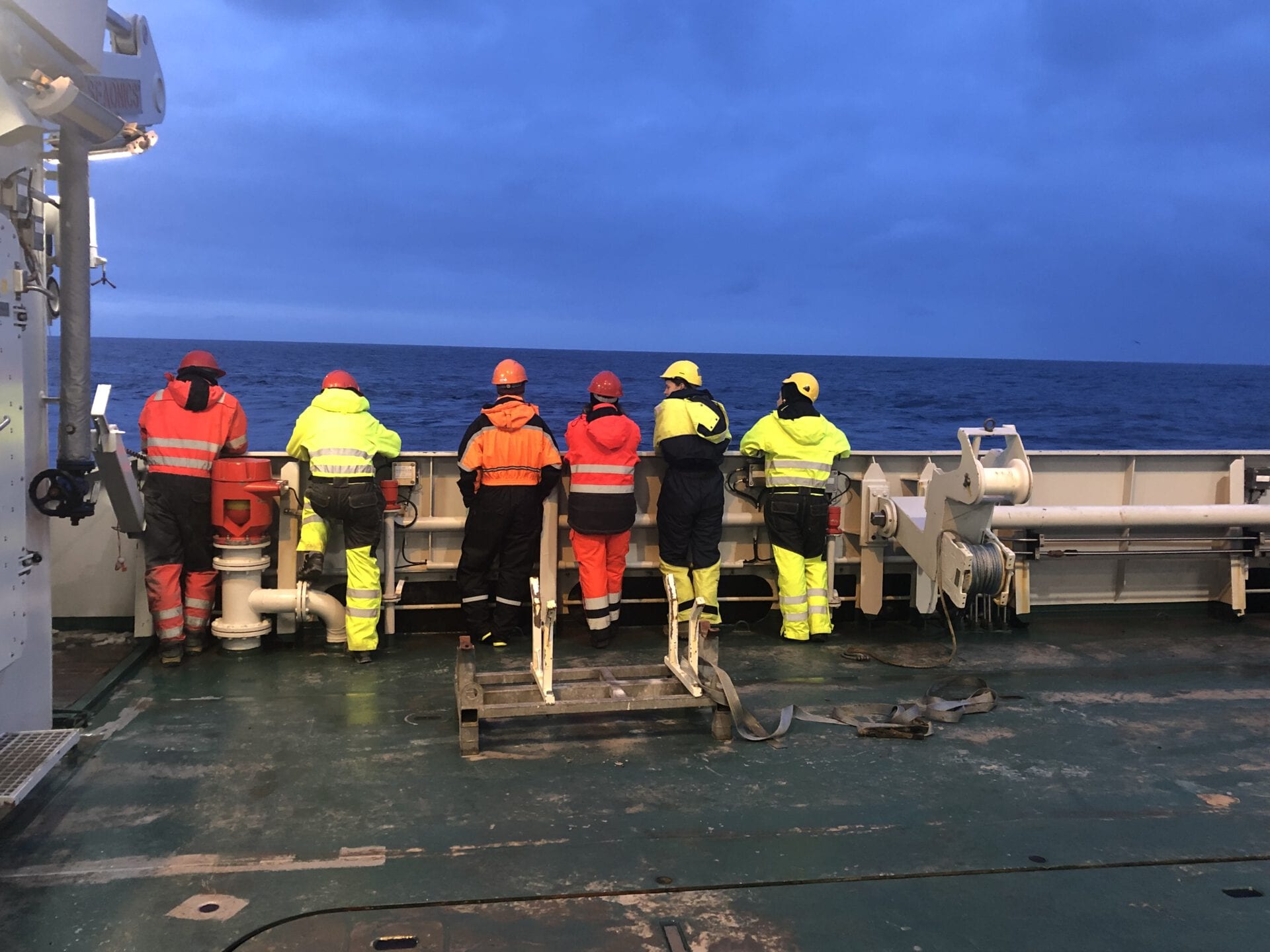
Chief Scientist’s Blog: Jochen Knies
October 28, 2019: It is all about teamwork
The routines onboard are now settled. Everyone has found their role and the good performance on deck is continuing. I appreciate all the help the team, researchers, students, and crew provide me to make this cruise a success. Shortening the Calypso Giant Piston corer to 17 m was a good decision. We cored one fault with seeping methane on the Yermak Plateau (10 m) and nicely stratified, fine-grained sequences northwest of Svalbard (~15 m), within the main pathway of northward flowing Atlantic water masses. We have now visited 9 stations and our cooling container is already halv full with new material.

Map of our stations so far. Image: Sunil Vadakkepulyambatta Today, the Polar night is rather chilly and work on deck becomes a challenge. After 12 hours with intense coring and profiling, a long transect into the central Fram Strait awaits us. We will sail towards the Hovgaard Ridge, a microcontinent in the middle of the deep water passage between the Arctic Ocean and the Atlantic. Here, we will look for traces of fossil icebergs once floating through the strait and try to identify its age. Exciting stuff!
October 30, 2019: Arctic challenges on deck
An Arctic coring expedition in November is challenging for both ship, crew, and scientists. With the aim of coring 20 m and more, plenty of time is required on deck to prepare various types of equipment.

Stig Monsen (UiB) at work in a chilly polar night. Photo: Jochen Knies Preparing The Giant Piston corer is of course most time consuming. Not only the preparation to deploy, but also the cleaning of the pipes, cutting the liners, and labelling takes time and effort. Yesterday, the team worked many hours on deck at -13 degrees Celsius with a strong breeze from the North. While working hard during the day, the team can rest during most of the night while we are acquiring bathymetric (seafloor topographic) data. We are currently working in the vicinity of the East Greenland Current at 79 degrees North. The current transports cold, polar waters and sea ice southwards along the East Greenland coast. RV “Kronprins Haakon” was surrounded by sea ice the entire day and we had to “escape” several times to safely deploy our equipment.

Today is the last day in this hostile environment. We will sail back tonight towards a more “pleasant” Atlantic climate regime on Vestnesa Ridge. Another Piezometer waits to be picked up at 1200 m water depth.
-
Working 8448
Text and Photos: Jens Gruetzner, Jens is a researcher in the Geophysics department at the Alfred-Wegener-Institute in Bremerhaven, Germany.
I am currently sailing as a guest on the “Kronprins Haakon”. My home institution is the Alfred-Wegener-Institut (AWI) in Bremerhaven, Germany. I have been doing marine research for quite some time, but this is my first cruise to the beautiful Arctic Ocean. I only recently started working with seismic data collected by my AWI-colleagues in the Fram Strait. During the expedition I can get an impression under what, sometimes very rough conditions, the data I am using has been collected. The time onboard the ship also provides an excellent opportunity to connect with international colleagues working in the same area and to get views of the spectacular nature, e.g. the Northern Lights (Aurora Borealis) we saw some days ago. So, I am very grateful to the organizers for having me invited to this journey and also to my department for financing the travel.

View into the galley: Can you smell the freshly baked bread? Although I have sailed on eleven ship expeditions before, every new cruise is again adventures, challenging and inspiring at the same time. The work with my colleagues in the “acoustic group” allows me to gain experience with shallow sub-bottom profiling and bathymetric methods (see Blog by Frances Cooke) in the search and characterization of gas hydrates, a field in which I do not have much experience in yet. The shift system we work on is: 8448. Which means 8 hours work, 4 hours rest, 4 hours work, 8 hours rest. Together with Frances I am on shift from 04:00 to 12:00 and again from 16:00 to 20:00. The first few days it was hard to get up at ~3:30 but now I am already used to it.

Daily selection of “knekkebrød” Compared to some older vessels this new ship is quite spacious and offers many amenities to spend the off-shift time: lounge, gym, sauna, lecture room, board games, video games…not to talk about the massage chair. Recently I managed to cope with the Norwegian menu control on the laundry machine. From Ranghild I learned that u/toymyk means “uten skyllemiddel” which in turn means “without softener”.
I sometimes walk around with my camera and try to get some objects of daily life documented (see photos) and also look at the pieces of art decorating some of the labs and the hallways. Like my shipmates I enjoy very much eating in the mess hall with panoramic windows. Reminds me that I had too many of the Norwegian deli “Smash” consisting of salted corn cones covered by milk chocolate. I am off to the gym

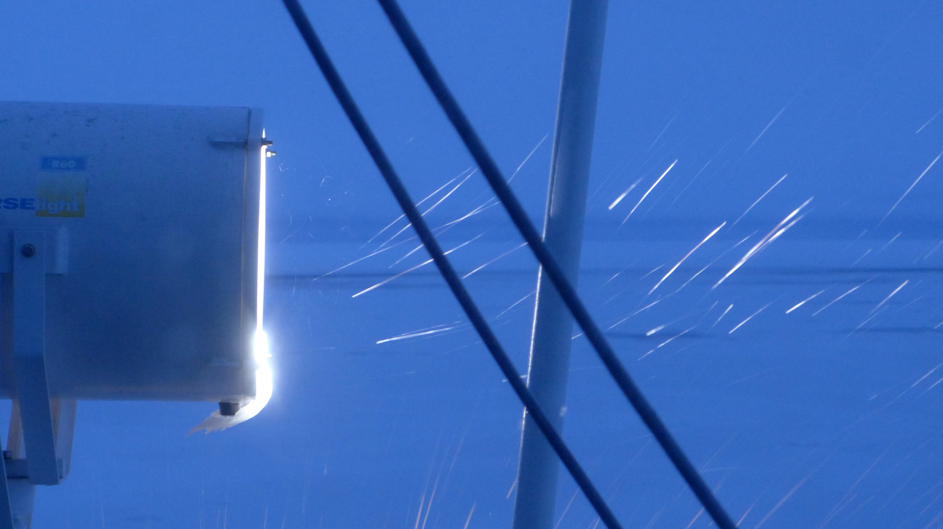
I am leaving you with this cool close up of the calypso corer winch. -
Pore water and cinnamon rolls
Text and photos: Simone Sauer
Last week was great on the RV Kronprins Haakon. We got a lot of pore water and delicious cinnamon rolls. Unfortunately, these things have nothing to do with each other. Cake is served every day on the boat which is very tempting, and yesterday no one could resist the cinnamon rolls.
As for the pore water, all the previous days we have been preparing very thoroughly setting up rack and vials, numbering them, and then waiting impatiently for them to be filled.
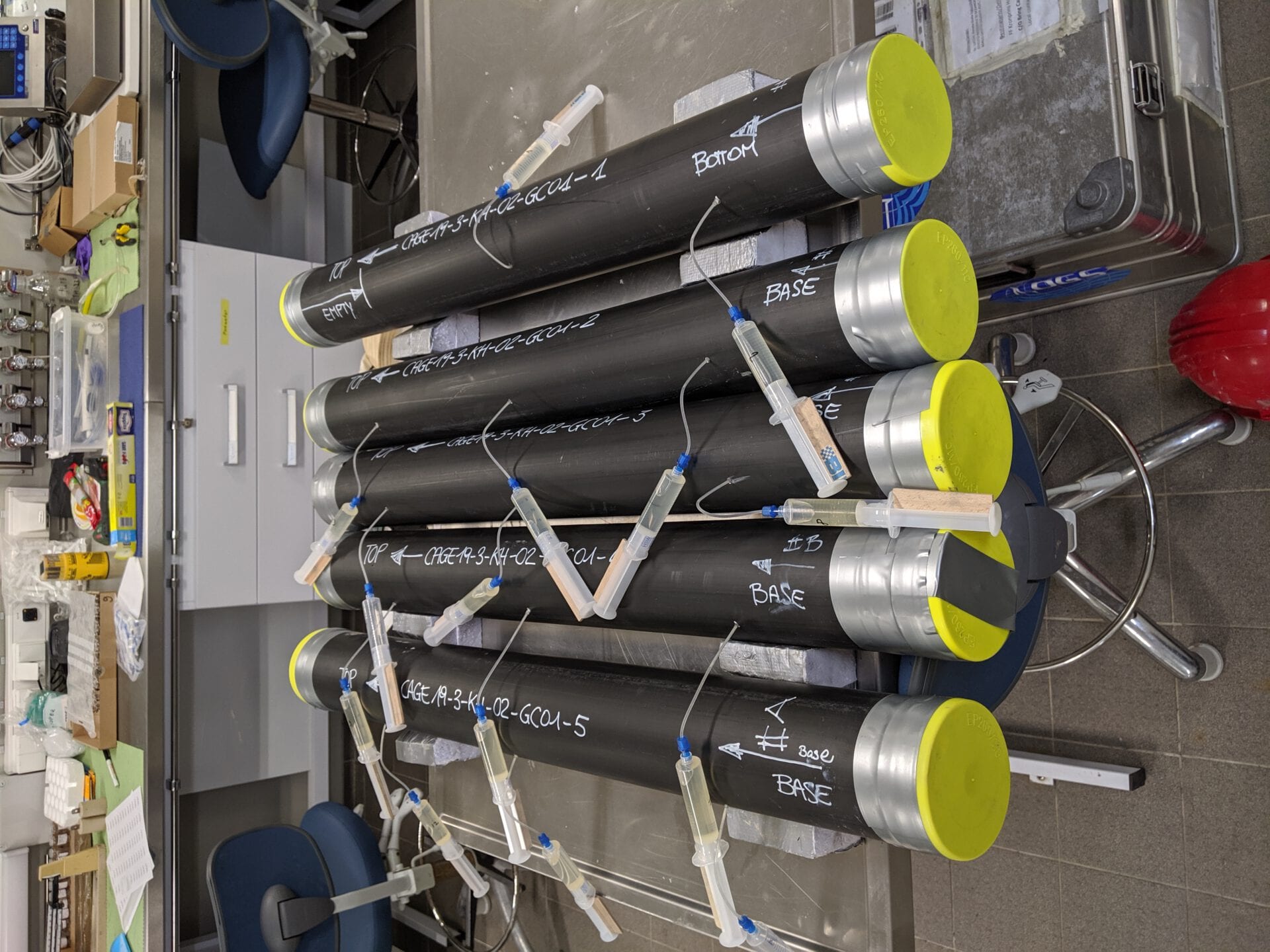
On superstation 2 we then got our first gravity core for pore water sampling. As you can see on the picture, we only need tiny holes in the liner to be able to extract the water. The so called rhizons are inserted into the sediment and a syringe attached. After a few hours of waiting time the syringes are filled with beautiful clear (filtered) pore water.

The pore water has to be divided in numerous vials (picture) of different shapes and colors After that the real work starts: the water has to be divided in numerous vials (picture) of different shapes and colors for analyses when we are back on land where we want to determine what kind of chemical components are dissolved in the pore water and how their concentrations change with depth.
This is very exciting as there is a lot of information that can be derived from these measurements. For example: Is there a lot of methane gas in the sediment? Are there horizons where carbonate minerals are formed? Are there horizons where some sediment components are dissolving? And how could these processes affect the sediment properties after they are deposited.
-
A core that stretches forever
Text and photos: Carmen Braun
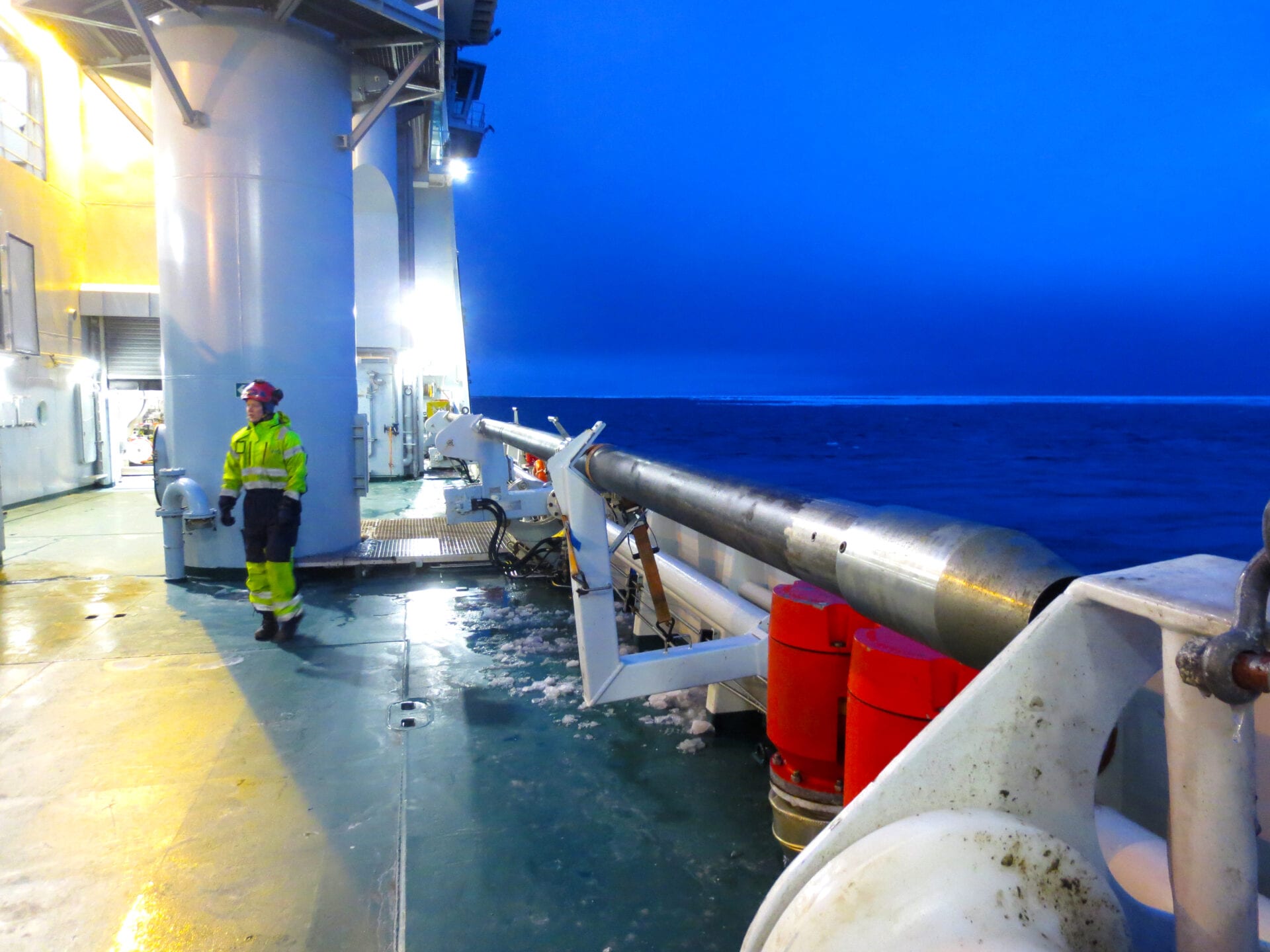
This is my first cruise with a Calypso corer, so I am very excited about it! As previous posts have explained, we have a multi-corer and a gravity corer as well, but neither can penetrate nearly as deep as the Calypso. When it is on deck, it seems to stretch forever.
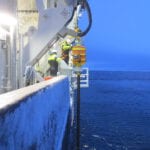
It takes some time to get the corer from its resting place to over the side of the ship and rotated so it is vertical. The technicians fix it up so that the weight (the yellow and orange) is properly secured to the trigger. You can also see how the rough seas of a few days ago left their icy mark on the side of the ship. Photo: Carmen Braun 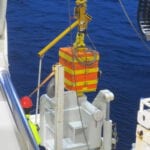
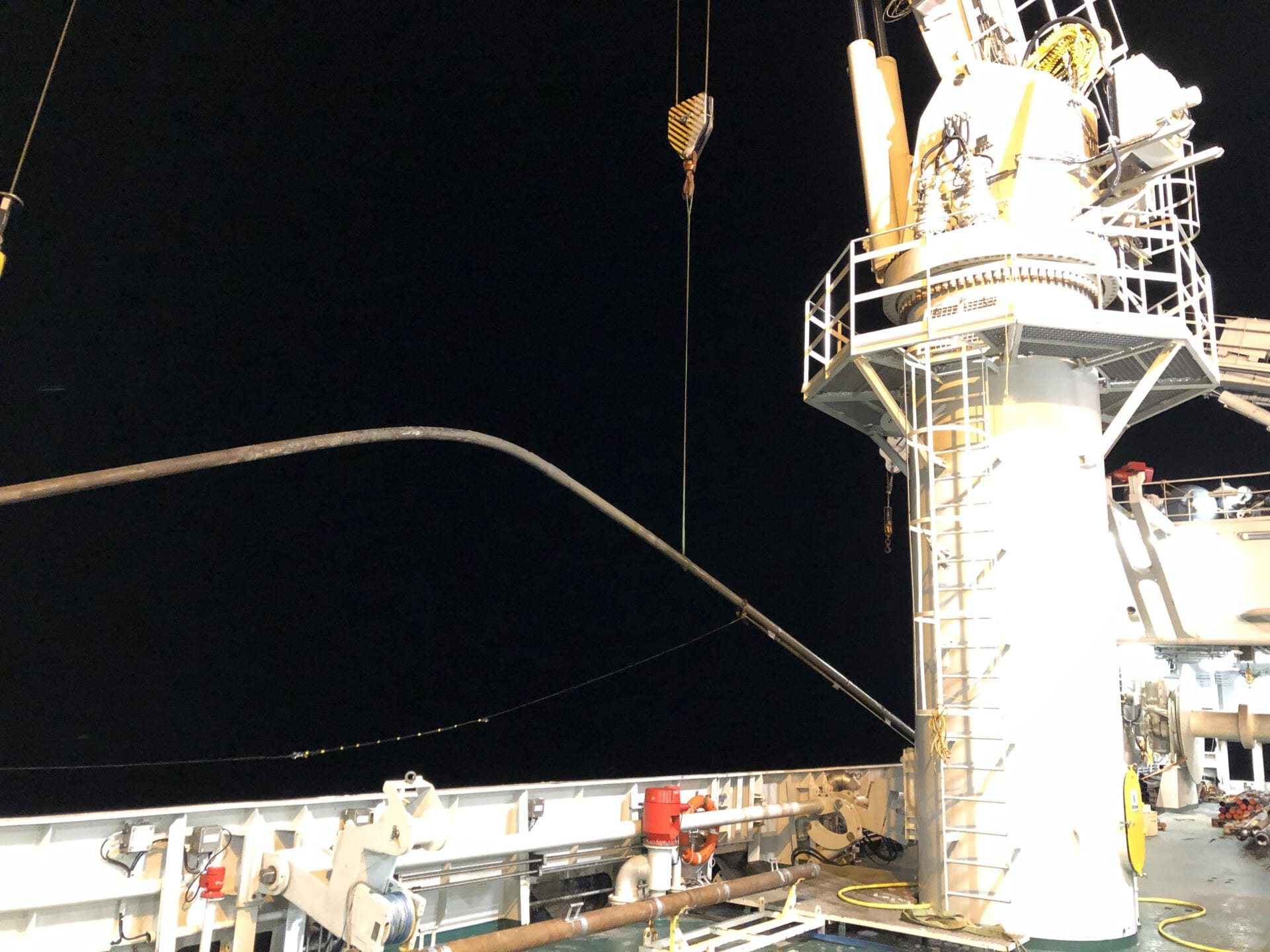
Here, you can better see the trigger set-up. Eventually, the long yellow arm will have a weight attached to it via a cable that is a little longer than the coring tube. When this weight hits the seafloor, the arm lifts up, releasing a catch attaching that part of the set-up to the weight by a cable, you can see the length of cable coiled nicely. This allows the corer to plunge deep into the sediment, propelled by the huge weight. 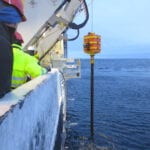
Getting the tube back on board is exciting, but painstaking process. 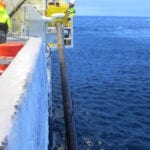
The process of rotating the coring tube back to horizontal and bringing it onboard the ship is slow and careful. The metal ring around the coring tube helps to support it during this process. 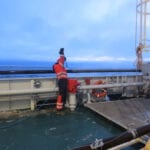
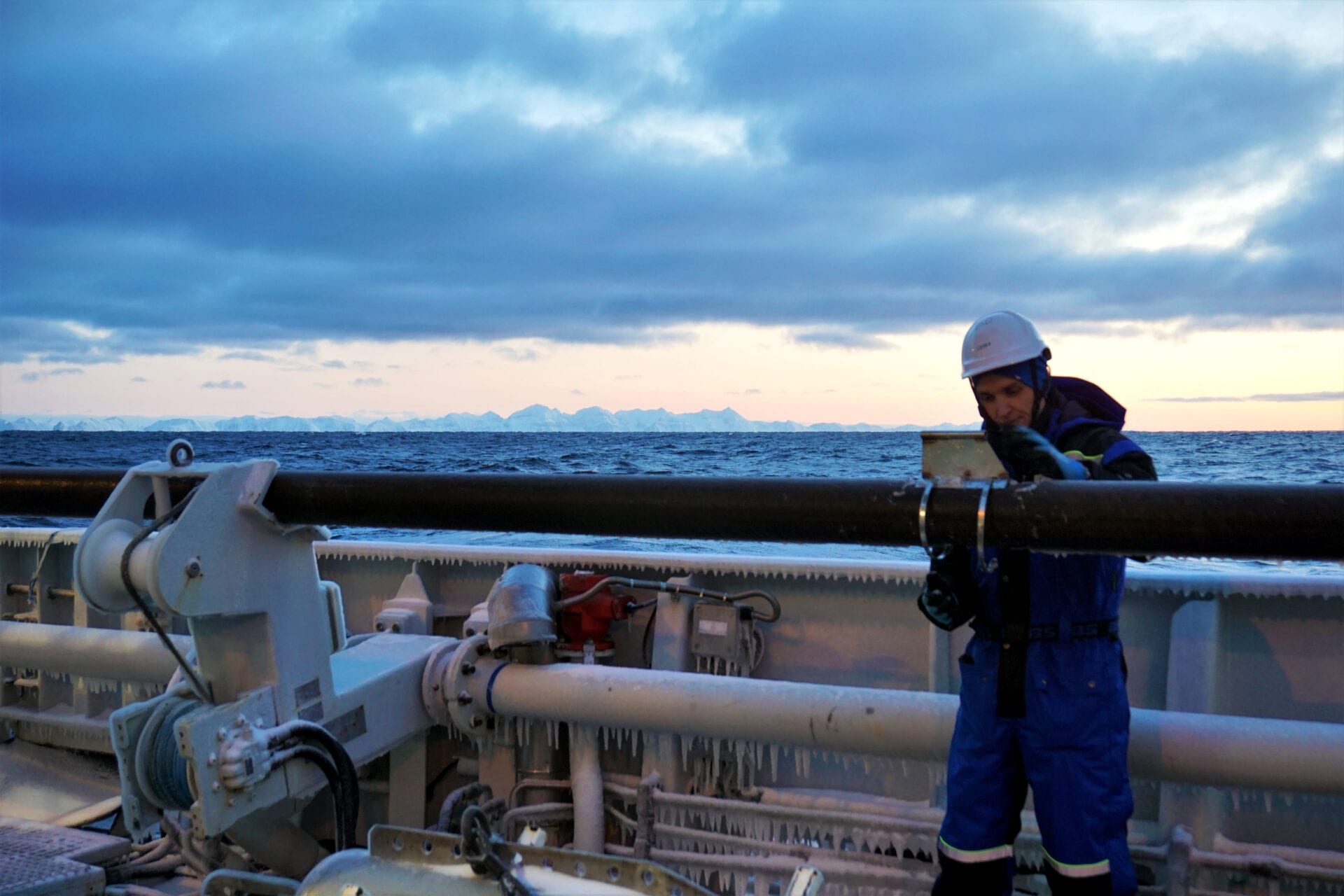
Once it is onboard, it is important to clean the outside of the coring tube, partially because it’s just better to keep all equipment clean, but the nature of the Arctic environment means the sediments stuck to the outside would quickly freeze solid if not pressure-washed away quickly! 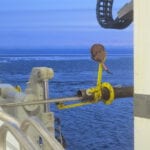
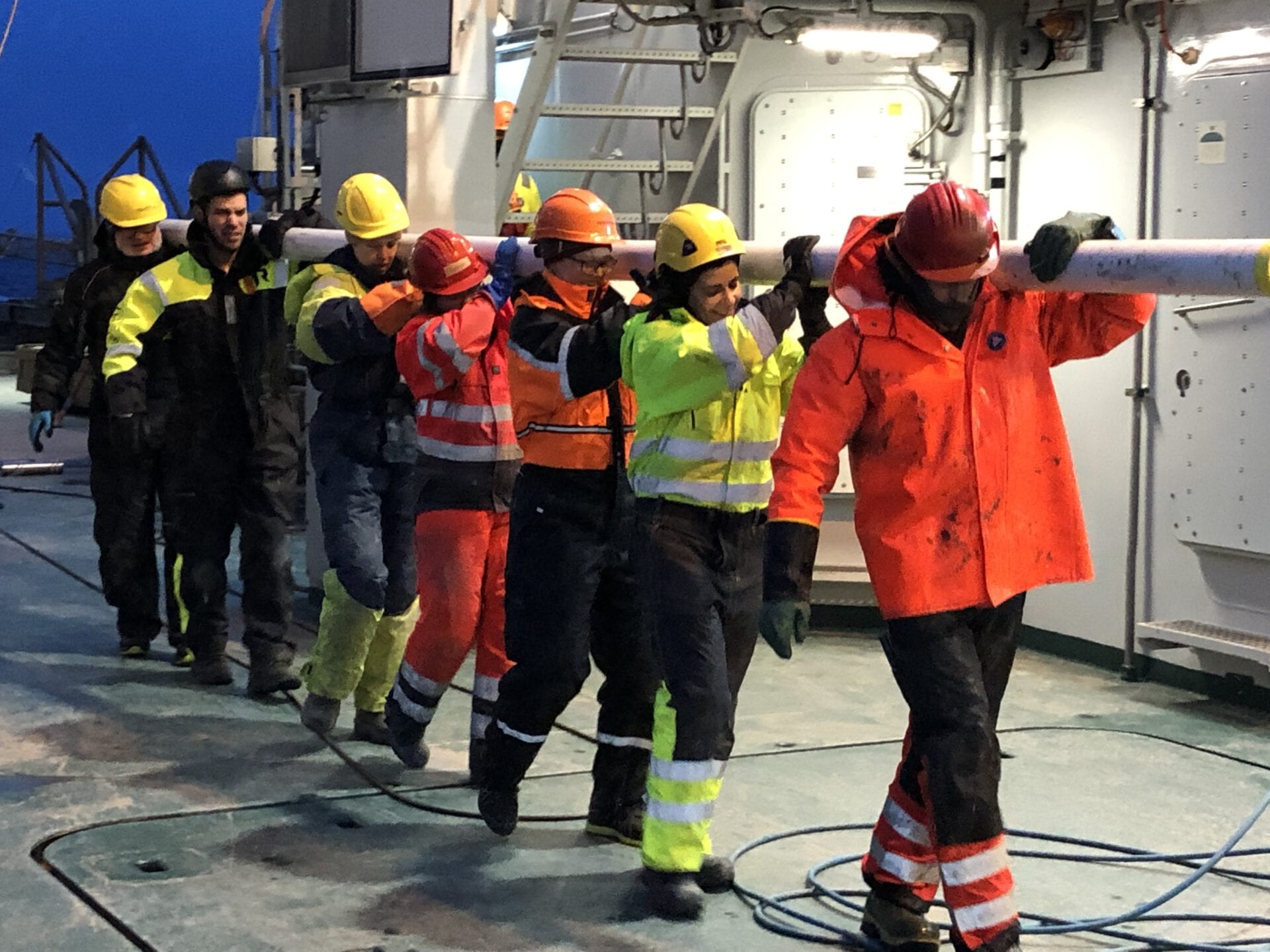
Getting the sediments out: To get the sediments out of the giant tube, we use this contraption to push them out. It is a slow process: turning the crank pulls a cable attached to a long stretch of pipe, which pushes the core liner out. However, because the core is so long, it is necessary to stop and add new pipe segments quite frequently! On the other end of the core there is a team working furiously to cut the core into more manageable metre-long segments as it is pushed out of the tube. 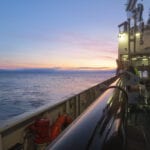
Of course, it is also very important to stop and enjoy the amazing views! I personally thought the sunset reflected in the freshly washed core, with sea ice drifting by, was especially picturesque, and since we will soon enter into polar night, it was all the more important to appreciate the moment. -
Chief Scientist’s Diary: Jochen Knies
October 26, 2019: Bend it like Beckham.
Well, things can go terribly wrong during an Arctic Expedition. Always expect the unexpected. We bend the Calypso Giant Piston corer on the first station on the Vestnesa Ridge, Northwest of Svalbard. We thought we had control of the sediments we were supposed to core. ( This is why a good geophysical survey is important!) Unfortunately the core came up on deck with an angle of more than 40 degrees. The good thing though: we saved 6 meter of core material, which will hopefully provide us with an explanation as to why this happened. A big applause to the crew onboard of RV “Kronprins Haakon” who saved our core material. We have learned a lesson and will shorten the piston core from ~25 m down to ~15 m, at least for the Vestnesa Ridge. Honestly, I would appreciate ONE boring day without any surprises. Just ordinary nine-to-five, you know. However, the crew feels otherwise. The reason that they love their job. is because something unexpected is bound to happen. We will see what’s surprises are coming next.

The crew members Aleksander and Jan Erik enjoying a well deserved cup of coffee after saving the core. Photo: Jochen Knies -
Creating lots of sound without too much noise
Text: Frances Cooke
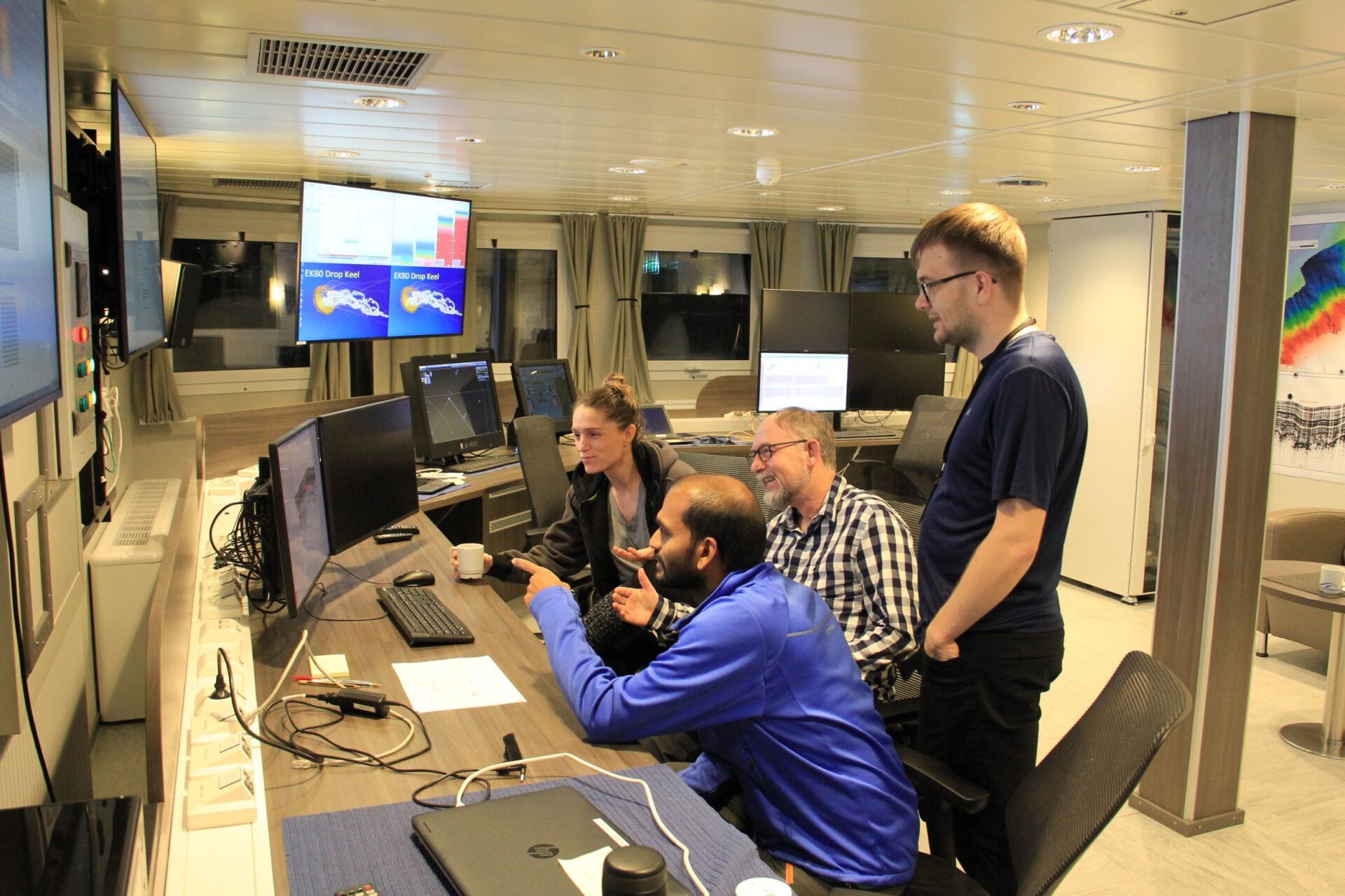
This is my first cruise aboard the Kronprins Haakon. It is a smooth sailing vessel, even while we are ice breaking. It is an extremely comfortable environment to be working in, you could say a little too luxurious for a scientific expedition! I am here to work with the acoustics. This is sound sent out from the vessel as a “ping” or a “chirp” and echoed back. The acoustics provide important geological, geophysical and biological information such as sediment thickness, presence of gas, and shallow buried features. This is necessary for our coring operations. While the coring teams are braving the freezing cold temperatures on deck, waiting eagerly for the cores to come onboard, the acousticians are sitting back, with a cup of coffee, watching the data scroll across the screen from the warmth of the operations room!

EM302 Bathymetry surface gridded at 40m at approximately 160 metres below sea level (blue is deepest). Seafloor displays ice berg scours. We already have some impressive imagery from our multibeam EM302 system (Figure 1). We completed the multibeam surveying last night over an area known for gas seeps. While “mowing the lawn” we actively watched for seeps in the water column, so that we could go back after the survey, and take water samples. I was off-shift sleeping and missed the show. There will be plenty of other opportunities this cruise. After acquiring multibeam data we first have to remove any unwanted pings (a process hydrographic surveyors refer to as “killing dots”) before creating a bathymetric map which is the topography of the seafloor. A seafloor etched by iceberg plough marks (Figure 1), large depressions formed by slow episodic release of gases, or mounds bulging out from the seafloor, formed by sudden upward flow of sediment, are all extremely pleasing on the eye and fascinating to study!
Geophysics is about visualizing what we cannot see. From tiny bubbles in the water column, to extremely large (metre to kilometre scale) features in the sub-surface. To be able to collect this data so quickly and so seamlessly, is extremely satisfying.
The recent advances in technology allow us to run large swaths of bathymetry (typically 4.5 x the water depth); where previously, using single beam echo-sounders, survey time would have been days rather than hours. We also no longer throw dynamite off the back of the ship to create sound for our seismic data collection!
What I also enjoy about geophysics is combining multiple datasets. We are currently profiling beneath the sediment surface using our sub-bottom profiler SBP300. This is a very high resolution seismic system. In a previous cruise, conventional multi-channel 2D seismic (MCS) data were collected across the same location on a previous cruise. We are able to see much more detail using the SBP300, which makes a large difference for the purpose of coring on this cruise. The advantage of using both high resolution shallow seismic and MCS is the ability to work at different depths and geological time.

Comparison of multi-channel seismic line (CAGE cruise 17-3) (above) and sub-bottom profiler line (below). Blue line on both profiles represents 130,000 year marker acquired from a core, collected from a previous cruise. After completion of the multi-beam survey at Superstation 3, the plan was to deploy both the multi-corer and gravity core, however the multi-corer returned just 12cm of sediment, which was expected, after poor sound penetration, observed on the SBP300. It was decided not to deploy the gravity core at this site – we don’t want any “bananas” (coring instrument bent by impenetrable seafloor). We are now on our way to a more core friendly location with preferably thick overlying sediment for our next Calypso core deployment. Wish us luck!
-
Core on deck? All hands on deck!
Text and photos: Mariana da Silveira Ramos Esteves, Follow Mariana on Twitter for more Arctic science updates: @tweetmariana
After some days of delays testing equipment, weather holds, and sea sickness, there was a renewed energy on the morning of day four. Finally(!) the first coring equipment was deployed and we couldn’t wait to see what we would get and to get started with the core processing! The first four cores to come on deck were from the multi-corer: one core was immediately sampled for later sediment analyses; two of the cores were sampled for DNA analyses; and the last core was stored in the cooling room as an archive.

Kristine Steinsland preparing two of the multi-corer cores for DNA sampling. These cores are some 50 cm long. While the first cores from the multi-corer were being cleaned, labelled and sampled, the calypso corer technicians were busy on deck in the cold teaching the ships crew how to prepare the giant calypso corer for deployment. Since this was the first time that the giant calypso corer was being used on the RV Kronprins Haakon, it took a couple of hours set everything up. Team work is key on a ship, helping to make the core flow procedures work efficiently. Particularly since we were using three different types of coring instruments, a multi-corer, a gravity corer, and a giant calypso corer, which have the possibility to collect up to 50cm, 6m, and 30m respectively. All these instruments require a lot of attention during the deployment and retrieval, meaning that scientists, technicians and the ship’s crew have to work together to make this work.

Scientists, technicians and the ship’s crew all working together to prepare the calypso corer which can retrieve up to 30 meter long sediment cores. Warm clothing and good waterproof gloves (and lots of warm tea and chocolate) are essential when working out on the deck, as the freezing temperatures make it very difficult to stay outside for prolonged periods. Without any complaints about the cold the crew and the technicians work tirelessly to make this research cruise a success. Within a couple of hours the giant calypso corer was set up and ready to be used, as the scientists on board gathered around to watch the deployment, eagerly awaiting to see how much sediment would be recovered.

The deployment of the giant calypso corer is relatively straight forward. The calypso corer is lowered through the water column until it reaches a few metres above the seafloor. Then it is important for the ship to identify the desired core location. Once this is identified, the piston is released allowing it to drop into the seafloor under its own weight (check out the colourful square weights on the calypso corer!, collecting (hopefully) a long palaeo-climate record. This core is then brought back to the ship, where it is essential to keep washing it with warm water to prevent the core liner from freezing to the steel core barrel.
To help the time pass once everything is prepared for the core processing and while waiting for the giant calypso corer to return to the vessel, there were a lot of discussions and guesses on how long the core would be, as well as a little yoga to keep everyone flexible and strong for carrying the heavy 1 metre core section, which can weigh up to 10kg each.

Remi Vachon and Steve Ossim practising yoga in preparation for the heavy lifting of the core sections. While the whole process involved with using the giant calypso corer took a few hours the first time round, once the cores were on deck, the RV Kronprins Haakon had many happy and excited scientists on board working efficiently to label, sample, and store these cores for future work. Let’s hope for many more successful stations!

Very cold and slushy working conditions on deck. The giant calypso corer had to be washed with warm water to remove the mud from the outside and prevent the liner from freezing to the steel core barrel. And they say scientists have boring office jobs. -
Chief Scientist’s Diary: Jochen Knies
October 23-24, 2019: Patience now, please!
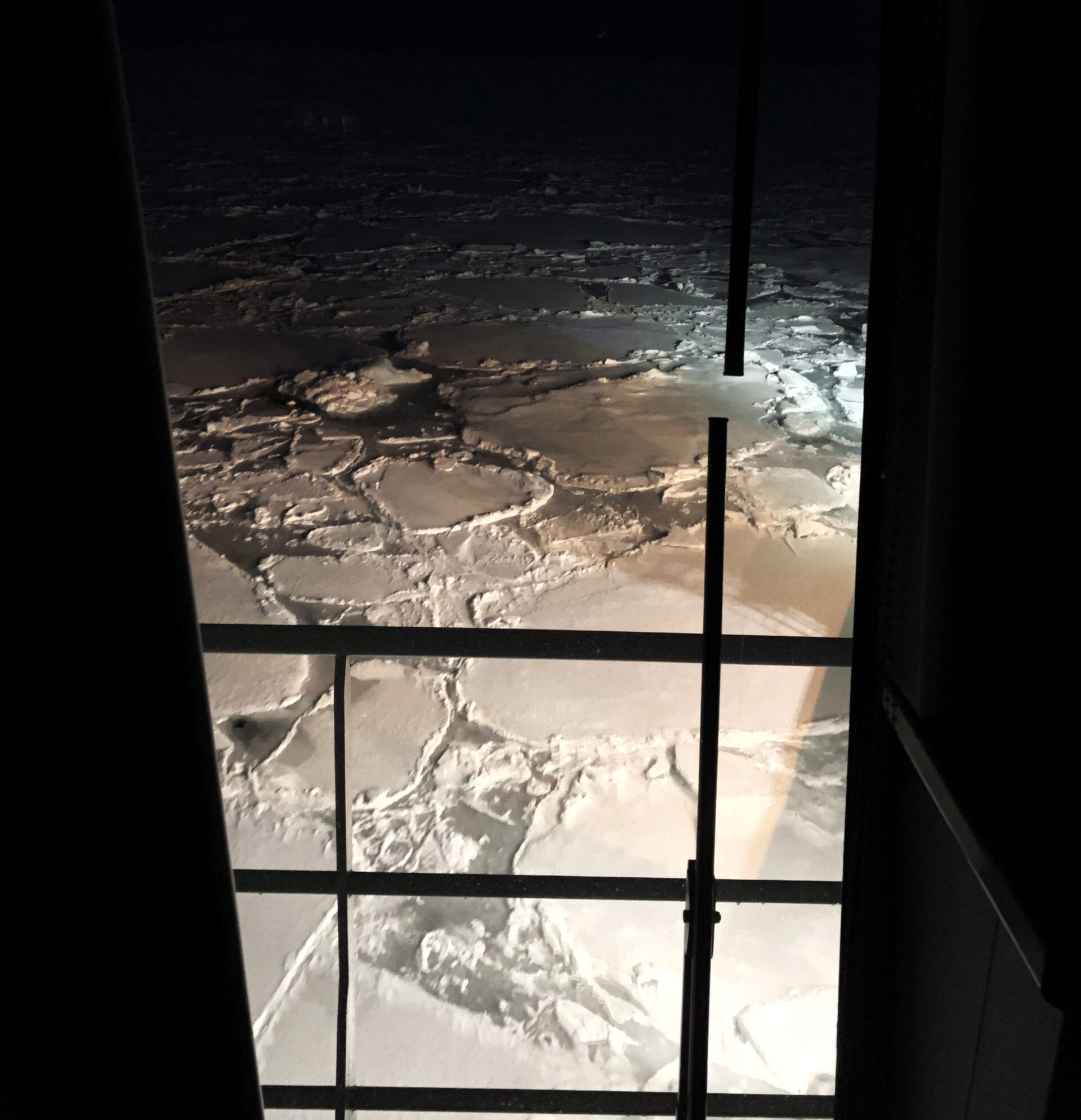
The cruise leader is supposed to design a scientific program and implement it during the cruise. In theory, all fine! What I have learned during the last two days: Patience and flexibility will save you! It was a roller coaster of emotional highs when things worked as planned, and pretty heavy lows when we encountered failures we haven’t calculated for. The sea ice is melting, yes, but it is still there to make a scientist’s life miserable. After a fair share of hassle, I got my happy ending. A great team work on deck managed to work out the second Calypso Giant Piston core (12 m), a gravity core (4 m), four tubes in the multicores, six new gas flares, and a couple of water samples above the gas flares on the northernmost station in our scientific program. I saw plenty of tired, but happy faces during dinner time. The award came after dinner with a beautiful sunset in the Arctic Ocean.

We are now heading south to pick up the Piezometer from our first station and continue the work in our gas hydrate laboratory ( which is not an actual laboratory, but the area in the ocean dedicated to specific scientific work) on the Vestnesa Ridge. People may ask what Piezometer is and why we are having it onboard. Well, I won’t provide you with complicated facts except the fact that the Piezometer is measuring pore pressure changes in the sediment below the seafloor. Still too academic? Well, I will ask the expert Nabil Sultan in our team tonight to explain it better in a later blog.
-
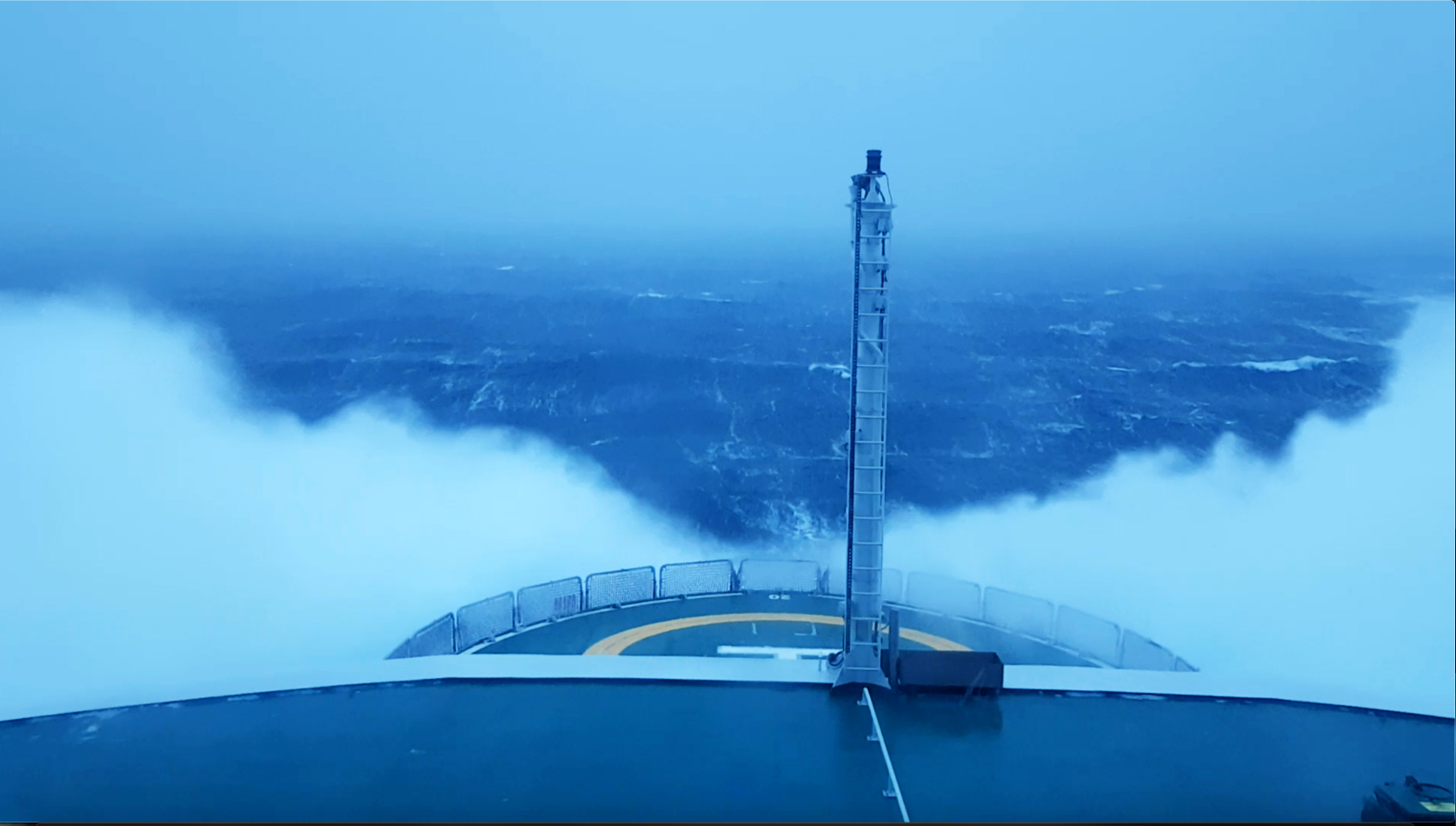
Braving the stormy seas
Text and photos: Mariana da Silveira Ramos Esteves, Follow Mariana on Twitter for more Arctic science updates: @tweetmariana
After a nine hour transit on our third day of cruise, we finally reached the first station in the Fram Strait. Unfortunately, we were put on a weather hold until further notice as high winds and large waves prevented us from initiating our work. The storm remained for the majority of the day, allowing for some dramatic pictures to be taken from the observation deck as the waves crashed against the bow (front section of the ship) and reached the helideck on deck 6! The weather hold lasted for the majority of the day and for many, even the most able seaman on-board, this was a difficult time to be on a ship as they try to get used to the motion of the ship during the storm.
Thankfully, the RV Kronprins Haakon is very stable even when passing rough seas, making it very comfortable for those on-board carrying out their day-to-day activities. Which on this day included the final preparations of the equipment, laboratories and procedures that we would undertaken once the cores arrived on deck. In addition to this, we were able to enjoy the facilities on-board the RV Kronprins Haakon, such as the observation deck, gym, library, ping-pong table, and day room. The discovery of the ping-pong table was a particular highlight for some during the transit period!

Testing the ping-pong table during the transit to the first station. Later this evening, the weather cleared up enough for us to begin our work (and get an amazing view of Svalbard). First we deployed a CTD (oceanography instrument used to measure conductivity, temperature and pressure of seawater) to collect water samples from the 900m of water column, before deploying the piezometer (an instrument used to measure ground pressure). Following this we will prepare the multi-corer and giant calypso corer.

Nabil Sultan, Pierre Guyavarch, and Mickael Rudeaut from Ifremer discussing with the engineers and technicians on board during the retrieval of the piezometer. -
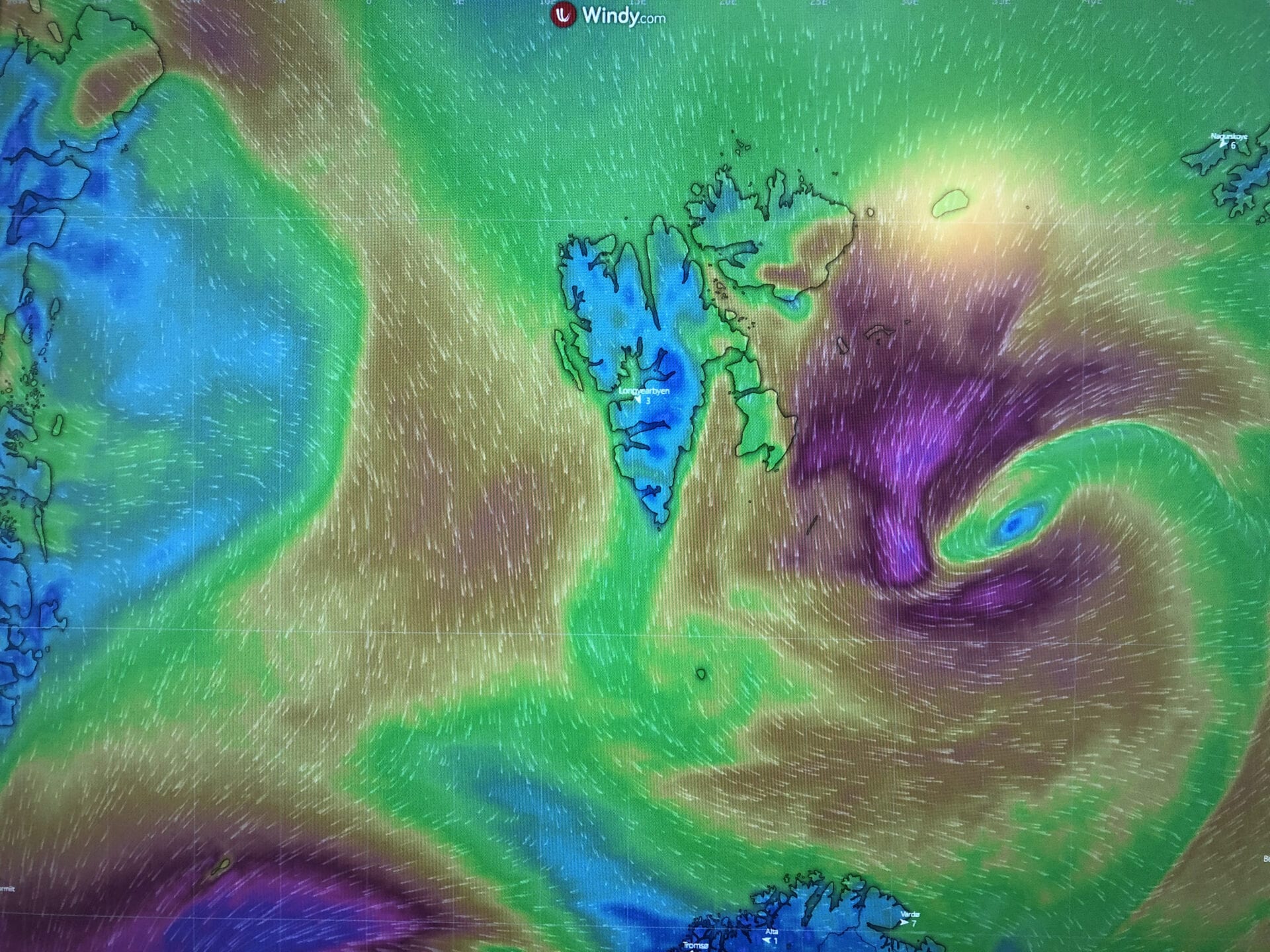
Chief Scientist’s Diary: Jochen Knies
October 21, 2019: Sea sickness medication is distributed.
We reached the first station in the morning and, as predicted, with a heavy storm. Some were prepared for it, some were caught by surprise. Medicine was distributed to everyone in need. The morning meeting went fast! All work on deck stopped for safety reasons and an alternative program started after breakfast. The data quality of the sub-bottom profiling system onboard RV Kronprins Haakon is excellent and we mapped the area of the diapir structure on the southern tip of Vestnesa Ridge. ( A diapir is a domed rock formation in which a core of rock has moved upward to pierce the overlying strata. It is often found around gas hydrates)
I had almost forgotten the fact that massive gas hydrates have been found two years ago! So, we made some extra efforts to find the right location for the Piezometer. In the meantime, I have become the “stair master”. Jumping back and forth from Deck 3 to 9, and back again to my cabin (Deck 6), and finally on Deck 3 again. 10 times a day. I don’t need a gym, that’s for sure. My preferred activity is to check the weather (wind) conditions. We waited all day long for the right conditions, and if the weather is not acceptable by 11 pm, we will have to abandon the station and sail towards the north.October 22, 2019: 150,000 years, pulled up in one core
Luckily, we stayed in position! We could finish the CTD (a collection of sensors which measure conductivity, temperature, and pressure of ocean water) before the beginning of the new day. Of course, the cruise leader has his cabin above the CTD lab, and hence moved his bedroom out on the bridge 😊. Our French colleagues worked hard the whole night and successfully launched the Piezometer at the seafloor.
Now, the whole team is excitingly awaiting the first core material. It will be a rush of people on deck! Hopefully we will manage to get the first Calypso core onboard. We have prepared a 23 m long steel pipe. It has been laying on deck for the last 2 days and looks like a big chunk of ice. Cold wind, freezing temperatures, and the sea water have converted the corer into an ice block. There goes another hour from our precious ship time.

But we were awarded! Four multicorer tubes and a 13 m long Calypso core came onboard during the afternoon. Two multicorer tubes went straight into the laboratories to prepare the samples for the ancient DNA work at the University of Bergen. The remaining two tubes were archived. The Calypso was of course the highlight of the day! Thanks to great teamwork on deck, we received 13 m of core material representing the last ca. 150.000 years. Now, we are heading north into the sea ice. We are to see the first ice flows tomorrow morning.
-
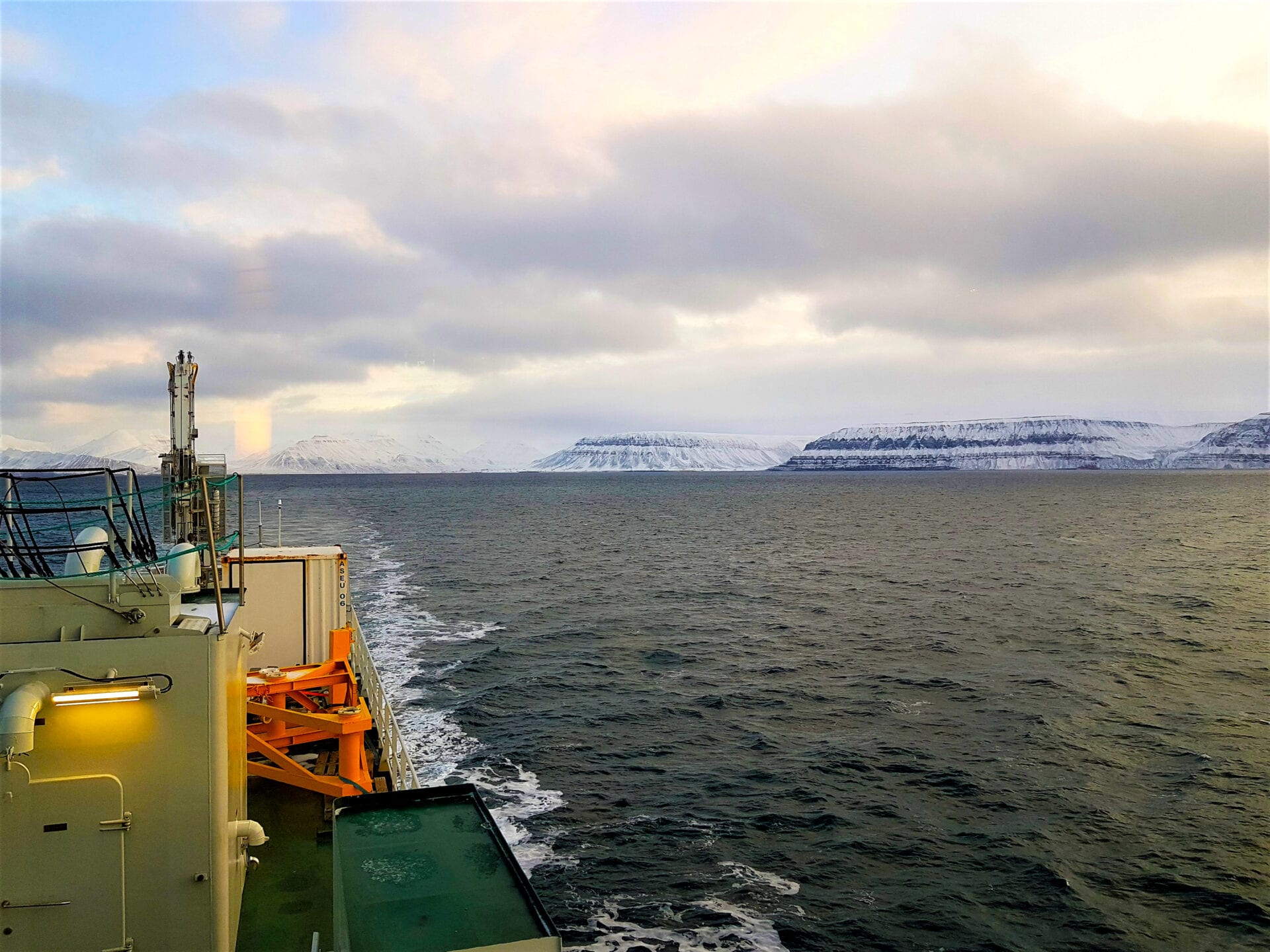
Ready, set, go! Next stop – Vestnesa Ridge in the Fram Strait
Text and photos: Mariana da Silveira Ramos Esteves, Follow Mariana on Twitter for more Arctic science updates: @tweetmariana

The coring equipment on deck. To the left you have the steel core barrels for the giant calypso corer, and to the right you have the core liners that will be placed inside the corer and used for the collection of the marine sediment cores.Photo: Mariana Esteves The final preparations for the core flow – which is a procedure we will undertake when the long cores of ocean floor sediments arrive on deck – and sampling strategies were completed on the morning of Sunday 20th October. Equipment in the laboratories and in the hangar were set up ready for arrival to the first station. This involved a lot of creative thinking and planning to make sure that the core flow would be efficient once the first sediment core arrived on-board later this evening.

Preparations in the lab included setting up the equipment, and labelling thousands of vials and sample bags. Here we see Renata Lucchi, Simone Sauer, Nessim Douss and Przemyslaw Domel hard at work getting everything ready. By lunch time, we set off from Longyearbyen and sailed towards the center of Isfjorden to test the new calypso corer deployment system. These tests are important to ensure that the equipment will work once we get to our first sites. By 3pm (cake break time!!), the deployment instrument tests are completed and we set sail towards Vestnesa Ridge, Fram Strait, where we will arrive after 9 hours of sailing. There is a lot of excitement on board now that everything is in place and ready to go! Just a few more hours to go before we arrive at the first station and begin our shifts.

Martin Klug and Stig Monsen preparing the area where the cores will be washed, labelled and cut into 1m sections, preliminary samples taken, all prior to the cores being stored for future analyses. -
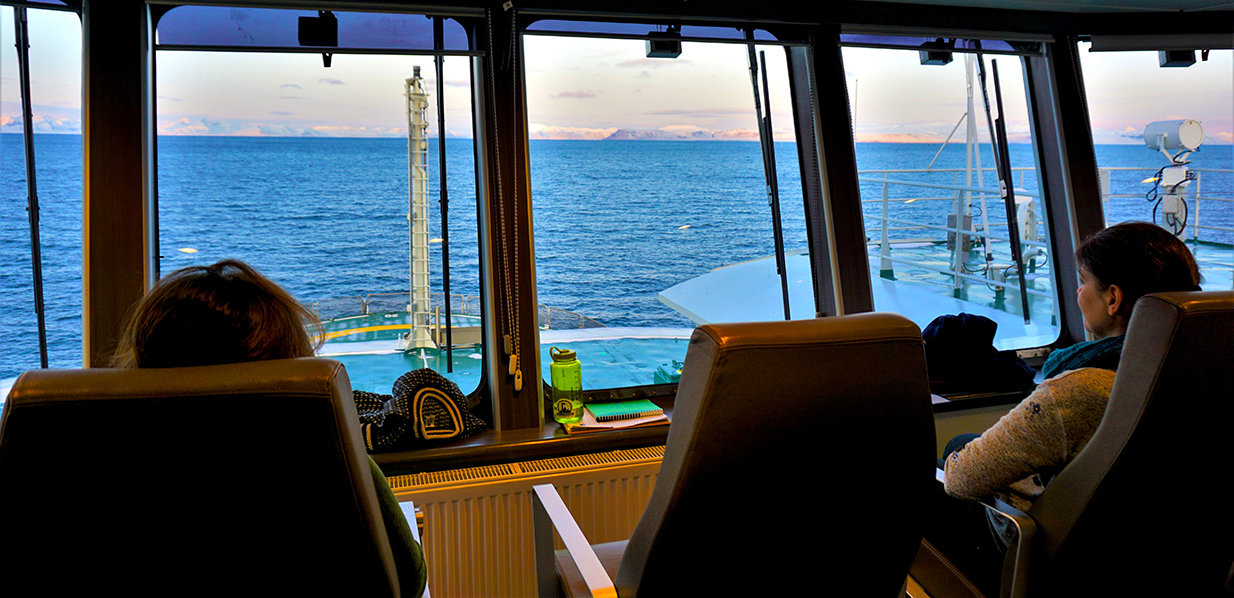
Take the tour: Research Vessel Kronprins Haakon
On the 18th October, there was a sense of excitement in the air as scientists from CAGE, UiT, NGU and numerous other institutes arrived to Longyearbyen, Svalbard, ready for their next exciting adventure. A three-week research cruise to Western and Northern Svalbard, on-board the new Norwegian icebreaker, RV Kronprins Haakon.
Text and photos: Mariana da Silveira Ramos Esteves, Follow Mariana on Twitter for more Arctic science updates: @tweetmariana

RV Kronprins Haakon moored at Longyearbyen ready for its next adventure. The RV Kronprins Haakon (KPH), built to operate in challenging ice conditions is fully equipped with the very latest high-tech equipment, enabling complex studies to be undertaken. The cruise will carry out important research for multiple projects such as, Tromsø Research Foundation funded SEAMSTRESS, and ERC funded AGENSI. Over the next few weeks we will be posting the progress of the cruise.

Safety briefing by the chief officer and first mate. It may look funny, but a survival suite is good to have. On the sleepy morning of the 19th October, scientists from all around the world, many of whom are sailing on-board the KPH for the first time, eagerly boarded the vessel ready for the expedition. We started the day with a scientific meeting by the chief scientist, Dr. Jochen Knies, who introduced us to the ship and the day’s activities, which primarily included the preparation of the equipment and procedures that will be undertaken throughout the expedition. Following this, the chief officer and first mate gave us a safety briefing and quick tour of the ship.
The KPH has 9 decks, all of which have been assigned a ‘theme’, ranging from micro- and macro-organisms in the lower decks, to marine and terrestrial mammals in the central decks, to birds and northern lights in the upper decks. Every door has either a picture of an animal, or a place name, making it very interesting to walk around and see how many you can recognise.

Euphausia superba (Antarctic Krill) on a door on the 3rd deck is a species of krill found in the Antarctic waters of the Southern Ocean. The laboratories where the marine sediment cores and samples collected will be examined is located on the 3rd deck, which is the same floor where there is a moon pool (A moon pool on a marine research vessel is an opening in the floor or base of the hull giving access to the water below, allowing technicians or researchers to lower tools and instruments into the sea). Here, the main drilling and water sampling operations take place. Hundreds of samples will pass through the moon pool during these three weeks, ready for further investigations at the scientists home institutes. The laboratories are fully equipped for high quality research and sample processing.

Dr. Renata Lucchi giving us a tour of the brand new educational laboratory on-board. The ship was fully operational and delivered to the Norwegian research institutions in 2018. Located on the 5th deck is the mess hall where we can enjoy delicious meals and snacks throughout the day. In addition, the day room where scientists can meet, discuss and have a warm drink, is located here.

Scientists enjoying their break with some nice discussions, warm drinks and view of the port in Lonyearbyen! The upper decks have a combination of both living and work spaces, with the instrument room where the geophysical data will be collected and processed is located on deck 7. The bridge and control room is located in deck 8 and on deck 9 is the observation deck where scientists can meet and relax, while watching the land- and seascapes go by.

Instrument room ready to go! Follow our progress with future blog posts from myself and other scientists on board!
-
Chief Scientist’s Diary: Jochen Knies
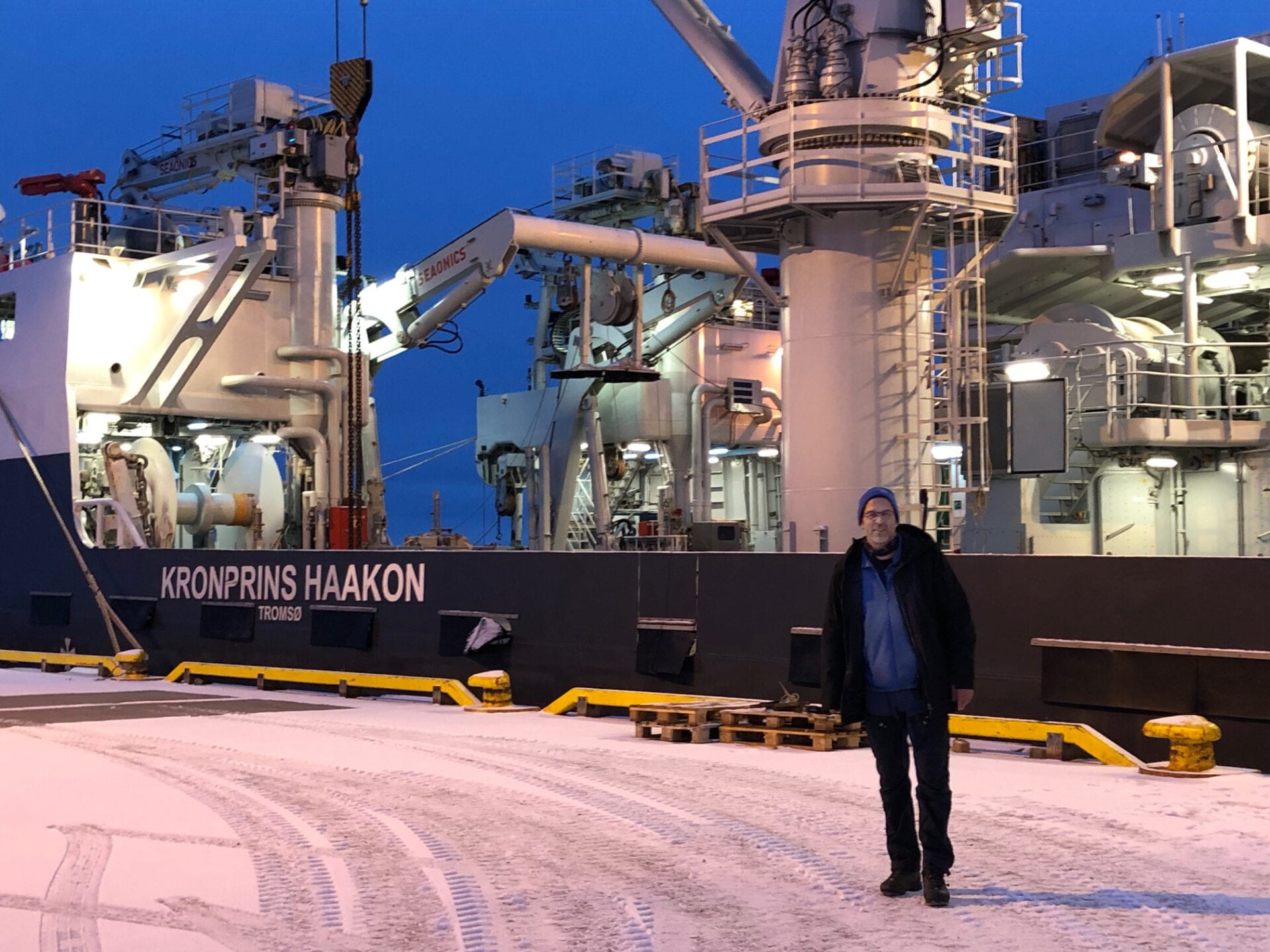
The state-of-the-art icebreaker RV Kronprins Haakon is currently deployed to the Arctic – Atlantic Gateway to collect data on methane release from the ocean floor. Along for the ride is coring equipment that will, for the first time, acquire up to 25-meter-long sediment samples in the study area. Here you can read the diary from the cruise by the Chief Scientist Jochen Knies.
October 18, 2019: A very distant past indeed!
When you call yourself a “Polar Researcher”, which I have been doing for the past 30 years, the next three weeks will be like a dream come true. Ever since I spent my first 4 months in the Arctic in 1991, I wished to realize our upcoming plans. I arrived on board of “Kronprins Haakon” today and was impressed by the capabilities of the vessel. Our main goal for this cruise is to get samples from the seafloor and below which will cover an age range of several 100.000 years. We may even be able to look back millions of years if we are lucky! For this purpose, we have sent tons of equipment to Longyearbyen which arrived at the ship this morning. Particularly, the so-called “Giant Calypso Piston Coring” system is the equipment, which will make my Arctic dream some true. Why would samples from the seafloor with an age of more than 100.000 years interesting for the world, you may ask. Well, the answer is relatively simple. More than 100.000 years ago the climate on Svalbard and surrounding Arctic areas was probably very similar to what we will face in the near future: Very little sea ice in the Arctic and very few glaciers on Svalbard. If we find samples with an age of millions of years, we will even find evidence when the Arctic was completely sea-ice free and all glaciers on Svalbard were melted away. So far, this is all unknown, and we may be first ones to find it out. Very exciting indeed. Tomorrow I will tell about the second major goal we have. Namely, why is the seafloor outside of Svalbard is leaking methane, a very powerful greenhouse gas?

October 19, 2019: We forgot a scientist on shore!
On the second day of our adventure, we tested our equipment in the Isfjorden. While facing all the challenges Polar climate can offer to ship (technical), crew (physical), and scientists (patience), we realized that we had forgotten a scientist ashore! We traced him in Longyearbyen and caught up with him later today. Now, our gang is complete and the mood is excellent! Tonight, we will finalize the loading of the last equipment and will hopefully sail northwards tomorrow morning. The goal is to find the leaking greenhouse gas methane on the seafloor. While we know where and what is leaking, we do not really understand the mechanisms behind it. To better understand this phenomenon, we, the Norwegian scientists and engineers from Universities of Tromsø and Bergen, The Geological Survey of Norway, and Norwegian Geotechnical Institute have teamed up with geotechnical experts from France and Italy. With the fantastic capabilities of “Kronprins Haakon”, we will try to make a difference! We will deploy advanced equipment already on the very first location to study the reasons why we sometimes find huge plumes of methane gas leaking into the ocean. It will be very exciting, and I am looking forward to the intense discussion onboard during the planned operation.

Majestic surroundings of Svalbard Archipelago in the Arctic Ocean make testing the equipment a breathtaking experience. Photo: Jochen Knies October 20, 2019: Heading into a storm
Finally, after two days of intensive mobilisation and testing of equipment, we are on our way to the first station west of Svalbard. The labs are prepared, and all coring equipment and the Piezometer for pore pressure measurements are ready to be deployed. The work on deck is very challenging with air temperature of minus 7 degrees Celsius and significant wind-chill effects. With the expected stormy weather during the next few hours, the work on deck will be even more challenging. However, our engineers are tough and capable and we trust them to handle these extreme conditions. In the meantime, we enjoy the hospitality onboard “Kronprins Haakon” with excellent food and the highlight of the day: cake at 3 pm! The team is enthusiastic, eager to work, and the spirits are high!

Slushy deck not withstanding, the work must go on in chilly conditions. Luckily we follow the Norwegian saying: There is no such thing as bad weather, only bad clothes. Photo: Jochen Knies 
Good bye Terra Firma. Off to the open Arctic ocean and into first serious storm of the season. Photo: Jochen Knies