Research Article: AU

graphical abstract

Title:
Low Pressure Carbonylation of Benzyl Carbonates and Carbamates for Applications in 13C Isotope Labeling and Catalytic CO2 Reduction

Abstract:
Herein, we report a methodology to access isotopically labeled esters and amides from carbonates and carbamates employing an oxygen deletion strategy. This methodology utilizes a decarboxylative carbonylation approach for isotope labeling with near stoichiometric, ex situ generated 12C, or 13C carbon monoxide. This reaction is characterized by its broad scope, functional group tolerance, and high yields, which is showcased with the synthesis of structurally complex molecules. A complementary method that operates by the catalytic in situ generation of CO via the reduction of CO2 liberated during decarboxylation has also been developed as a proof-of-concept approach that CO2-derived compounds can be converted to CO-containing frameworks. Mechanistic studies provide insight into the catalytic steps which highlight the impact of ligand choice to overcome challenges associated with low-pressure carbonylation methodologies, along with rational for the development of future methodologies.

Find a list of publications by NordCO2 members on our Publications page 🙂
Research Article: UiT

graphical abstract

Title:
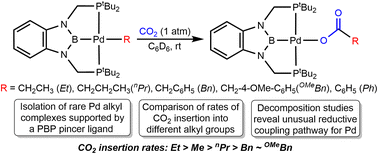
Comparative study of CO2 insertion into pincer supported palladium alkyl and aryl complexes

Abstract:
The insertion of CO2 into metal alkyl bonds is a crucial elementary step in transition metal-catalyzed processes for CO2 utilization. Here, we synthesize pincer-supported palladium complexes of the type (tBuPBP)Pd(alkyl) (tBuPBP = B(NCH2PtBu2)2C6H4; alkyl = CH2CH3, CH2CH2CH3, CH2C6H5, and CH2-4-OMe-C6H4) and (tBuPBP)Pd(C6H5) and compare the rates of CO2 insertion into the palladium alkyl bonds to form metal carboxylate complexes. Although, the rate constant for CO2 insertion into (tBuPBP)Pd(CH2CH3) is more than double the rate constant we previously measured for insertion into the palladium methyl complex (tBuPBP)Pd(CH3), insertion into (tBuPBP)Pd(CH2CH2CH3) occurs approximately one order of magnitude slower than (tBuPBP)Pd(CH3). CO2 insertion into the benzyl complexes (tBuPBP)Pd(CH2C6H5) and (tBuPBP)Pd(CH2-4-OMe-C6H4) is significantly slower than any of the n-alkyl complexes, and CO2 does not insert into the palladium phenyl bond of (tBuPBP)Pd(C6H5). While (tBuPBP)Pd(CH2CH3) and (tBuPBP)Pd(CH2CH2CH3) are resistant to β-hydride elimination, we were unable to synthesize complexes with n-butyl, iso-propyl, and tert-butyl ligands due to β-hydride elimination and an unusual reductive coupling, which involves the formation of new C–B bonds. This reductive process also occurred for (tBuPBP)Pd(CH2C6H5) at elevated temperature and a related process involving the formation of a new H–B bond prevented the isolation of (tBuPBP)PdH. DFT calculations provide insight into the relative rates of CO2 insertion and indicate that steric factors are critical. Overall, this work is one of the first comparative studies of the rates of CO2 insertion into different metal alkyl bonds and provides fundamental information that may be important for the development of new catalysts for CO2 utilization.

Find a list of publications by NordCO2 members on our Publications page 🙂

Research Article: AU

graphical abstract

Title:
Nickel-Catalyzed Carbonylative Coupling of Alkylzinc Reagents and α-Bromo-α,α-difluoroacetamides

Abstract:
We report a nickel-catalyzed carbonylative cross-coupling of alkyl zinc reagents with α,α-difluorobromoacetamides to obtain α,α,-difluoro-β-ketoamides in moderate to good yields. The reaction is catalyzed by a bench-stable nickel(II) pincer complex, in contrast to other reports involving palladium catalysts. The carbonylative reaction is performed in a two-chamber system (COware) in which carbon monoxide (CO) is generated ex situ from the solid precursor SilaCOgen, and then consumed in the adjacent chamber. The reaction operates at low temperatures using near-stoichiometric amounts of CO. Isotopically labeled products can be effortlessly accessed, as demonstrated by using 13C-labeled SilaCOgen.

Find a list of publications by NordCO2 members on our Publications page 🙂

Research Article: HU

graphical abstract

Title:
Dual Nickel Photocatalysis for O-Aryl Carbamate Synthesis from Carbon Dioxide

Abstract:
We report the use of dual nickel photocatalysis in the synthesis of O-aryl carbamates from aryl iodides or bromides, amines, and carbon dioxide. The reaction proceeded in visible light, at ambient carbon dioxide pressure, and without stoichiometric activating reagents. Mechanistic analysis is consistent with a Ni(I–III) cycle, where the active species is generated by the photocatalyst. The rate-limiting steps were the photocatalyst-mediated reduction of Ni(II) to Ni(I) and subsequent oxidative addition of the aryl halide. The physical properties of the photocatalyst were critical for promoting formation of O-aryl carbamates over various byproducts. Nine new phthalonitrile photocatalysts were synthesized, which exhibited properties that were vital to achieve high selectivity and activity.

Find a list of publications by NordCO2 members on our Publications page 🙂

Research Article: KTH and UU

graphical abstract

Title:
Alternating Metal-Ligand Coordination Improves Electrocatalytic CO2 Reduction by a Mononuclear Ru Catalyst

Abstract:
Molecular electrocatalysts for CO2-to-CO conversion often operate at large overpotentials, due to the large barrier for C−O bond cleavage. Illustrated with ruthenium polypyridyl catalysts, we herein propose a mechanistic route that involves one metal center that acts as both Lewis base and Lewis acid at different stages of the catalytic cycle, by density functional theory in corroboration with experimental FTIR. The nucleophilic character of the Ru center manifests itself in the initial attack on CO2 to form [Ru-CO2]0, while its electrophilic character allows for the formation of a 5-membered metallacyclic intermediate, [Ru-CO2CO2]0,c, by addition of a second CO2 molecule and intramolecular cyclization. The calculated activation barrier for C−O bond cleavage via the metallacycle is decreased by 34.9 kcal mol−1 as compared to the non-cyclic adduct in the two electron reduced state of complex 1. Such metallacyclic intermediates in electrocatalytic CO2 reduction offer a new design feature that can be implemented consciously in future catalyst designs.

Find a list of publications by NordCO2 members on our Publications page 🙂