Research Article: UiT

graphical abstract

Title:
Mechanistic Investigations of the Asymmetric Hydrogenation of Enamides with Neutral Bis(phosphine) Cobalt Precatalysts

Abstract:
The mechanism of the asymmetric hydrogenation of prochiral enamides by well-defined, neutral bis(phosphine) cobalt(0) and cobalt(II) precatalysts has been explored using(R,R)-iPrDuPhos ((R,R)-iPrDuPhos = (+)-1,2-bis[(2R,5R)-2,5-diisopropylphospholano]benzene) as a representative chiral bis(phosphine) ligand. A series of (R,R)-(iPrDuPhos)Co(enamide) (enamide = methyl-2-acetamidoacrylate (MAA), methyl(Z)-α-acetamidocinnamate (MAC), and methyl(Z)-acetamido(4-fluorophenyl)acrylate (4FMAC)) complexes (1-MAA1-MAC, and 1-4FMAC), as well as a dinuclear cobalt tetrahydride, [(R,R)-(iPrDuPhos)Co]22-H)3(H) (2), were independently synthesized, characterized, and evaluated in both stoichiometric and catalytic hydrogenation reactions. Characterization of (R,R)-(iPrDuPhos)Co(enamide) complexes by X-ray diffraction established the formation of the pro-(R) diastereomers in contrast to the (S)-alkane products obtained from the catalytic reaction. In situ monitoring of the cobalt-catalyzed hydrogenation reactions by UV–visible and freeze-quench electron paramagnetic resonance spectroscopies revealed (R,R)-(iPrDuPhos)Co(enamide) complexes as the catalyst resting state for all the three enamides studied. Variable time normalization analysis kinetic studies of the cobalt-catalyzed hydrogenation reactions in methanol established a rate law that is first order in (R,R)-(iPrDuPhos)Co(enamide) and H2 but independent of the enamide concentration. Deuterium-labeling studies, including measurement of an H2/D2 kinetic isotope effect and catalytic hydrogenations with HD, established an irreversible H2 addition step to the bound enamide. Density functional theory calculations support that this step is both rate and selectivity determining. Calculations, as well as HD-labeling studies, provide evidence for two-electron redox cycling involving cobalt(0) and cobalt(II) intermediates during the catalytic cycle. Taken together, these experiments support an unsaturated pathway for the [(R,R)-(iPrDuPhos)Co]-catalyzed hydrogenation of prochiral enamides.

Find a list of publications by NordCO2 members on our Publications page 🙂

Research Article: UiT

graphical abstract

Title:
Cobalt-Catalyzed Asymmetric Hydrogenation of Enamides: Insights into Mechanisms and Solvent Effects

Abstract:
The mechanistic details of the (PhBPE)Co-catalyzed asymmetric hydrogenation of enamides are investigated using computational and experimental approaches. Four mechanistic possibilities are compared: a direct Co(0)/Co(II) redox path, a metathesis pathway, a nonredox Co(II) mechanism featuring an aza-metallacycle, and a possible enamide–imine tautomerization pathway. The results indicate that the operative mechanism may depend on the type of enamide. Explicit solvent is found to be crucial for the stabilization of transition states and for a proper estimation of the enantiomeric excess. The combined results highlight the complexity of base-metal-catalyzed hydrogenations but do also provide guiding principles for a mechanistic understanding of these systems, where protic substrates can be expected to open up nonredox hydrogenation pathways.

Find a list of publications by NordCO2 members on our Publications page 🙂

Research Article: UiT

graphical abstract

Title:
Room-Temperature-Stable Magnesium Electride via Ni(II) Reduction

Abstract:
Herein, we report the synthesis of highly reduced bipyridyl magnesium complexes and the first example of a stable organic magnesium electride supported by quantum mechanical computations and X-ray diffraction. These complexes serve as unconventional homogeneous reductants due to their high solubility, modular redox potentials, and formation of insoluble, non-coordinating byproducts. The applicability of these reductants is showcased by accessing low-valent (bipy)2Ni(0) species that are challenging to access otherwise.

Find a list of publications by NordCO2 members on our Publications page 🙂

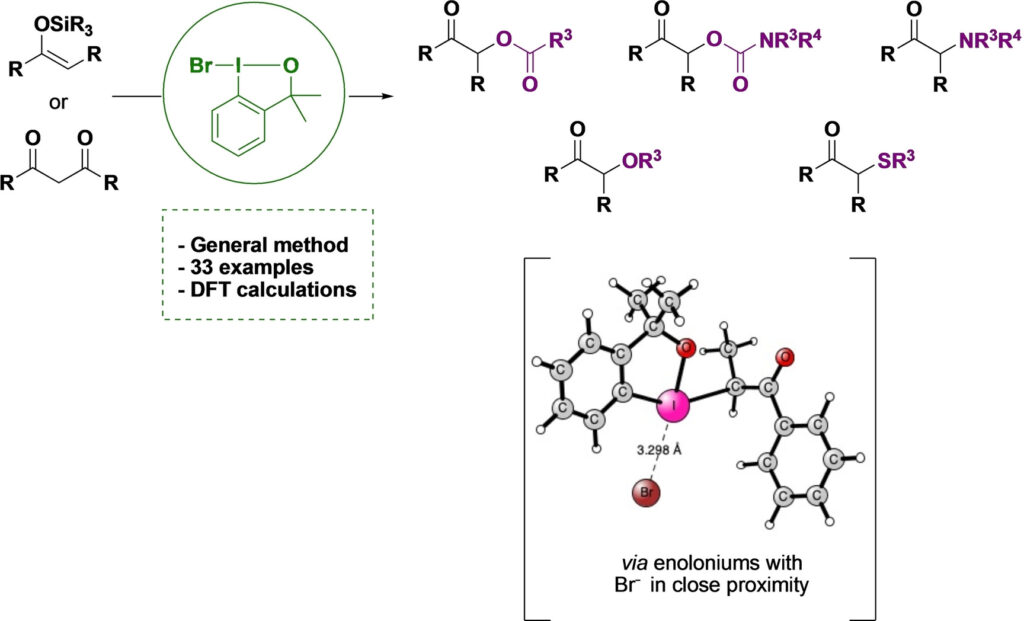
Research Article: SU

graphical abstract

Title:
An Expedient Method for the Umpolung Coupling of Enols with Heteronucleophiles

Abstract:
In this paper, we present an unprecedented and general umpolung protocol that allows the functionalization of silyl enol ethers and of 1,3-dicarbonyl compounds with a large range of heteroatom nucleophiles, including carboxylic acids, alcohols, primary and secondary amines, azide, thiols, and also anionic carbamates derived from CO2. The scope of the reaction also extends to carbon-based nucleophiles. The reaction relies on the use of 1-bromo-3,3-dimethyl-1,3-dihydro-1λ3[d][1,2]iodaoxole, which provides a key α-brominated carbonyl intermediate. The reaction mechanism has been studied experimentally and by DFT, and we propose formation of an unusual enolonium intermediate with a halogen-bonded bromide.

Find a list of publications by NordCO2 members on our Publications page 🙂