Research Article: UU

graphical abstract

Title:
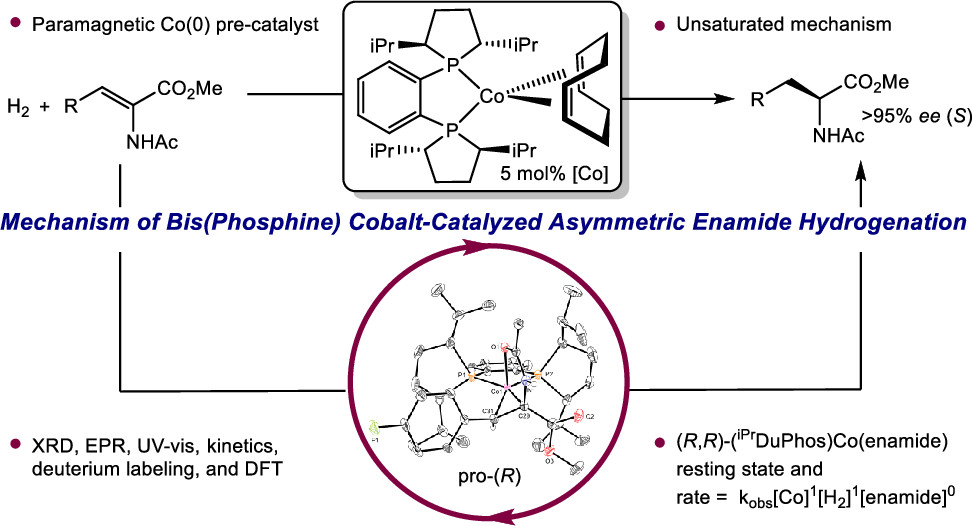
Self-Assembled Liposomes Enhance Electron Transfer for Efficient Photocatalytic CO2 Reduction

Abstract:
Light-driven conversion of CO2 to chemicals provides a sustainable alternative to fossil fuels, but homogeneous systems are typically limited by cross reactivity between different redox half reactions and inefficient charge separation. Herein, we present the bioinspired development of amphiphilic photosensitizer and catalyst pairs that self-assemble in lipid membranes to overcome some of these limitations and enable photocatalytic CO2 reduction in liposomes using precious metal-free catalysts. Using sodium ascorbate as a sacrificial electron source, a membrane-anchored alkylated cobalt porphyrin demonstrates higher catalytic CO production (1456 vs 312 turnovers) and selectivity (77 vs 11%) compared to its water-soluble nonalkylated counterpart. Time-resolved and steady-state spectroscopy revealed that self-assembly facilitates this performance enhancement by enabling a charge-separation state lifetime increase of up to two orders of magnitude in the dye while allowing for a ninefold faster electron transfer to the catalyst. Spectroelectrochemistry and density functional theory calculations of the alkylated Co porphyrin catalyst support a four-electron-charging mechanism that activates the catalyst prior to catalysis, together with key catalytic intermediates. Our molecular liposome system therefore benefits from membrane immobilization and provides a versatile and efficient platform for photocatalysis.

Find a list of publications by NordCO2 members on our Publications page 🙂
Research Article: AU

graphical abstract

Title:
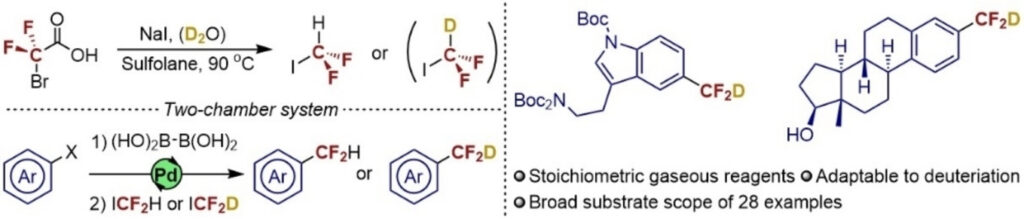
Pd-Catalyzed Difluoromethylations of Aryl Boronic Acids, Halides, and Pseudohalides with ICF2H Generated ex Situ

Abstract:
An expedient ex-situ generation of difluoroiodomethane (DFIM) and its immediate use in a Pd-catalyzed difluoromethylation of aryl boronic acids and ester derivatives in a two-chamber reactor is reported. Heating a solution of bromodifluoroacetic acid with sodium iodide in sulfolane proved to be effective for the generation of near stoichiometric amounts of DFIM for the ensuing catalytic coupling step. A two-step difluoromethylation of aryl (pseudo)halides with tetrahydroxydiboron as a low-cost reducing agent, both promoted by Pd catalysis, proved effective to install this fluorine-containing C1 group onto several pharmaceutically relevant molecules. Finally, the method proved adaptable to deuterium incorporation by simply adding D2O to the DFIM-generating chamber.

Find a list of publications by NordCO2 members on our Publications page 🙂

Research Article: KTH and UU

graphical abstract

Title:
Microscopic Insights into Cation-Coupled Electron Hopping Transport in a Metal–Organic Framework

Abstract:
Electron transport through metal–organic frameworks by a hopping mechanism between discrete redox active sites is coupled to diffusion-migration of charge-balancing counter cations. Experimentally determined apparent diffusion coefficients, Deapp, that characterize this form of charge transport thus contain contributions from both processes. While this is well established for MOFs, microscopic descriptions of this process are largely lacking. Herein, we systematically lay out different scenarios for cation-coupled electron transfer processes that are at the heart of charge diffusion through MOFs. Through systematic variations of solvents and electrolyte cations, it is shown that the Deapp for charge migration through a PIZOF-type MOF, Zr(dcphOH-NDI) that is composed of redox-active naphthalenediimide (NDI) linkers, spans over 2 orders of magnitude. More importantly, however, the microscopic mechanisms for cation-coupled electron propagation are contingent on differing factors depending on the size of the cation and its propensity to engage in ion pairs with reduced linkers, either non-specifically or in defined structural arrangements. Based on computations and in agreement with experimental results, we show that ion pairing generally has an adverse effect on cation transport, thereby slowing down charge transport. In Zr(dcphOH-NDI), however, specific cation–linker interactions can open pathways for concerted cation-coupled electron transfer processes that can outcompete limitations from reduced cation flux.

Find a list of publications by NordCO2 members on our Publications page 🙂
Research Article: UiT and HU

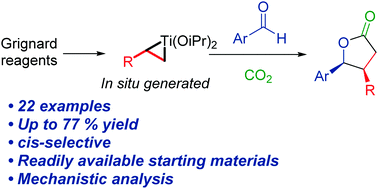
The first NordCO2 collaboration paper of the year is from UiT and HU, involving PhD students Aleksi (HU), Dat (UiT), and Jere (HU) from Kathrin’s and Timo’s groups. Together, they studied the the synthesis of butyrolactones from CO2 using  titanacyclopropane as mediator.

Graphical abstract: Titanium isopropoxide-mediated cis-selective synthesis of 3,4-substituted butyrolactones from CO2

Title:
Titanium isopropoxide-mediated cis-selective synthesis of 3,4-substituted butyrolactones from CO2

Abstract:
We report a Ti(OiPr)4-mediated multicomponent reaction, which produces 3,4-substituted cis-δ-lactones from alkyl magnesium chloride, benzaldehyde and CO2. The key intermediate, titanacyclopropane, is formed in situ from Ti(OiPr)4 and a Grignard reagent, which enables 1,2-dinucleophilic reactivity that is used to insert carbon dioxide and an aldehyde. An alternative reaction route is also described where a primary alkene is used to create the titanacyclopropane. A computational analysis of the elementary steps shows that the carbon dioxide and the aldehyde insertion proceeds through an inner-sphere mechanism. A variety of cis-butyrolactones can be synthesized with up to 7 : 1 diastereoselectivity and 77% yield.

Find a list of publications by NordCO2 members on our Publications page 🙂
Research Article: UiT

NordCO2 postdoc Ljiljana Pavlovic and PI Kathrin Hopmann have collaborated with the Hazari Group from Yale for their study on “the insertion of CO2 into palladium and nickel methyl complexes supported by RPBP […] pincer ligands”. They performed the computational analysis part of the study, where they investigated the plausible pathways for insertion.

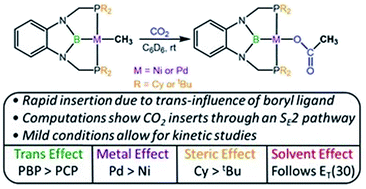
Graphical abstract: Ligand and solvent effects on CO2 insertion into group 10 metal alkyl bonds

Title:
Ligand and solvent effects on CO2 insertion into group 10 metal alkyl bonds

Abstract:
The insertion of carbon dioxide into metal element σ-bonds is an important elementary step in many catalytic reactions for carbon dioxide valorization. Here, the insertion of carbon dioxide into a family of group 10 alkyl complexes of the type (RPBP)M(CH3) (RPBP = B(NCH2PR2)2C6H4; R = Cy or tBu; M = Ni or Pd) to generate κ1-acetate complexes of the form (RPBP)M{OC(O)CH3} is investigated. This involved the preparation and characterization of a number of new complexes supported by the unusual RPBP ligand, which features a central boryl donor that exerts a strong trans-influence, and the identification of a new decomposition pathway that results in C–B bond formation. In contrast to other group 10 methyl complexes supported by pincer ligands, carbon dioxide insertion into (RPBP)M(CH3) is facile and occurs at room temperature because of the high trans-influence of the boryl donor. Given the mild conditions for carbon dioxide insertion, we perform a rare kinetic study on carbon dioxide insertion into a late-transition metal alkyl species using (tBuPBP)Pd(CH3). These studies demonstrate that the Dimroth–Reichardt parameter for a solvent correlates with the rate of carbon dioxide insertion and that Lewis acids do not promote insertion. DFT calculations indicate that insertion into (tBuPBP)M(CH3) (M = Ni or Pd) proceeds via an SE2 mechanism and we compare the reaction pathway for carbon dioxide insertion into group 10 methyl complexes with insertion into group 10 hydrides. Overall, this work provides fundamental insight that will be valuable for the development of improved and new catalysts for carbon dioxide utilization.

Find a list of publications by NordCO2 members on our Publications page 🙂