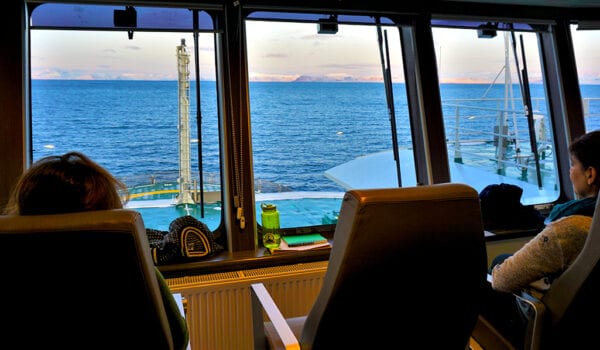
The state-of-the-art icebreaker RV Kronprins Haakon is currently deployed to the Arctic – Atlantic Gateway to collect data on methane release from the ocean floor. Along for the ride is coring equipment that will, for the first time, acquire up to 25-meter-long sediment samples in the study area. Here you can read the diary from the cruise by the Chief Scientist Jochen Knies.
October 18, 2019: A very distant past indeed!
When you call yourself a “Polar Researcher”, which I have been doing for the past 30 years, the next three weeks will be like a dream come true. Ever since I spent my first 4 months in the Arctic in 1991, I wished to realize our upcoming plans. I arrived on board of “Kronprins Haakon” today and was impressed by the capabilities of the vessel. Our main goal for this cruise is to get samples from the seafloor and below which will cover an age range of several 100.000 years. We may even be able to look back millions of years if we are lucky! For this purpose, we have sent tons of equipment to Longyearbyen which arrived at the ship this morning. Particularly, the so-called “Giant Calypso Piston Coring” system is the equipment, which will make my Arctic dream some true. Why would samples from the seafloor with an age of more than 100.000 years interesting for the world, you may ask. Well, the answer is relatively simple. More than 100.000 years ago the climate on Svalbard and surrounding Arctic areas was probably very similar to what we will face in the near future: Very little sea ice in the Arctic and very few glaciers on Svalbard. If we find samples with an age of millions of years, we will even find evidence when the Arctic was completely sea-ice free and all glaciers on Svalbard were melted away. So far, this is all unknown, and we may be first ones to find it out. Very exciting indeed. Tomorrow I will tell about the second major goal we have. Namely, why is the seafloor outside of Svalbard is leaking methane, a very powerful greenhouse gas?

October 19, 2019: We forgot a scientist on shore!
On the second day of our adventure, we tested our equipment in the Isfjorden. While facing all the challenges Polar climate can offer to ship (technical), crew (physical), and scientists (patience), we realized that we had forgotten a scientist ashore! We traced him in Longyearbyen and caught up with him later today. Now, our gang is complete and the mood is excellent! Tonight, we will finalize the loading of the last equipment and will hopefully sail northwards tomorrow morning. The goal is to find the leaking greenhouse gas methane on the seafloor. While we know where and what is leaking, we do not really understand the mechanisms behind it. To better understand this phenomenon, we, the Norwegian scientists and engineers from Universities of Tromsø and Bergen, The Geological Survey of Norway, and Norwegian Geotechnical Institute have teamed up with geotechnical experts from France and Italy. With the fantastic capabilities of “Kronprins Haakon”, we will try to make a difference! We will deploy advanced equipment already on the very first location to study the reasons why we sometimes find huge plumes of methane gas leaking into the ocean. It will be very exciting, and I am looking forward to the intense discussion onboard during the planned operation.

October 20, 2019: Heading into a storm
Finally, after two days of intensive mobilisation and testing of equipment, we are on our way to the first station west of Svalbard. The labs are prepared, and all coring equipment and the Piezometer for pore pressure measurements are ready to be deployed. The work on deck is very challenging with air temperature of minus 7 degrees Celsius and significant wind-chill effects. With the expected stormy weather during the next few hours, the work on deck will be even more challenging. However, our engineers are tough and capable and we trust them to handle these extreme conditions. In the meantime, we enjoy the hospitality onboard “Kronprins Haakon” with excellent food and the highlight of the day: cake at 3 pm! The team is enthusiastic, eager to work, and the spirits are high!