Forskningsdagene 2022
Arctic Optica will participate in this year’s “Forskningsdagene” (Research Days) event which will take place from the 21st of September to the 1st of October 2021. Our group will be presenting several fun demonstrations for the general public at the Nordnorsk vitensenter (North Norwegian Science Center). Members of our group will be sharing some simple and interactive experiments that have at their center some important and useful principles of optics. Optics is present in our everyday life. We only have to highlight it. The funding for the tools used in these experiments was partially provided by Tvibit.
General Optics
Oliver and Mathias will be demonstrating some general optics principles which you have certainly used in your everyday life.
- Reflection: mirrors and retroreflectors
- Refraction matching: hydrogel beads
- Diffraction gratings: Optica goggles
- Prisms and Lenses (convex/concave)
- Stereo microscope
- Polarization: polarizing sheets, white monitor
- Pixel visualization with a hand-held microscope
So, which principles of optics will you see in these demonstrations and how do they work?
Reflection
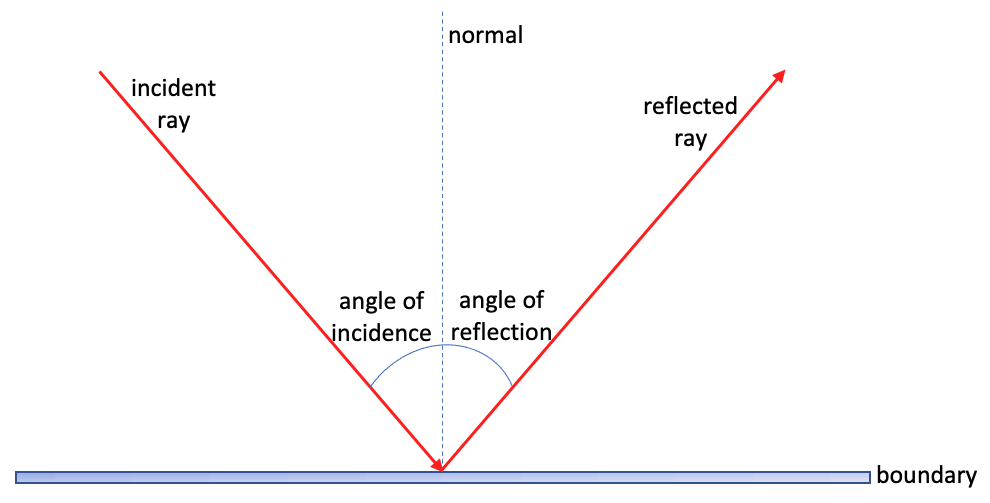
Reflection happens when light encounters a boundary between two media. In this case, at least a part of the light will be turned back to the same medium in which it was traveling before. In the following figure, Reflection happens when light encounters a boundary between two media. In this case, at least a part of the light will be turned back to the same medium in which it was traveling before. In the following figure, the ray representing the light ray before it encounters the boundary is called the “incident ray” and the light after it encounters the boundary and is reflected is called the “reflected ray”. Each of these rays forms an identical angle with respect to a line perpendicular to the boundary, called the “normal”. These angles, namely the “angle of incidence” and the “angle of reflection”, respectively, are equal to each other.
For a more detailed explanation watch the following video
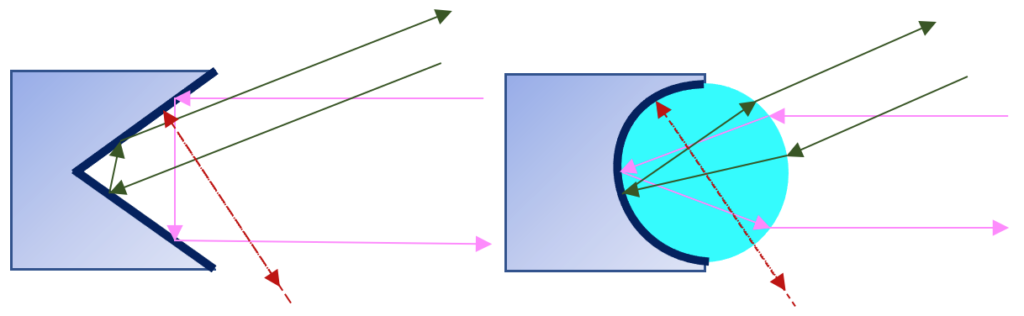
Retroreflectors use this principle to reflect light back to the direction it came from. Instead of a boundary, retroreflectors have multiple boundaries which the light is reflected from. In this way, regardless of the angle of incidence on the first mirror (boundary), the light will always return in the direction of the source. This makes them very useful for applications such as reflective garments and even for measuring the distance from the Earth to the Moon (see: Lunar RetroReflector). Retroreflectors can take different forms: they can have the shape of a prism (like the corner-cube retroreflector in our demonstration) or that of a sphere (like the ones in reflective strips). Google “refleks redder liv” for more information, videos, etc.
Refraction
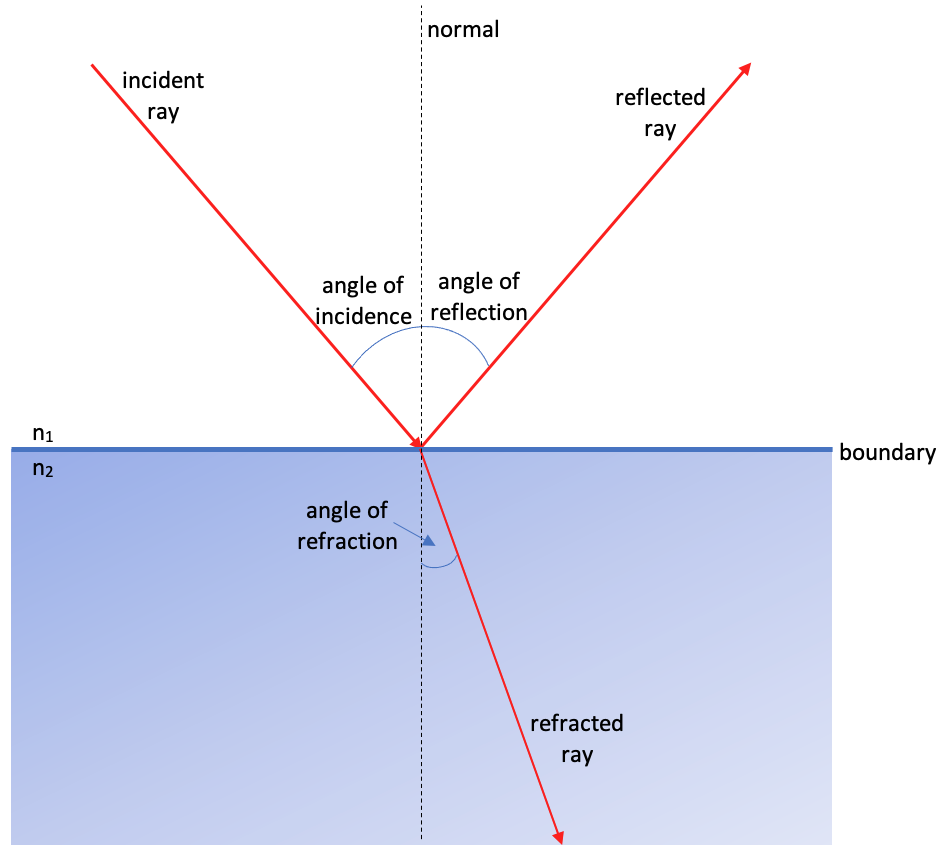
When light encounters a boundary, not all of it gets reflected, however. A part of it passes through the material. How much passes through depends on the material’s transparency. But, even when light passes from one transparent medium into another, it usually bends. This bending is due to the different refractive index (n) of the two materials. When light hits the boundary between two materials, it bends towards the material with the higher refractive index. That means that if light passes from a material with a lower refractive index into a material with a higher refractive index, it will get closer to the normal, while if it passes from a material with a higher refractive index into one with a lower refractive index, it will get farther away from the normal.
It is precisely this bending of the It is precisely this bending of the light which allows us to see the different transparent materials. In our demonstration, we show that when the refractive index of the two different materials is the same, the materials become impossible to distinguish from each other. Light passes through both of them without bending and we see only one medium where, in fact, there are two.
For a more detailed explanation of refraction, see the video
Diffraction
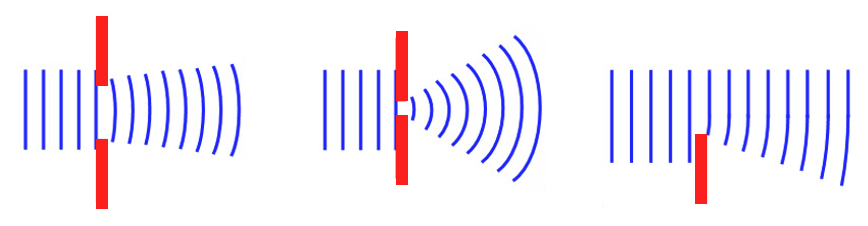
One of the ways we can think of light is as a wave. When a light wave passes near an obstacle, it bends. That is how we see shadows. The smaller the hole through the obstacle, the more the light bends. Light with different wavelengths bends differently. So, for the same size of the hole, light with a longer wavelength will bend more while light with a shorter wavelength will bend less. On the other hand, light of the same wavelength will bend more when the hole is smaller.
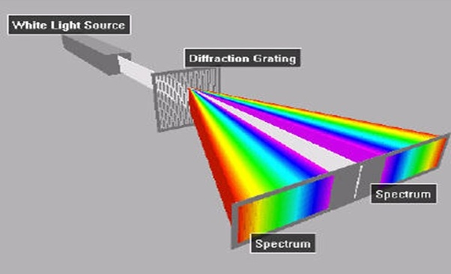
White light is indeed composed of multiple beams of different wavelengths. When white light passes through a diffraction grating, it is possible the spectrum of the light. At the center is the white light for which there is no diffraction and at the corners is the red light for which we have maximum diffraction. If you put on the Optica goggles, that is exactly what you see.
Optical Components
Optical components such as prisms and lenses are used to manipulate light in many different forms. Combinations of them can make cameras, microscopes, telescopes, etc. In our demonstrations, you will see how refraction happens in different types of lenses. When light is refracted in prisms it also separates into different wavelengths which bend at different speeds. This is called dispersion and it is the mechanism that allows us to see rainbows.
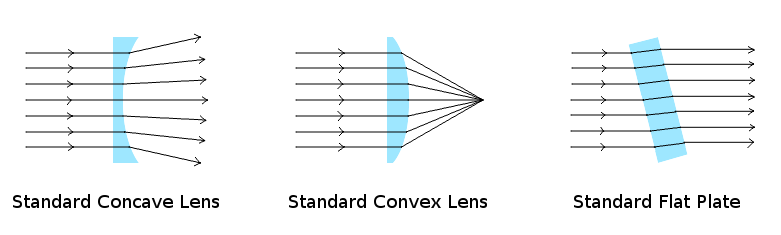
Watch the following videos to learn more about how lenses and prisms work.
Polarization
We talked before about light being a wave. It is actually an electromagnetic wave, with its electric and magnetic fields oscillating in perpendicular planes. The polarization of a wave is the direction in which it oscillates. In the case of light, we refer to the electric field. Light can be unpolarized (with its electric field oscillating in random directions), linearly polarized (with its electric field oscillating in one direction), or circularly polarized (when the electric field describes a circle). It can be fully polarized or only partially polarized. The polarization of light can be rotated. We make use of polarization all the time and we will show you a few simple examples of this.
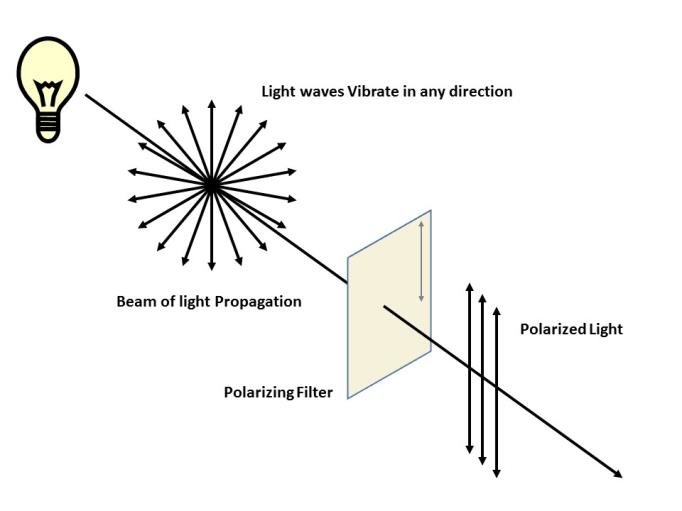
The white monitor is a normal computer screen with one twist: we have removed the polarized filter which normally allows us to see the projected images. Now, you can only see the images on it if you look at the screen through a polarized sheet or if you use polarized goggles.
Total Internal Reflection
Luis will be demonstrating the use of total internal reflection (TIR) for communication with some interesting examples.
- TIR in a jar filled with water
- Leaking light in a bucket
- Optical fibers
- Optical communication: Morse code signals through a fiber
What should we really remember from this?
Total Internal Reflection
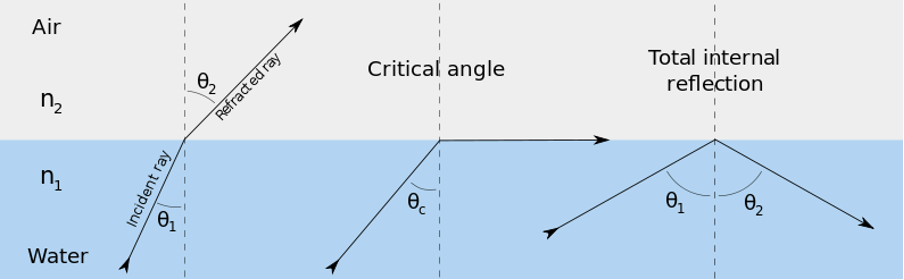
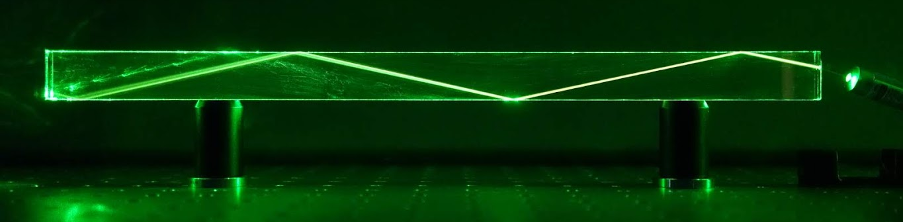
Remember reflection? There is one more amazing thing about it that we exploit in everyday life. It’s called “total internal reflection” and it happens only when light is passing from a denser medium (with a higher refractive index) into a less dense medium. At incident angles (θ1) smaller than the “critical angle” (θc), light cannot be refracted anymore. When this happens, all the light is reflected back into the denser medium. If the denser medium is surrounded by a less dense medium, the light gets trapped inside. In the experiments that you will see here, we will trap light in water and in optical fibers.
Total Internal Reflection at UiT
Researchers at UiT have a strong interest in Total Internal reflection. Two of our research groups use it constantly in their research. In these groups we are developing photonic chips that will miniaturize devices for super-resolution microscopy and trace gas detection. We make “waveguides” into which we trap the light on the top of these chips. To find out more about our research, see
Optical Fibers
Optical fibers are very important for many applications, one of them being communication. It uses total internal reflection to bounce light from the walls of the fiber without letting it get out until the end. We will demonstrate this with participants sending Morse code signals from one end of a long optical fiber to another. Can you decode the message? The morse code alphabet is at the end of this page.
Funny Optics
Abhishek will be having the most fun of all with his funny optics targeting the younger members of our audience. But there is plenty of real optics there, I promise.
- Fluorescence: UV-light hidden message
- Optics and acoustics: dancing light
- Scattering: light-board painting
- Electric discharge and light: plasma globe
What optical phenomena will you see here?
Fluorescence
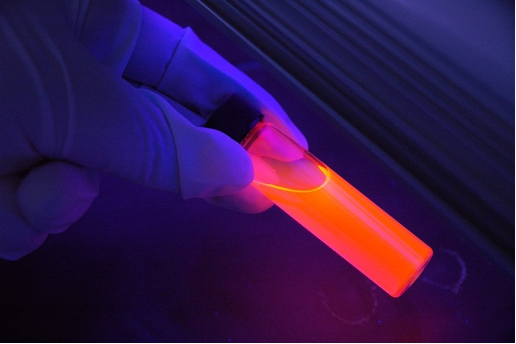
Apart from reflection and refraction, when light encounters a substance another phenomenon can happen as well. The light can be absorbed, which means that the substance can take in the energy of the light. Some substances only take a small part of the energy that light has and then return the rest by emitting light. This is called fluorescence. Because they have absorbed some of the energy, the emitted light has less energy than the absorbed light, and therefore it has a longer wavelength. This has many applications in science and in real life. For example, one can write messages in a fluorescent ink and only those who know what wavelength of light to use can read them. We will be demonstrating this with messages that can be read only with a UV light. Fluorescence is used also in forensics, to find traces of blood that has been washed off, or other bodily fluids.
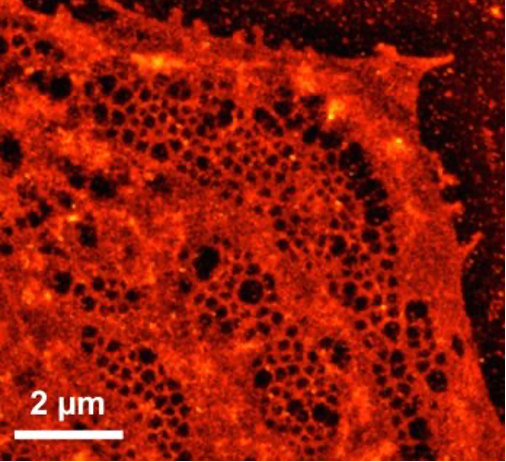
In our labs at UiT, the nanoscopy group uses fluorescent dyes to “tag” parts of cells. When they look at them through microscopes, the dyes glow and make different parts of the cells visible to the researchers.
Scattering
When a surface isn’t flat, the line normal to it is different depending on the point on the surface that you are looking at. Therefore, when light is reflected from such a surface, even though it all comes from the same direction, it is reflected in different directions. This is called scattering. Most surfaces are not smoot so most of what we see is scattered light.
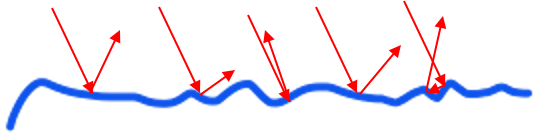
It also happens when there is dust on a smooth surface. That is how we can see that there is dust.
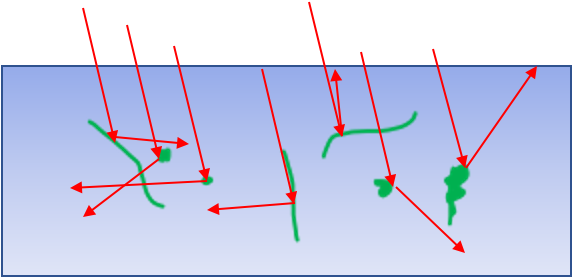
When we write on the surface of a piece of glass into which we have trapped light, our writing will change the surface at some points. The lines we make will scatter the light, just like dust will.
Optics related to electricity and acousto-mechanics
When a voltage is applied to a globe filled with gas, plasma will form and its filaments will run from the central electrode towards the glass globe. These filaments emit light that can give us information about the gas which is used in plasma physics and analytical chemistry. Plasma glow discharges have many applications such as their use in neon lights, fluorescent lights, and plasma screen TVs.

We can create many interesting effects by using light and sound. In one of our demonstrations, we use sound to move a thin membrane that has a mirror attached to it. By observing the light reflected from the mirror, we can gain information about the movement of the membrane. That is how we know that different sound waves move the membrane differently.


